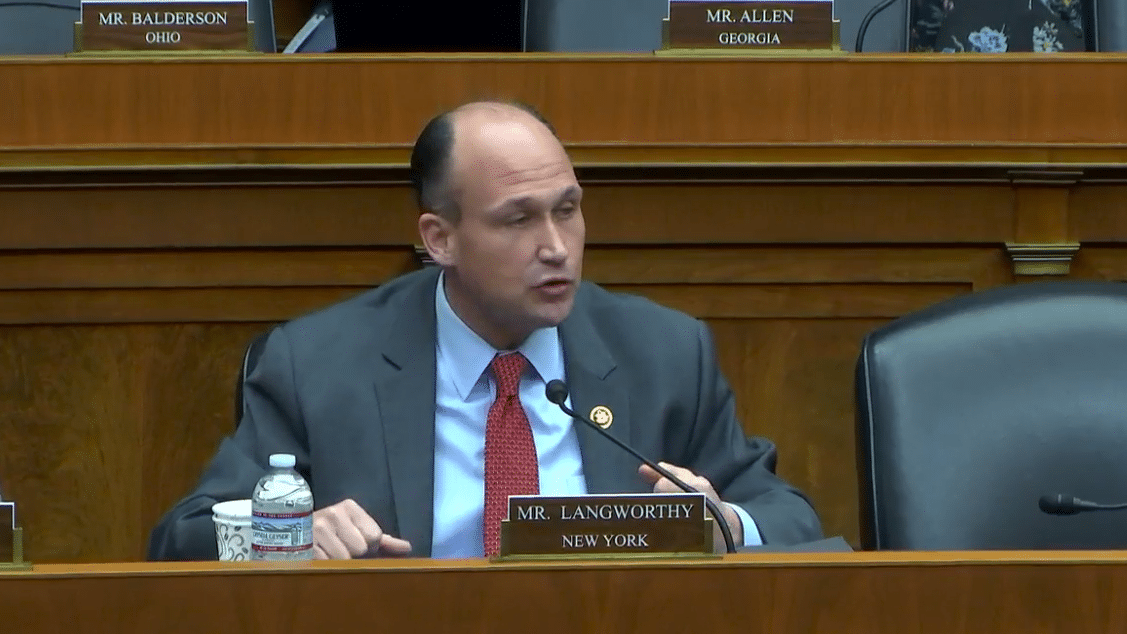
In July 2026, smoke from more than a hundred Canadian wildfires rolled down over Western New York and the Southern Tier. Air quality alerts went up across the region. On July 16, Nick Langworthy put out a statement about it.
He knew exactly whose fault it was:
"Americans should not be forced to breathe hazardous air year after year because Canada refuses to properly manage its forests. This is no longer a one-time emergency – it's becoming an annual public health crisis. That is unacceptable."
He said he was reaching out to members of the Canadian Parliament and the Canadian ambassador "to demand answers about the devastating impact Canada's forest management failures are having on Western New York, the Southern Tier, and communities across the United States." He added:
"We can all accept that nature is unpredictable. But repeated failures to reduce wildfire risk and manage forests responsibly are a policy choice."
And if Canada didn't fix it, "there should be consequences."
A local outlet that covered the statement noted what wasn't in it: no details about the outreach, no timetable, and no specific policy proposal. He also wouldn't say what the "consequences" would be.
Three weeks later
On August 6, 2026, World Weather Attribution — the international team of climate scientists that runs rapid analyses on extreme weather — published its study of this exact fire season.
Their finding: human-caused warming made the fire weather driving these fires substantially more likely.
- In Ontario, the observational record puts the seven-day fire-weather event at about 3.5 times more likely with 1.4°C of global warming. Measured over 30 days, the observed increase was about eight times.
- In the Northwest Territories, conditions that now recur roughly every two years would have been about a 50-year event in a 1.4°C cooler climate. On the 30-day measure: a 6-year event now, a 100-year event before.
- The climate models the team ran alongside the observations show smaller increases. Combining the two, the study's own bottom line is that warming made the week-long event about five times more likely in the Northwest Territories and about twice as likely in Ontario.
- More than 3 million hectares had burned by the time of the study.
- And on the American side: over 120 million people in the Midwest and Northeast were hit by dangerous air quality, with alerts stretching from Minnesota to New Hampshire.
Langworthy is right that the smoke is not a one-time emergency and right that it's becoming annual. He is right that policy choices are making it worse. He has the wrong policy and the wrong country.
His own record on air
Here's the part that makes the Canada framing hard to take at face value.
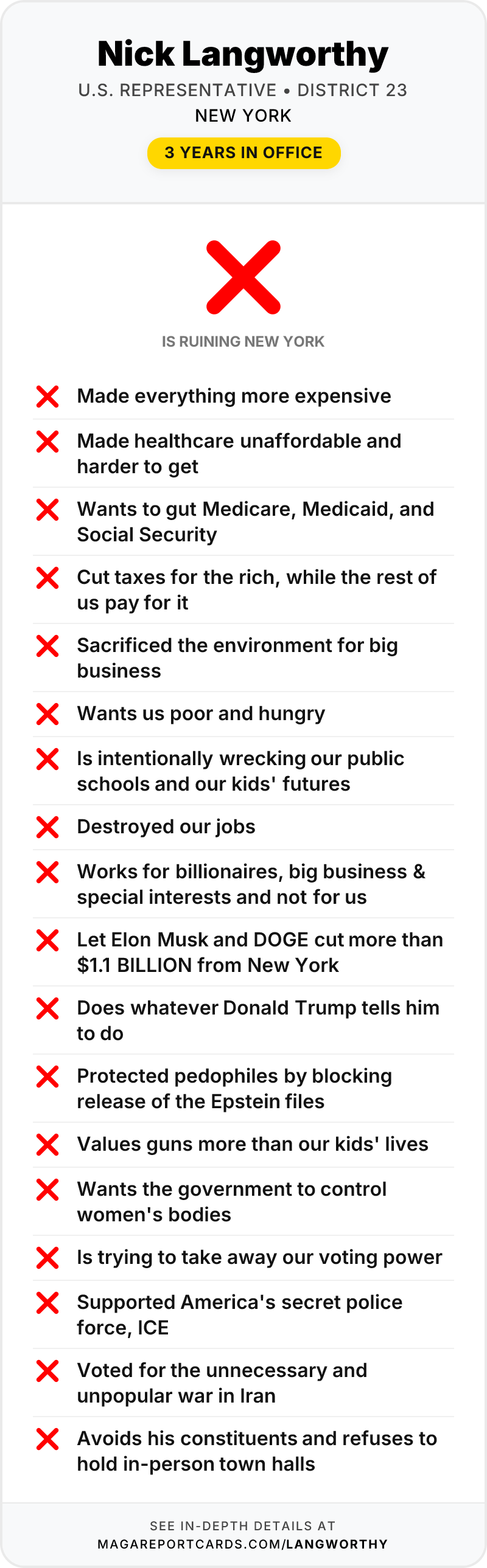
Langworthy has a 0% score from the League of Conservation Voters for 2025, and a 2% lifetime score. Those scorecards are built out of votes on exactly this — pollution, emissions, clean air.
In December 2025, he was one of 218 Republicans who voted for the Reliable Power Act, a bill handing the Federal Energy Regulatory Commission the power to hold up EPA rules on power-plant pollution. The whole point of that bill is to slow down clean-air regulation. He voted yes on the roll call.
And in February 2026, he joined state Sen. George Borrello and Assemblyman Andrew Molitor in pressing Gov. Kathy Hochul to repower the idled NRG plant in Dunkirk with natural gas. His argument:
"Energy demand is rising rapidly — driven by data centers, manufacturing and everyday use — yet the state continues to shut down reliable power generation and restrict natural gas supply."
Data centers. That's the demand he wants a fossil plant fired back up to serve — the same buildout Republicans elsewhere are promising won't land on ratepayers.
Two policy choices
Put his two positions next to each other.
On Canada's forests: repeated failure to reduce wildfire risk is "a policy choice," Americans shouldn't have to breathe the results, and there should be "consequences."
On his own votes: slow down the EPA's power-plant pollution rules, restart a gas plant, and score zero on the year's clean-air votes.
If failing to reduce fire risk is a policy choice worth threatening a neighboring country over, then so is voting to make the underlying problem worse. The smoke in Jamestown doesn't care which side of the border the decision was made on.
It's also worth noticing how the demand is structured. Langworthy is asking Ottawa to change its forest policy. He is not asking for anything from Washington — no funding for air filtration in schools, no support for the U.S. and Canadian firefighting agreements, no emissions action. The one government he actually votes in gets no ask at all.
What his district breathes
NY-23 sits directly downwind. Chautauqua, Cattaraugus, Allegany, Chemung, Steuben — rural counties, older populations, and the kind of outdoor work that doesn't stop for an air-quality alert. Farm workers, construction crews, and kids at summer programs are the people who eat the difference between "moderate" and "hazardous."
They deserve a congressman who will do something about it in the chamber he was actually elected to.
Instead they got a press release about Canadian rakes, no bill, no timetable, and an unspecified threat.
We deserve better.
Source
"Langworthy blames Canadian forest management for smoky air," FingerLakes1.com, July 17, 2026. Full statement as released by his office via Niagara Frontier Publications.