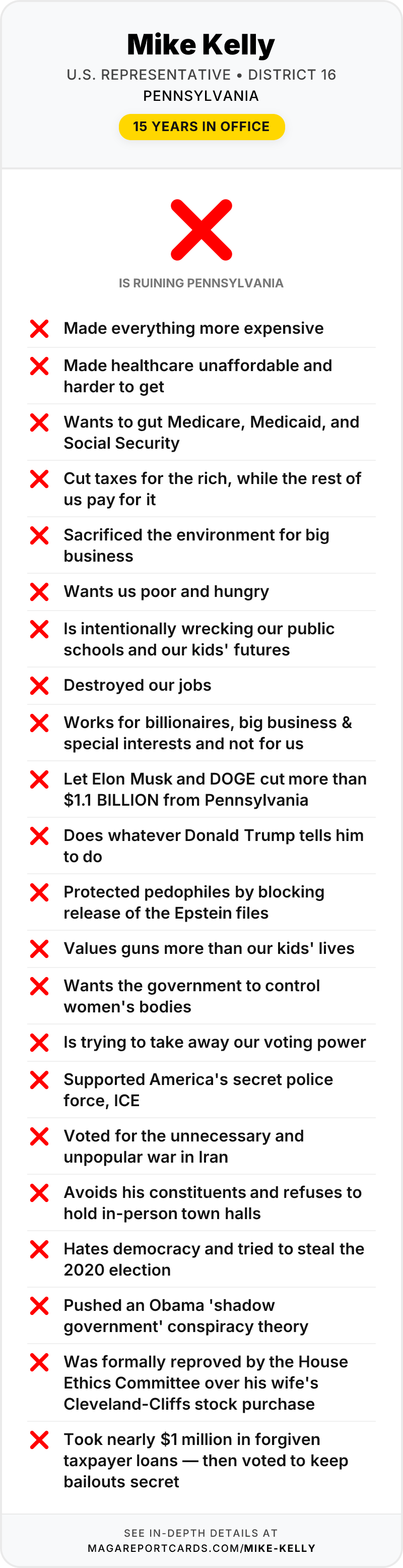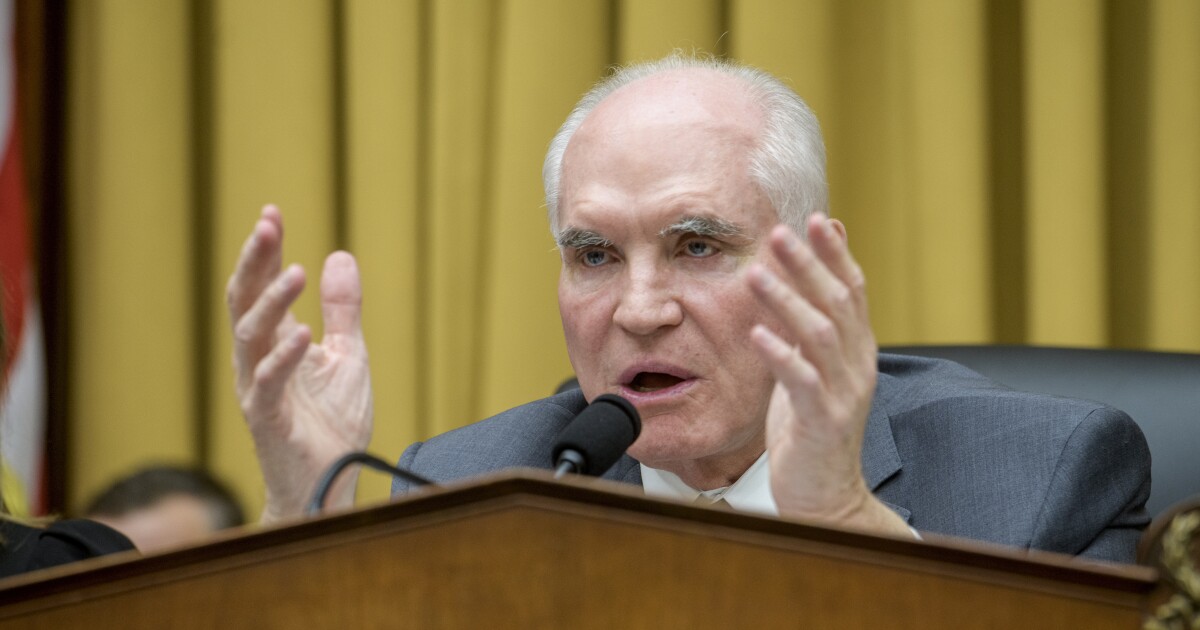
There is a version of this story where a congressman gets exonerated. That is roughly how Mike Kelly described it. When the House Ethics Committee finished its investigation into his wife's stock trade, he said in a statement that he and his family looked "forward to putting this distraction behind us".
Then you read the actual report.
On July 22, 2025, the House Ethics Committee — five Republicans and five Democrats — voted unanimously to formally reprove Kelly. The 28-page report it released three days later is not an exoneration. It is a detailed account of a congressman who could not, or would not, give a straight answer about how his wife came to buy stock in a company he was personally lobbying the White House to rescue.
The trade
Butler, Pennsylvania is Kelly's hometown. The plant there is the last producer of grain oriented electrical steel in the United States — the stuff that goes inside electrical transformers. In March 2020 the CEO of its owner, Cleveland-Cliffs, said publicly the company might close the plant unless the Trump administration extended steel tariffs to cover the products that were undercutting it. He told a hearing of the Congressional Steel Caucus that month that "1,500 jobs in Butler, PA will be gone . . . if I don't get help."
Kelly went to work. He signed letters to President Trump. He and his staff contacted Commerce Secretary Wilbur Ross, the U.S. Trade Representative, and senior White House officials. The report calls it a "high priority" for his office.
Around noon on April 28, 2020, Ross told Cleveland-Cliffs' CEO that Commerce would open the investigation the company wanted. Cleveland-Cliffs employees told Kelly's staff that same day. Commerce officials told his staff too. One of his staffers testified he would have told Kelly by 4:00 that afternoon at the latest.
The next morning — April 29 — Kelly's wife Victoria bought 5,000 shares of Cleveland-Cliffs for $23,075.
The public did not learn about the investigation until May 4, five days later.
On January 11, 2021, she sold the whole position for $87,551.06. Profit: $64,476.06. The share price had gone from $4.70 to $18.11 — up about 285%.
This was not how she normally invested
Her portfolio was worth more than $7 million. Almost all of it was funds, bonds, and a trust — and her broker at PNC handled the trades at its own discretion. She had liquidated every individual stock she held.
Cleveland-Cliffs was different. It wasn't on PNC's platform, so she had to personally instruct the purchase and personally confirm it. Her broker's note back to her reads: "Per your direction, I purchased 5,000 shares of Cleveland Cliffs (CLF), for a little more than $20,000. Because this stock is not currently covered by our analysts, I will take all trade direction from you."
It was her first individual stock purchase in nearly a year, and the only one since at least 2017 that required her explicit instruction. An outside expert hired to review the trade concluded that it "represented a sharp departure from her investment behavior, leading to the inference that this investment was due to some special event or consideration."
Kelly was working from his house in Butler that week, recovering from COVID-19. He told the committee that his wife "would've heard any of my conversations" and that she "sits around for most of the time I'm on the phone."
The committee's summary of where that left them: it "did not receive convincing evidence from any individual as to why Mrs. Kelly chose to purchase Cleveland-Cliffs stock the day after Representative Kelly learned that Cleveland-Cliffs would not be closing the Butler plant."
The story changed, and changed again
When the Pittsburgh Post-Gazette started asking questions in September 2020, Kelly's office put out a statement saying his wife "made a small investment to show her support for the workers and management" of the plant.
Investigators could not find any explanation for why she actually bought it. They also could not find any evidence Victoria Kelly had anything to do with writing that line. The records suggest Kelly's own communications director came up with it. Nobody told the workers. Nobody announced it at the time.
Then there was the question of what Kelly himself knew and when.
- First, through his lawyer, he said he learned of the purchase from a staffer who got an inquiry, shortly after the disclosure was filed in May 2020.
- In his interview, he first said he didn't know about it until the ethics office contacted him in 2021.
- Then he said his wife "probably told" him.
- Then he recalled a specific conversation in which she told him she'd bought it because it was "so cheap."
The committee noted, dryly, that the stock "had in fact been 'cheap' for years." Kelly then offered a different theory on the record: "the natural follow [is], I think people buy stock because they think they're going to make money on it."
He also texted a staffer at the time — "Let me know how we answer the [Post-Gazette's] question about my wife's investment in our hometown steel mill before we release it" — and then told investigators, "I don't ever recall reading that statement."
Asked whether he saw a conflict in working on Cleveland-Cliffs matters while his wife owned the stock, Kelly said this:
"I know that plant, and I know what we make, and I know we're the last producer of that product in the United States . . . Am I an insider? Damn right. I have been inside that mill."
Then she bought it again — while he was under investigation
This is the part that turned the case.
The investigation had been open since 2021. The ethics office had already recommended subpoenas for both Kellys back in October 2021, after neither cooperated with its initial review. Kelly sat for a voluntary interview with the committee on May 8, 2024.
Five weeks after that interview, he disclosed that his wife had bought another $50,000 to $100,000 of Cleveland-Cliffs stock — on March 28, 2024.
One week after that purchase, the Energy Department announced it would back off a proposed rule change that would have made the Butler plant's product irrelevant to transformer manufacturing. Kelly's own office called it the end of "a years-long legislative effort to reverse the DOE proposed rule to save these jobs". He had held a town hall about it, and he later introduced an amendment to repeal the rule outright.
He filed the disclosure late. The committee sent him a bill for a $200 late fee in August 2024 — noting it was his fourth late filing — and sent a second notice in November. As of the day the report was published, he still had not paid it and had not asked for a waiver.
When the committee sent him written questions about the second purchase, he asked that they be mailed to his house instead of emailed. They mailed them. He never answered, and never explained why he wouldn't correspond electronically.
His wife didn't answer either. The committee had cut its request down to less than two pages of written questions, answered under oath — why did you buy it, did you discuss Commerce's decision with your husband, why did you sell in January 2021. She declined all of it. Kelly told the committee she found the process "invasive."
Other members of Congress have been fined for late stock disclosures too — Blake Moore broke the same law more than 70 times in six months and paid $200. That's the whole enforcement system. Kelly couldn't be bothered with the $200.
What the committee actually found
Two things, and it matters which is which.
On insider trading and conflict of interest: no substantial evidence. The committee couldn't prove Kelly tipped his wife, and without her cooperation it couldn't determine what she knew. It also accepted that fighting for the Butler plant was genuinely his constituents' interest, not just his family's — the plant's jobs were real, and an Ohio congressman was fighting the same fight for a Cleveland-Cliffs plant in his own district.
On his conduct during the investigation: substantial evidence of a violation. His answers to key questions were "inconsistent." His document production was "largely unresponsive." And on the second stock purchase, he and his wife "refused to cooperate altogether." The committee found he violated clause 1 of the House Code of Official Conduct "by failing to meet his duty of candor."
The committee also wrote that "the financial benefit of a nearly $65,000 profit risks creating an appearance of self-dealing" — and then recorded that Kelly "stated to the Committee multiple times that 'no one cares' about his wife's stock purchase."
The committee's answer to that is the most direct sentence in the report:
"The conflict of interest standards and federal laws prohibiting insider trading exist because people do care whether he, in his role as a Member of Congress, obtained confidential information and gave that information to his wife while advocating for policies that would benefit his family, resulting in thousands of dollars in financial gain."
The committee told the Kellys to sell their Cleveland-Cliffs stock before he takes any further official action touching the company.
One more detail from the report, from around the same weeks the press first came asking: Cleveland-Cliffs helped plan a virtual "steel industry" fundraiser for Kelly.
He voted for a stock trading ban last month
On July 22, 2026 — one year to the day after the Ethics Committee voted to reprove him — the House passed the Stop Insider Trading Act. Kelly voted yes.
He can now go home and say he voted to ban members of Congress from trading stocks. What he won't mention is that the bill is widely criticized as a fake ban that still lets members own and sell individual stocks — and that it came bolted to a set of voter ID rules that would gut mail voting.
It's the same move another Pennsylvania Republican made. Rob Bresnahan, in the 8th District, took his own victory lap on that bill after selling up to $130,000 in Medicaid company stock and then voting to cut Medicaid.
Kelly has been in Congress since 2011. He chairs the Ways and Means Subcommittee on Tax — he writes the tax code. He also violated the STOCK Act in 2021 by filing his wife's purchase of Beauty Health Company shares more than seven weeks after the deadline.
A bipartisan committee spent more than four years and read over 25,000 pages of documents. In the end it asked his wife a list of questions that fit on less than two pages. Nobody answered.
We deserve better.
Sources
- In the Matter of Allegations Relating to Representative Mike Kelly — House Committee on Ethics, July 25, 2025
- Report and Findings of the Office of Congressional Ethics — Review No. 21-9221
- Rep. Mike Kelly reprimanded by House ethics panel following investigation of wife's stock purchase — Stephen Groves and Lisa Mascaro, Associated Press, via WESA, July 26, 2025. Photo: AP.