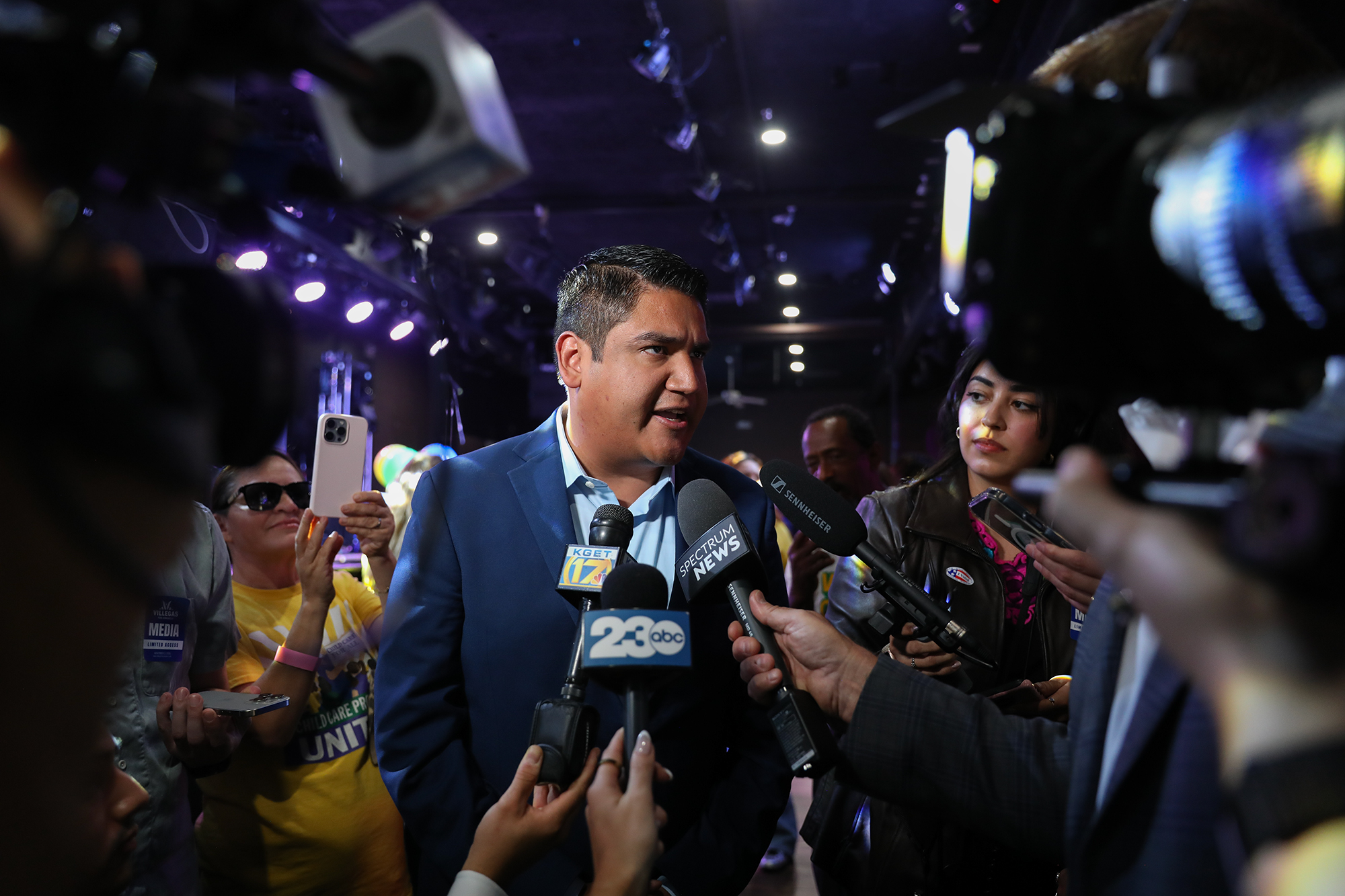
On November 3, Kansas fired a Republican U.S. senator and its Republican attorney general, elected a Democratic governor, and took away the supermajority Republicans had used for years to override vetoes in the state House.
Three Republican congressmen held their seats, all by much less than two years ago. And the race to run Kansas elections went to the Republican who carried the bill to throw out late-arriving mail ballots, and who once said, if it were up to him, there would be no early voting at all.
Here's the good, the bad and the ugly. Unless we say otherwise, vote counts are NBC News', with 99% counted as of November 27.
The good: Roger Marshall is out, and so is the supermajority
Roger Marshall lost his Senate seat to Democrat Adam Hamilton, a Kansas City-area pastor, 51.2% to 45.8%, a margin of 60,213 votes. Six years ago Marshall won the seat with 53.2%. Hamilton is the first Democrat Kansas has elected to the U.S. Senate in 94 years, according to the Kansas Reflector.
Trump and JD Vance each came to Kansas twice to campaign for Marshall. It didn't help. "I don't have any answers," Marshall said in his concession speech in Wichita. Greg Orman, who ran for the Senate as an independent in 2014, said at Hamilton's party that Marshall's "behavior over the last two years clearly demonstrated a disregard for the voters of Kansas."
We spent a lot of this year on that behavior. Marshall's lawyers repeatedly asked judges for arrest warrants against patients who owed his medical practice money. He told a Kansas manufacturer squeezed by Trump's tariffs that his experience was "different from most". Hamilton's case against him was that he failed to break with Trump when Trump's policies hurt Kansans.
Some of Hamilton's biggest gains came where you might not expect. He won Ford, Finney and Seward counties in western Kansas, where about half or more of registered voters are Latino and sweeping federal immigration raids had kept children out of school and spread fear. After the raids, Marshall encouraged local and federal law enforcement to work together. Hamilton said ICE was "not commissioned to arrest preschool teachers in front of their children."
Republicans lost two more statewide races:
- Governor. Democrat Cindy Holscher beat Senate President Ty Masterson 50.5% to 49.5%, by 11,369 votes. The race was close enough to trigger a hand-count audit, and Masterson conceded on November 12 once it confirmed her lead. Her running mate, state Rep. KC Ohaebosim, becomes only the second Black Kansan elected to statewide office, and the first in 140 years.
- Attorney general. Democrat Chris Mann beat Attorney General Kris Kobach 50.8% to 49.2%, the exact reverse of their 2022 race, when Kobach won by those same shares. Kobach stayed at the GOP watch party in Topeka for less than an hour and didn't put out a statement the next day.
The Kansas House
Going in, Republicans held 88 of the 125 seats in the Kansas House. Democrats flipped as many as 20 seats, according to the Kansas Reflector, which would leave Republicans ahead 68 to 57. Those counts are unofficial, but if they hold it will be the smallest Republican majority since 1992. Fifteen of the seats Republicans lost were in districts Trump won in 2024.
- The majority leader lost. House Majority Leader Chris Croft lost to Democrat Megan Phillips in Overland Park, 51% to 49%, in a district Trump carried by 6.1 points. Croft was in the running to be the next speaker. Republicans looked set to lose at least 10 House seats in Johnson County alone.
- A rematch. Democrat Jason Probst won back his Hutchinson seat from Republican Rep. Kyler Sweely, 53% to 47%, two years after Sweely beat him.
- Garden City. A Democrat beat Republican Rep. Bob Lewis in a western Kansas town that went through the immigration raids.
- The closest. Democrat Sara Kiewiet led Republican Rep. Sean Tarwater by 41 votes the day after the election, and the race went to a hand-count audit.
Democrats also flipped a seat on the State Board of Education. Former teacher Amy Diediker won 55% against Jim McMullen, who lost his vice president role on the Blue Valley school board in 2022 over anti-trans social media posts.
Why 84 matters
It takes 84 votes in the Kansas House to override a governor's veto, or to put a constitutional amendment on the ballot. With 88 seats, Republicans could do both without a single Democrat. Gov. Laura Kelly vetoed private school vouchers and other Republican bills, and "her veto ended up not mattering," Park University professor Matt Harris told KCTV.
Republicans needed those 84 votes for everything on this list:
- A new congressional map. Under pressure from Trump, Kansas Republicans spent the fall of 2025 and the start of 2026 trying to redraw the map to push out Rep. Sharice Davids, the only Democrat in the state's delegation. Masterson called it critical to the state's future: "the battle for the heart and soul of this country is real." In January, House Speaker Dan Hawkins said he was about 20 votes short of the 84 he needed. Davids won on November 3 with 59.6%, up from 53.4% in 2024. Masterson lost the governor's race, and Croft, who stood beside Hawkins when he said the votes weren't there, lost his seat.
- Purging voter rolls. In April, Republicans overrode Kelly's veto of a bill that makes the secretary of state check the voter rolls against Trump's SAVE citizenship database twice a year. The House override vote was 84 to 39, with not one vote to spare.
If the new count holds, Republicans in the House would need 16 Democrats to override Holscher.
The bad: they won, by less
All three Republican House members on this site won, and all three saw their margins "shrink considerably" from two years ago, as the Reflector put it.
- Tracey Mann won the 1st District, western and central Kansas, with 59.2% to Democrat Lauren Reinhold's 38.1%. In 2024 he won with 69.1%, and his margin fell from 38 points to 21. At a Trump rally two weeks before the election, Mann told Republicans to "tie every Democrat up and down the ballot" to the Democratic Socialists of America, a group that hadn't endorsed a single Kansas Democrat for statewide or federal office. Reinhold said her campaign "sidestepped hyperpartisan nonsense."
- Derek Schmidt won the 2nd District, eastern Kansas, with 51% to 45.2% for Democrat Don Coover, a veterinarian and military veteran. That's a 14,550-vote margin, in a district Trump won by 20 points and Schmidt won by 19 in 2024. Coover closed his campaign with "More cattle, less bull." While Schmidt was in Washington, Kansas lost more than 500 USDA employees, about 32% of the state's USDA workforce, and Schmidt called DOGE's approach "maturing."
- Ron Estes won the 4th District, around Wichita, with 53.3% to 44.3% for Democrat Katy Tyndell. In 2024 he won with 65%. On election night he blamed Joe Biden for high prices. Estes chairs the House subcommittee in charge of Social Security, and two months into the job he told Newsmax he looked forward to what DOGE would find there. The agency then lost 6,645 employees in less than a year.
The ugly: the man who will run Kansas elections
The closest statewide race in Kansas went to a Republican, and he will be in charge of running elections in Kansas.
Republican state Rep. Pat Proctor beat Democrat Jennifer Day for secretary of state 48.1% to 47.6%, by 5,392 votes. Day conceded on November 17, the day the AP called the race, and her statement put the margin at "fewer than 5,500 votes." (KWCH reported it as about 8,800 the same day. The NBC count matches Day's.)
What he said he wants
As chair of the House Elections Committee, Proctor carried the 2025 bill that ended Kansas's three-day grace period for mail ballots, so a ballot postmarked by Election Day but arriving a day late would be thrown out. In a private Zoom meeting, recorded and published by the voting group Loud Light, he said what he really wanted, according to the Kansas News Service:
"If it was up to me, Election Day would be Election Day. There wouldn't be early voting – mail-in ballots would only be for military or severely disabled. But I've got to bring 84 people with me, so I'm trying to chip away at it."
He told the Kansas News Service in February 2025 that he would not try to end voting by mail.
He argued that with the grace period, a ballot arriving in those three days had only "a one-in-three chance" of being counted. The state's own numbers said otherwise: of about 2,800 mail ballots that arrived after Election Day in November 2024, about 2,100 were counted.
Judge Carl Folsom of Douglas County blocked the repeal in July. The judge found the plaintiffs were "substantially likely to prevail" and wrote that without the grace period, thousands of voters "would have been disenfranchised." So this November, mail ballots postmarked by Election Day still counted if they arrived by Friday. That includes ballots in Proctor's own race.
Proctor also led the push to put a "citizens only" voting amendment on this year's ballot. In October 2025, as Republicans tried to force a special session to redraw Davids' district, Proctor said one was "very close." It fell short.
What he's saying now
A week after the election, Proctor went on Wichita talk radio and suggested, without evidence, that foreign money helped Democrats win. "It was all these dark money nonprofits, a lot of them foreign funded," he said. He didn't name one. He said he plans to "rebuild" the secretary of state's power to investigate and prosecute election crimes.
The day after the election, a Kansas Reflector reporter texted to ask if he would answer questions about the race. He replied: "Not for you!"
He takes office in January. One of his jobs will be checking the voter rolls against the SAVE database twice a year, under the law Republicans passed over Kelly's veto. Voters it flags will be removed from the rolls unless they prove their citizenship. When Missouri ran its voter list through SAVE, at least 81% of the "noncitizens" it flagged in St. Louis County turned out to be wrong.
The rest of the ugly
- An amendment that changes nothing, for now. Voters approved the citizens-only amendment 63.6% to 36.4%. The Kansas Constitution already required voters to be citizens. University of Kansas law professor Amii Castle warned that lawmakers could use the new wording as an excuse to demand citizenship papers: "Now it says only citizens can vote, therefore, prove your citizenship. Bring your documents."
- The speaker who led the map push won statewide. Dan Hawkins, the House speaker who called redrawing Davids' district a priority, won the race for insurance commissioner by about 17,000 votes.
- A recount paid for by an election-fraud activist. The Libertarian Senate candidate, who got 3%, asked for hand recounts of 60 precincts in Johnson, Shawnee and Wyandotte counties. A $47,548 check from the Show Me the Votes Foundation paid for them. The group is run by Beth Clarkson, who has pushed election fraud conspiracies in Kansas for more than a decade. Outgoing Republican Secretary of State Scott Schwab said the money "raises serious concerns" and said he would refer it to the FEC and the Justice Department.
What the results show
Roger Marshall lost to Adam Hamilton by 60,213 votes, 51.2% to 45.8%, and Kansas elected a Democratic governor and attorney general. In the state House, unofficial results show Democrats gaining as many as 20 seats, which would leave Republicans 16 short of the 84 votes they used to override vetoes. Tracey Mann, Derek Schmidt and Ron Estes all won, by 21, 6 and 9 points, down from 38, 19 and 30 in 2024. Pat Proctor won the office that runs Kansas elections by 5,392 votes. He carried the bill to throw out late-arriving mail ballots and said that if it were up to him, there would be no early voting.
Source
Kansas Democrats in line to pick up 20 seats in House, wipe out Republican supermajority — Tim Carpenter, Kansas Reflector, November 4, 2026.