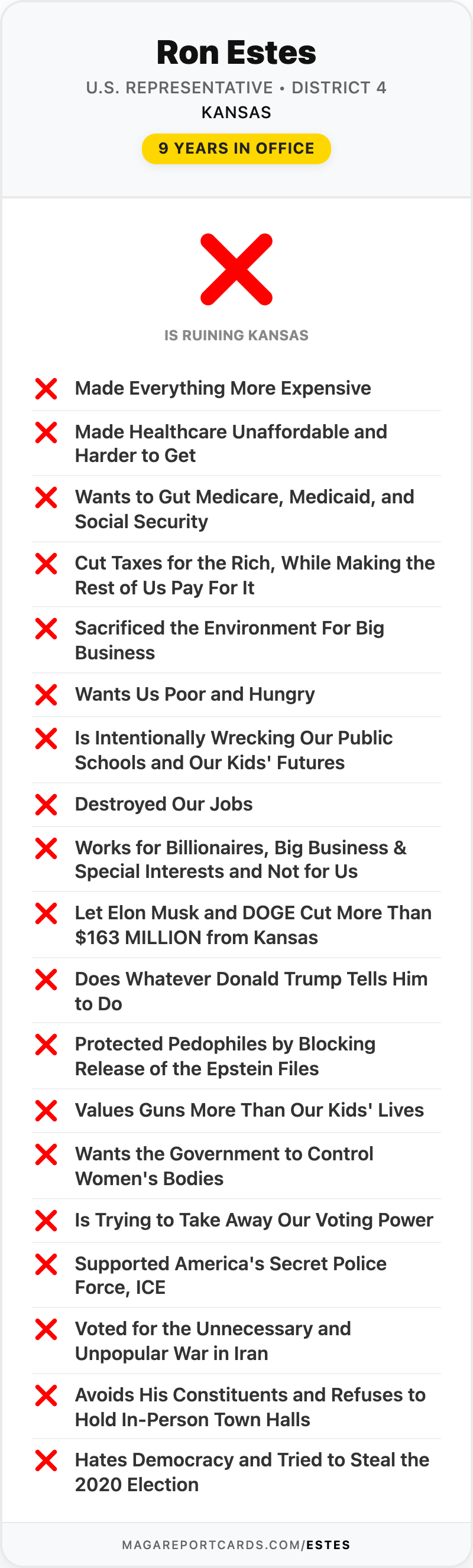
In January 2025, House Ways and Means chairman Jason Smith named Ron Estes chairman of the Subcommittee on Social Security.
That is not a ceremonial post. It is the single job in the House of Representatives whose entire purpose is to watch over the Social Security Administration — the agency that sends a check every month to more than 71 million Americans. When the agency stops working, the subcommittee chairman is the person Congress has designated to do something about it.
Two months into the job, with DOGE already inside the agency, Estes went on Newsmax to explain his priorities.
"Efficiency"
Newsmax's March 18, 2025 write-up opens like this:
"The new chair of the House Social Security Subcommittee, Ron Estes, R-Kan., told Newsmax on Tuesday that his focus is on making the Social Security Administration more efficient and that he also looks forward to any discoveries the Department of Government Efficiency uncovers in aiding that effort."
Here is what Estes himself said on the air:
"My first goal is to make sure that we have good operational efficiencies — that the processes work — that when somebody retires, they're able to get enrolled; if unfortunately their spouse dies, they're able to get the survivor benefits; if they're disabled, that they're able to get those benefits."
"We want to make sure that the agency works well. And so that's our first process: making sure that there's efficiency and that we don't have improper payments or waste, fraud, and abuse in there."
Read that list again, because it is a good list. Retirement enrollment. Survivor benefits. Disability benefits. Those are the three things the agency does that people cannot live without.
Now look at what happened to them.
What DOGE actually did
Estes wasn't a bystander watching this happen to him. He'd signed up early. In November 2024 he joined the DOGE Caucus. In December 2024 he published an op-ed welcoming it:
"With Trump back in the White House as of Jan. 20 and Musk and Ramaswamy heading DOGE, there's hope that Republicans in Congress will have allies in reforming our government."
The "allies" got to work. Between January and November 2025, the Social Security Administration lost 6,645 employees — more than 11% of its workforce, according to a January 2026 analysis by Molly Weston Williamson at the Center for American Progress. She calls it the largest one-year drop in SSA staff in the agency's history.
It wasn't spread evenly, either. In 33 states the agency had at least 10% fewer staff in fiscal 2025 than the year before. Some individual field offices lost a quarter of their people or more.
The federal employees' union put the ratio in plain terms: by June 2025, one SSA staff member was left to serve every 1,480 beneficiaries.
That is the "efficiency" Estes said he was after — an agency doing the same work for the same 71 million people with thousands fewer people to do it.
The subcommittee chairman's job description
There is a specific reason this matters more for Estes than for the average member.
Any of the 435 members of the House can complain about a federal agency. The chairman of the Social Security Subcommittee has tools nobody else has. He can hold hearings. He can subpoena documents. He can put the Commissioner of Social Security under oath in public and make him answer for a wait time. He can hold a bill hostage. That is the whole point of the gavel.
Estes had that gavel the entire time this was happening. He had also, in December 2024, publicly welcomed the people doing the cutting as "allies." When the largest one-year staff loss in the agency's history was underway, the chairman charged with overseeing that agency was on cable television saying he looked forward to what DOGE would turn up.
And then there's what happened to the data
Staffing was only half of it. The other half was the agency's files — the Social Security numbers, birthdates and parents' names of essentially every American who has ever had one.
In August 2025, the agency's own chief data officer went public. Charles Borges, who had held the job since January 2025, disclosed to Congress that DOGE staff had placed a live copy of the Social Security data of more than 300 million Americans in a "vulnerable cloud environment" that circumvented the agency's standard oversight.
SSA's answer was that the data was "walled off from the internet" and that it was "not aware of any compromise."
Three days later, Borges resigned. He called it a constructive discharge, writing to the commissioner that the agency's actions against him made his duties "impossible to perform legally and ethically," and describing "exclusion, isolation, internal strife, and a culture of fear."
Then, in a court filing dated January 16, 2026, the Justice Department confirmed a version of it. A DOGE staffer had shared Social Security data through Cloudflare — a service, in the filing's words, "not approved for storing SSA data and when used in this manner is outside SSA's security protocols." Agency officials didn't know it had happened. And because the server sits outside SSA, the agency cannot determine what was sent, or whether it's still there.
Buried in the same filing was something else. In March 2025, a political advocacy group approached two DOGE members at the Social Security Administration and asked them to analyze state voter rolls — with the stated aim, per the filing, of finding "evidence of voter fraud and to overturn election results in certain States." One of them signed a "Voter Data Agreement" in his official SSA capacity on March 24, 2025. Nobody at the agency reviewed or approved it. SSA discovered the arrangement in November and made two Hatch Act referrals in December.
Every one of those events happened inside the agency Ron Estes was appointed to oversee. He welcomed the people who did it as "allies" three months before the first of them.
The bill for all this comes due in 2032
The other half of Estes's record on Social Security is the money.
He voted for Trump's 2025 budget bill. Sen. Ron Wyden, citing the Social Security actuary's own numbers, said in August 2026 that the bill "plundered Social Security to the tune of $168 billion" — and moved up the date the trust fund runs dry.
That date is now the fourth quarter of 2032, per the trustees report released in June 2026 and reported by CNBC. When it arrives, benefits get cut across the board unless Congress acts.
So the chairman of the Social Security Subcommittee voted for a bill that pulled the deadline closer, while the agency that administers the program was being hollowed out on his watch.
Meanwhile his colleagues are lining up behind a plan to hand the whole question to a 13-member commission whose recommendations Congress would have to vote on without being allowed to amend a word.
What Kansans get
Kansas's 4th District covers Wichita and most of south-central Kansas — a lot of retirees, a lot of people on disability, a lot of small towns where the nearest Social Security office is already a drive.
When a field office loses a quarter of its staff, nobody sends a letter announcing it. You find out when you call and stay on hold, or when the appointment you need is six weeks out, or when a survivor benefit that should take weeks takes months and the bills don't wait.
Estes told Newsmax he wanted to make sure that "when somebody retires, they're able to get enrolled." He had the gavel that could have made that true. He used it to cheer on the people cutting the staff who do the enrolling.
Source
Estes's remarks are from Nick Koutsobinas's March 18, 2025 report, Rep. Estes to Newsmax: Social Security to Focus on Efficiency.