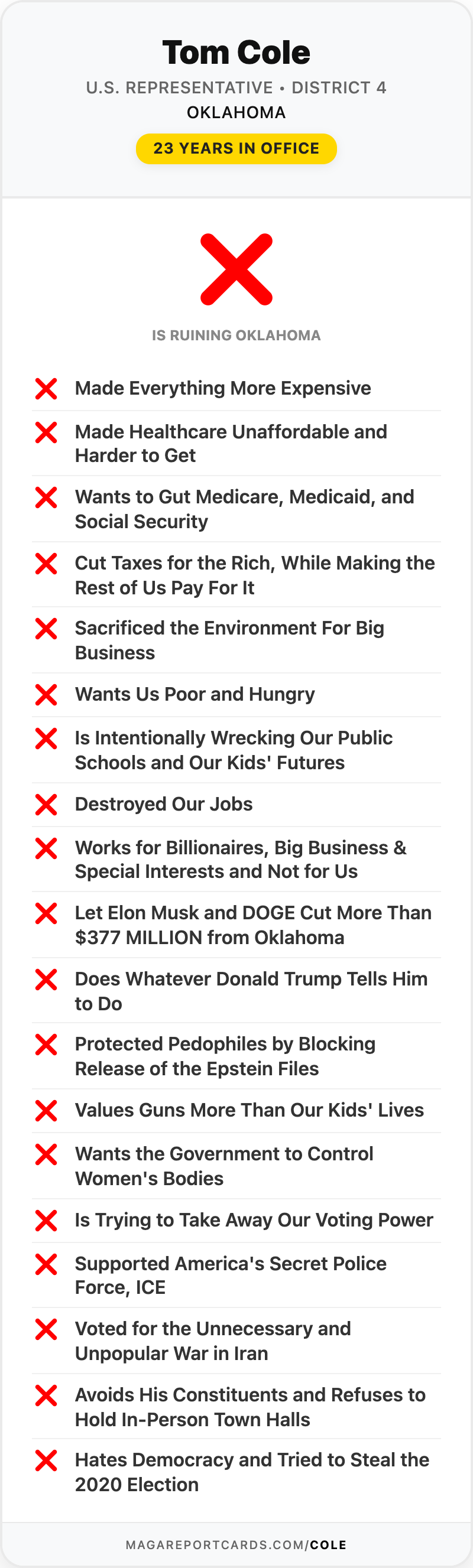
On June 8, 2026, Tom Cole introduced H.R. 9187, the Bipartisan Social Security Commission Act of 2026. He is the lead sponsor. Rep. Tom Suozzi of New York signed on as the first cosponsor, which is where the word "bipartisan" in the title comes from.
Cole has been pushing this same idea for a long time. His own office says he has led or co-led it for seven Congresses — fourteen years of trying.
Here's how he described it:
"I am going to tell you the truth that many of my fellow politicians in Washington refuse to acknowledge: the solvency of Social Security is at a critical point... doing nothing on Social Security is not an option."
That sounds reasonable. Social Security really does have a money problem. The 2026 trustees report projects the trust fund that pays retirees, their spouses, and survivors may run out in late 2032. At that point, benefits get cut across the board.
So the problem is real. The question is who gets to fix it, and whether you get any say.
Read the bill and you find out the answer is no.
What the bill actually does
Cole's bill creates a 13-person group called the Commission on Long-Term Social Security Solvency. Nobody elects them. Every single one is appointed:
- 1 by the President, who also chairs it
- 2 each by the Speaker, the House minority leader, the Senate majority leader, and the Senate minority leader
- 1 each by the chair and top Democrat of the House Ways and Means Committee and the Senate Finance Committee
Only two of the thirteen are required to be experts from outside government. The rest can be politicians.
Within one year, those 13 people have to hand Congress a plan to keep Social Security solvent for 75 years — plus the actual bill text to do it. Nine of the thirteen have to sign off.
The bill requires the commission to hold at least one public hearing — one, in the whole year, is all it has to do. It "may hold such other hearings" as it "considers appropriate," which means whether there is a second one is up to the 13 of them. Everything else can happen behind a closed door.
Then comes the part that matters.
"Amendments prohibited"
Normally, when Congress writes a law that touches your retirement, the process is slow on purpose. Committees hold hearings. Members offer amendments. Bad ideas get stripped out. Good ideas get added. You get time to call your representative.
Section 9 of Cole's bill throws all of that out. Here is the language, word for word from the bill:
"Amendments prohibited.—No amendment to, or motion to strike a provision from, an approval bill considered under this section shall be in order in either the Senate or the House of Representatives."
That is not a summary. That is the text.
The rest of Section 9 is just as tight:
- Any committee the bill is sent to must report it "without amendment" within three legislative days — and if it doesn't, the committee is automatically discharged and the bill goes to the floor anyway.
- House debate is capped at four hours, split between one supporter and one opponent.
- "All points of order against the approval bill and against its consideration are waived."
- In the Senate, debate is capped at 30 hours. A motion to recommit is not allowed. That cap means no filibuster — the 60-vote threshold that normally protects a program like this simply doesn't apply.
So: 13 appointed people write a plan in private. Nine of them approve it. Congress gets four hours in the House to talk about it, cannot change a comma, and then votes yes or no.
If you don't like one piece of it — say, the piece that raises your retirement age — there is no mechanism to take that piece out. It's the whole package or nothing.
The model Cole picked actually proves the opposite
Cole's own press release says the bill is "Modeled after the 1983 Social Security Commission." That's the Greenspan Commission, the one everybody in Washington points to as the time this worked.
Here's the problem with that comparison: the 1983 commission didn't finish the job. Congress did — by amending it.
Rudolph Penner, a former director of the Congressional Budget Office, walked through what happened in a paper for the Urban Institute. The commission, he wrote, "was rather cautious," and "its proposals did not solve Social Security's financial problems for the entire 75 year period."
What closed the gap was an amendment offered on the House floor:
"During the House debate Congressman J. J. Pickle, Chairman of the Ways and Means Subcommittee that dealt with Social Security, added a provision that would very gradually raise the normal retirement age (NRA) from 65 to 67... This provision did more to improve the financial health of Social Security than any single recommendation of the Commission."
Penner's conclusion: "It took courageous actions by the Congress to enhance the report and make it much more meaningful."
Two things follow from that.
First, the single biggest change to come out of 1983 was a benefit cut. Raising the retirement age from 65 to 67 means people work longer for the same check. Everyone born in 1960 or later lives under it.
Second — and this is the part Cole doesn't mention — that amendment would be illegal under his own bill. Pickle's provision was added during floor debate. Section 9 of H.R. 9187 says no amendment "shall be in order in either the Senate or the House of Representatives." The one move that made the 1983 deal work is the exact move Cole's bill bans.
So the precedent he's invoking is a case where open debate mattered. His bill would prevent it from happening again — while leaving the door open for the same kind of cut, just written by people you never voted for.
Cole also listed who is cheering the bill on. His press release names the Peterson Solutions Fund, the Committee for a Responsible Federal Budget, the American Action Forum, and the American Enterprise Institute among the groups praising it. These are the organizations that have spent decades arguing that the answer to Social Security is spending less on it.
They are not going to be the ones locked out of that room.
Who is against it
This isn't a fringe objection. The people whose entire job is watching out for retirees have been saying the same thing for years about bills like this one.
In January 2024, Reps. John Larson and Jan Schakowsky led 116 House Democrats in a letter opposing fast-track commissions. Their words:
"The goal of these commissions would be to produce legislation that cuts benefits and calls for an up or down vote without hearings, and that is unamendable. This is not a simple debate over process."
The next month, the AFL-CIO, the Teamsters, AFGE, the AFT, the NEA, the Alliance for Retired Americans and other unions stood at the Capitol to oppose a similar commission bill. AFL-CIO President Liz Shuler called it "a power grab that is trying to bypass the regular democratic process by hiding behind closed doors."
AARP has taken the same position on fast-tracking. In a July 21, 2026 letter about a different Senate fast-track bill, AARP's chief advocacy officer Nancy LeaMond wrote:
"We strongly object to fast-tracking Social Security changes through Congress... If regular order is the gold standard for routine legislative matters, it certainly should be the standard for something as important as Social Security."
And on August 5, 2026, at a Senate Finance Committee hearing on exactly this idea, Sen. Ron Wyden put it bluntly:
"Republican members of this panel will claim they have the solution: an unaccountable 'commission' that will rubber stamp benefit cuts like increasing the retirement age."
He added that such commissions "are designed to smuggle in benefit cut plans with minimal public scrutiny or debate."
The part Cole leaves out
Cole says the crisis means "doing nothing is not an option." He does not mention that he helped make the crisis worse.
Cole voted for Trump's 2025 budget bill. According to the Social Security actuary's own numbers, cited by Wyden, that bill "plundered Social Security to the tune of $168 billion" — and moved the trust fund's exhaustion date up a year, from 2033 to 2032.
So the sequence is: vote for a bill that drains Social Security faster, then point at the faster deadline as the reason Congress must hand the program to a commission that answers to nobody, on terms that forbid Congress from changing a word.
There is another way to do this, and it isn't complicated. Members could introduce bills, hold hearings, take amendments, and vote in public where their constituents can see them. That is what Congress is for. It's the same argument Ohio Rep. Troy Balderson made about spending before walking it back and voting the other way — Congress decides, or it doesn't. It's what Cole gets paid to do — and he has been getting paid to do it for 23 years.
He chairs the House Appropriations Committee, the most powerful spending gavel in Congress. If anyone in the building has the standing to run a real, open debate on Social Security, it's him.
Instead, the bill he keeps reintroducing would hand the job to 13 appointees and tell the rest of Congress — and you — to take it or leave it.
Social Security pays out to more than 71 million Americans every month, and plenty of them live in Oklahoma's 4th District. They deserve to know what's in a plan before it becomes law — and they deserve a representative who will fight for the right to change it.
Source
The bill text quoted here is H.R. 9187, the Bipartisan Social Security Commission Act of 2026, as introduced in the House on June 8, 2026.