In May 2025, Republicans dropped a 1,082-page budget bill on Congress late on a Sunday night. Buried on page 1,081 — the second-to-last page — was a provision that had nothing to do with the budget.
It would double the maximum prison sentence for leaking someone's tax return, from 5 years to 10. It would raise the maximum fine from $5,000 to $250,000 for every single violation. And it would add criminal penalties for anyone who helps "print or publish in any manner" that leaked tax information.
The Intercept found it and asked the man behind it — Missouri Congressman Jason Smith — a simple question: is a decade-long prison sentence really something that belongs in a budget bill?
His office wouldn't answer.
"Wish I could be helpful, but that's a question for the Senate parliamentarian," Smith's communications director wrote back.
That's the whole answer. From the chairman of the House Ways and Means Committee — the most powerful tax-writing committee in Congress — about a provision his own committee wrote.
Who the leak law actually protects
Let's be clear about what this is about, because it isn't about you.
The reason Republicans care so much about tax-return leaks comes down to one man: Charles Littlejohn, an IRS contractor who leaked Donald Trump's tax returns to the New York Times and a huge cache of data on thousands of the wealthiest Americans to ProPublica. That data is how the country learned Trump paid just $750 in federal income taxes the year he won the presidency.
Littlejohn pleaded guilty. And here's the part that matters: he already got the maximum sentence. In January 2024, Judge Ana Reyes sentenced him to the full five years — plus three years of supervised release and a fine — even though federal sentencing guidelines pointed to a fraction of that. The judge went well above the guidelines and gave prosecutors everything they asked for.
Republicans on Smith's committee had written to the judge the week before asking her to do exactly that. When she did, Smith put out a press release praising her:
"I commend Judge Reyes for imposing the maximum sentence of five years... punishing Mr. Littlejohn with the maximum allowable sentence still sends a strong message that the U.S. judicial system takes these crimes seriously."
So by Smith's own account, the existing law worked. The judge used it. It sent a strong message. He said so himself.
Then he spent the next year and a half trying to double it.
He already tried this the honest way. It failed.
Smith didn't have to sneak this into a budget bill. He had already run it as a regular bill.
In 2024 he introduced the Taxpayer Data Protection Act — the same 10-year sentence, the same $250,000 fine. The House passed it in September 2024, and then it went to the Senate and died. Nobody picked it up.
That's how the process is supposed to work. You write a bill, you make your case, and if the other chamber isn't convinced, it doesn't become law.
So the following spring, Smith took the bill that failed and slipped it into the back pages of a must-pass budget package — where no senator would get a clean vote on it, and where it would ride to the president's desk attached to the biggest tax package in years.
Even the referee said it didn't belong there
Budget bills like this one move through a special fast-track process called reconciliation. There's a rule — the Byrd rule — that says you can't stuff things into these bills that aren't really about money. It exists precisely to stop this kind of maneuver.
The Joint Committee on Taxation scored Smith's leak provision as having "negligible" effect on federal revenue. In other words: it doesn't raise money. It just puts people in prison longer.
Budget experts said at the time it would almost certainly get thrown out. As Bobby Kogan of the Center for American Progress put it to The Intercept:
"Slapping on a jail sentence is about punishment for offenses, not about changing dollars and cents coming in or out of the government."
He was right. When the final law came together, the provision raising those penalties was stripped out. It never became law.
So this was never serious legislating. It was a chairman using the one lever he controls — the text of the bill — to try to get something he'd already lost.
The part that should make Missourians angry
Here's where it goes from silly to insulting.
Two months before Smith wrote a 10-year prison sentence for anyone who exposes taxpayer data, he stood up in his own committee and told his colleagues to stop worrying about who was walking around inside the IRS.
On March 12, 2025, Ways and Means Democrats brought two resolutions asking for documents about DOGE — Elon Musk's operation — getting into Treasury and Social Security systems. Smith opened the markup with a statement calling the request "manufactured outrage":
"No hard evidence has been presented that accusations of illegal access to taxpayer information by DOGE employees are true or based in fact... All Democrats have are insinuation, rumor, and hearsay."
Republicans on the committee voted both requests down along party lines. No documents. No hearing. Nothing.
Read those two positions next to each other:
- An IRS contractor exposes a billionaire's tax return? Five years isn't enough. Make it ten. Fine him a quarter million dollars per person. Go after the publishers too.
- A team of outside engineers is nosing around the systems that hold your tax data? Insinuation. Rumor. Hearsay. Motion denied.
The privacy of your tax information is apparently a national emergency in exactly one direction.
And it didn't stay hypothetical. By the summer of 2025, the IRS was building an automated system to hand your confidential home address to ICE on demand, according to reporting on an internal blueprint. When the acting IRS general counsel refused to turn over addresses for 7.3 million taxpayers — saying "there's just no way ICE has 7 million real criminal investigations, that's a fantasy" — he was forced out of his job within weeks.
That is millions of taxpayers' confidential information moving out the door. Smith wanted 10-year sentences for one contractor. For this, he has had nothing to say.
What he could have put on page 1,081 instead
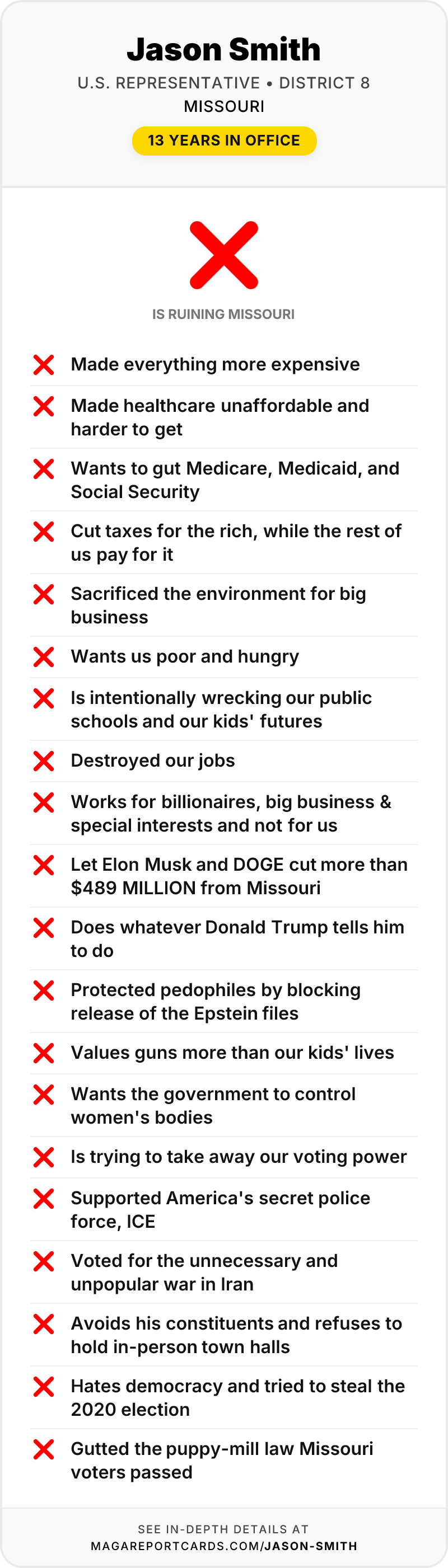
Jason Smith represents Missouri's 8th District. He's been in Congress since 2013 — 13 years — and he chairs the committee that writes the nation's tax laws. He had 1,082 pages to work with.
Here's what that bill did to the people he represents:
- An estimated 32,167 people in MO-8 are projected to lose health coverage — 13,500 losing Affordable Care Act coverage and 18,667 losing Medicaid — according to the Joint Economic Committee.
- 37,855 households in the district — 12.3% of them — rely on SNAP to buy groceries, including more than 16,000 households with kids and more than 16,000 with someone 60 or older, per USDA data.
And here's who the bill was actually built for. The Congressional Budget Office ran the numbers on the House-passed version — the exact draft with page 1,081 in it. Averaged over 2026 through 2034:
- Households in the lowest tenth of the income scale lose about $1,559 a year.
- Households in the highest tenth gain about $12,044 a year.
(CBO's own interactive tool, figures in 2025 dollars.)
So the bill takes health coverage and food from people in southeast Missouri, hands five figures a year to the richest households in America — and on the second-to-last page, adds a decade in prison for anyone who might let the public see those households' tax returns.
That's not a coincidence of page numbering. That's the whole design, printed in order.
The question his office wouldn't answer
Smith's spokesman said the parliamentarian would have to decide whether a prison sentence belongs in a budget bill. The parliamentarian's job is procedure. It was never the question.
The question was why the chairman of Ways and Means — with the power to write tax law for 330 million people — spent that power on protecting the tax secrets of the very wealthiest ones, using a back door, after losing in the front.
He still hasn't answered it.
Source
- Shawn Musgrave, Why Does GOP Budget Bill Focus on Punishing People Who Leak Tax Returns?, The Intercept, May 21, 2025. Photo: Ting Shen/Bloomberg via Getty Images.