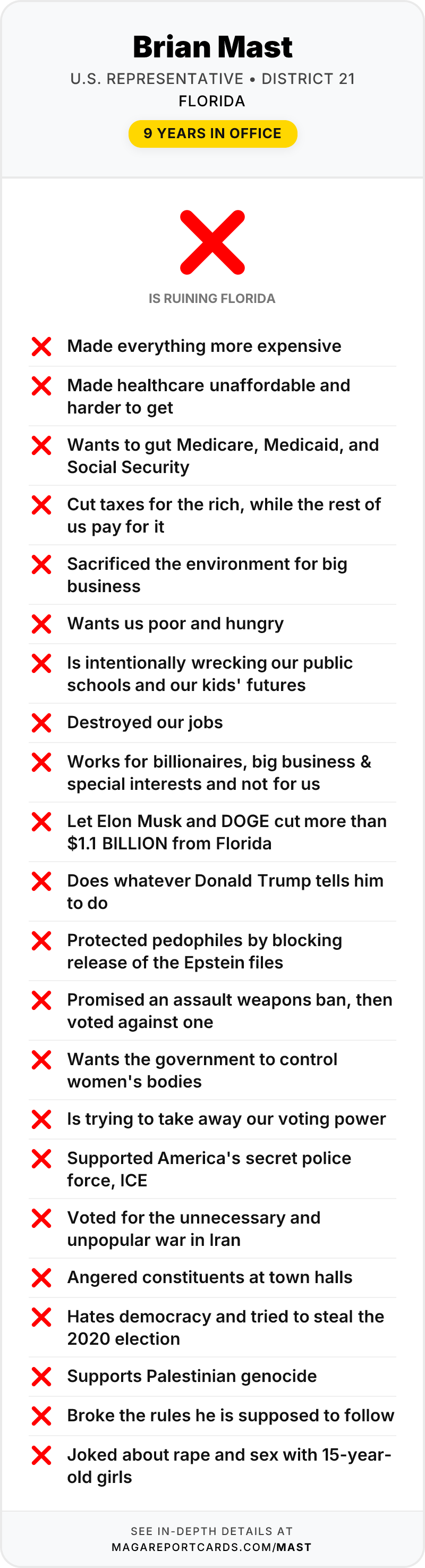
Brian Mast owns a company that holds almost ten acres of land in St. Lucie County, Florida. This year that land got a $712,631 agricultural credit, a farm tax break that cut its taxable value by more than 98%.
The problem is that the land doesn't look like a farm. According to a new report from American Journal News, property records and photos suggest the parcel is undeveloped. There has been no building on it since one was torn down in 2018.
Florida's farm tax break is only for land that is actually being farmed. Mast's campaign did not answer questions about it.
What the records show
Here is what the report found:
- Mast owns 4M Properties of South Florida LLC, a real estate investment and holding company based in Palm City, Florida.
- The company has owned a 9.78-acre parcel in St. Lucie County since 2020.
- On the 2026 tax roll, the parcel was granted a $712,631 agricultural credit, cutting its taxable value from $536,006 last year to $9,780 — a drop of more than 98%.
- Property records and photos suggest the land is not being used for business or for housing. There is no record of a structure on it since a 2018 demolition.
- Mast has been in Congress since 2017 and has to file a yearly report listing what he owns. His reports for 2021 through 2023 listed the land as a "9.78 Acre Property in Fort Pierce", but it disappears from his reports for 2024 and 2025, even though county records still show his company as the owner. And he has never reported earning any income from it.
That last point matters. A real farm sells something. A crop, cattle, timber, sod. Land that brings in nothing at all is hard to square with a tax break that exists for working farms.
What the law actually says
Florida's farm tax break is written into state law, section 193.461. The rule is plain:
"only lands that are used primarily for bona fide agricultural purposes shall be classified agricultural. The term 'bona fide agricultural purposes' means good faith commercial agricultural use of the land."
Good faith. Commercial. The same law tells the county to take the break away from "land no longer being utilized for agricultural purposes." And St. Lucie County's property appraiser says land "used primarily for residential, developmental, or investment purposes" is not eligible.
Mast's company describes itself as a real estate investment and holding company.
The report says St. Lucie County claims to check every parcel that asks for the farm break. Owners are expected to show records of what they spend on feed, seed, fertilizer and irrigation. So either Mast's company handed the county records like that for an empty lot, or the county didn't look very hard. Neither Mast nor his campaign has said which.
Who pays when a congressman doesn't
Property taxes pay for the things a county runs: schools, sheriff's deputies, firefighters, roads. When one landowner pays almost nothing, the bill doesn't disappear. Every other property owner in the county carries a little more of it.
This is happening while property taxes are one of the biggest fights in Florida. Byron Donalds, the Republican running for governor, is the loudest voice for a property tax amendment that, as we reported, would pull as much as $12 billion a year out of Florida's cities and counties, and renters would get nothing from it. Mast's company, meanwhile, already got its land's taxable value cut by more than 98%.
A pattern, not a one-off
Mast's votes in Congress have tilted the tax code the same way. He voted for Trump's budget bill, which cuts taxes for the richest 1% by more than $1 trillion over the next ten years. It pays for part of that with cuts to Medicaid.
Working families in Florida pay their property taxes in full. They don't have a holding company, and they can't get a farm break on an empty lot. Mast has backed big tax cuts for people at the top, and his own company is getting a farm break on land where no farming seems to happen.
He isn't the only Republican on this site whose private business and public job run together. Michigan's Bill Huizenga had his campaign pay more than $400,000 to his half-brother's company, the same brother who helped run his condo business.
The questions Mast hasn't answered
Mast is running for a sixth term against Democrat James Martin, a lieutenant in the Coast Guard Reserve. These are the questions voters in Florida's 21st District deserve answers to before Election Day:
- What farming happens on the St. Lucie parcel, and who does it?
- What records of feed, seed, fertilizer or irrigation did 4M Properties give the county?
- Why did the land drop off Mast's financial disclosures in 2024, when his company still owns it?
- If the land earns no farm income, how does it qualify for a break the law reserves for "commercial agricultural use"?
His campaign did not respond when American Journal News sent it questions for its story.
The bottom line
A company owned by Brian Mast got a $712,631 farm credit this year that cut the land's taxable value by more than 98%, on a 9.78-acre parcel that records suggest has been empty since 2018. Florida law gives that break only to land in good-faith commercial farm use and bars land held as an investment. Mast has never reported income from the parcel, dropped it from his financial disclosures starting in 2024, and hasn't said what's being farmed there.
Source
Did Brian Mast's company get a farm credit for undeveloped land? — American Journal News