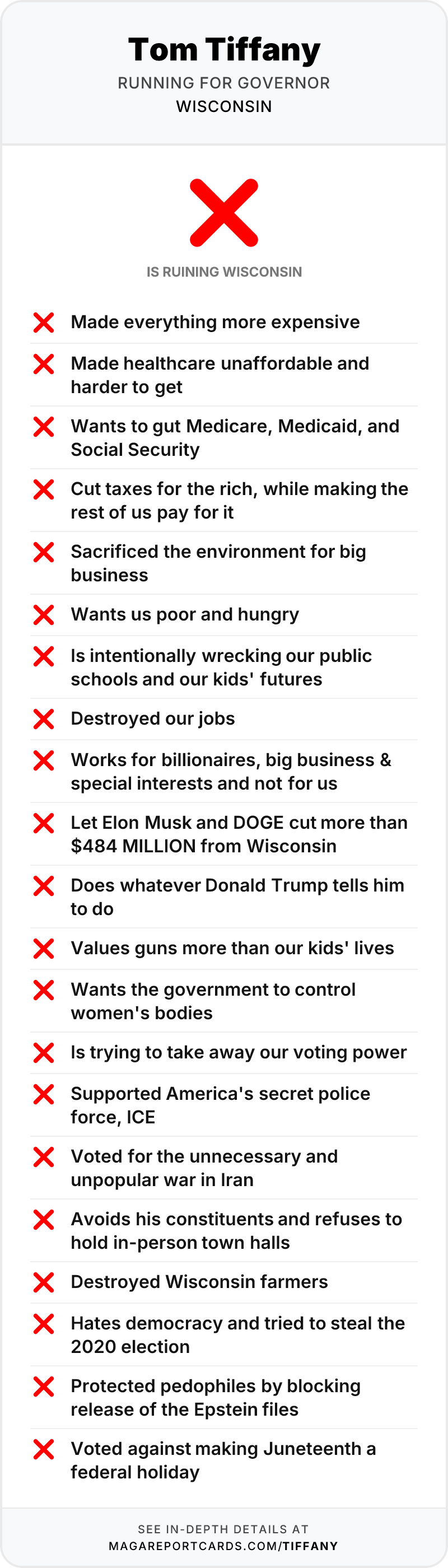
Tom Tiffany is running for governor of Wisconsin. Back when he was a state senator, he put his name on a bill that would have cut his own taxes and raised taxes on homeowners, and for years he didn't tell the state the asset that bill would have helped existed.
That's the finding of a Civic Media investigation published by the Milwaukee Courier on September 30. Tiffany's campaign did not respond to a request for comment.
The billboard
Tiffany has owned a billboard in rural Oneida County, near Cassian, since 1995. It has advertised the Wildwood Wildlife Park in recent years. Under Wisconsin law, a billboard counts as personal property, so it was subject to the personal property tax.
It wasn't always that way. Billboards used to be taxed as real property, like a house or land. Then in 2013, Tiffany voted for Gov. Scott Walker's state budget, which reclassified billboards as personal property. At the time, the Wisconsin State Journal reported critics calling it "a giveaway to out-of-state corporations," and that the change was estimated to shift about $2 million a year in taxes from billboard owners onto other property taxpayers.
Tiffany also owned business equipment through his tour boat company, Willow Inc., that was subject to the same tax, according to the investigation.
The bill
In the 2015–16 session, Tiffany was one of the senators who introduced Senate Bill 765, "relating to: eliminating the personal property tax," and a cosponsor of its Assembly twin, Assembly Bill 750.
Getting rid of that tax would have cut taxes on his own billboard and business equipment. But the money had to come from somewhere, and the bill didn't say where. The Legislature's own nonpartisan Legislative Fiscal Bureau found that taxes on the average Wisconsin home would go up 2.7% to make up the difference.
The people who usually agree with Republicans on taxes said so. "Eliminating this tax by increasing taxes on homeowners and other owners of real property is not the answer," Tom Larson, a vice president of the Wisconsin Realtors Association, told legislators. The League of Wisconsin Municipalities and the Wisconsin Counties Association also urged lawmakers not to shift the burden onto homeowners.
Both bills died in April 2016 without a vote.
The tax did eventually go away. In 2023, Democratic Gov. Tony Evers signed Act 12, which ended the business personal property tax. The difference is that Evers's version paid local governments millions of dollars in state aid to make up for the lost revenue, rather than leaving homeowners to cover it.
The part he didn't report
State lawmakers in Wisconsin report what they own to the state Ethics Commission. That's how voters can find out when a lawmaker's bill would put money in the lawmaker's own pocket.
Tiffany did not list the billboard on his state disclosures for years, including the years he was in the State Legislature sponsoring bills that would have lowered its taxes, according to the investigation. He has reported it to federal regulators as a member of Congress. He finally reported it on his 2025 state financial disclosure.
So the one document that would have shown Wisconsin voters that Senator Tiffany had a personal stake in his own tax bill left that stake out.
A pattern on taxes
This isn't the first time Tiffany's own taxes have raised questions about how he talks about other people's. He campaigns as a small-business success story, but we've reported that he paid Wisconsin no personal income tax at all in six different years.
What the record shows
As a state senator, Tom Tiffany sponsored a 2015–16 bill to eliminate Wisconsin's personal property tax. That would have cut taxes on the billboard he has owned since 1995 and on his business equipment, and the Legislative Fiscal Bureau found it would have raised taxes on the average home by 2.7%. He did not report the billboard to the state Ethics Commission until 2025.