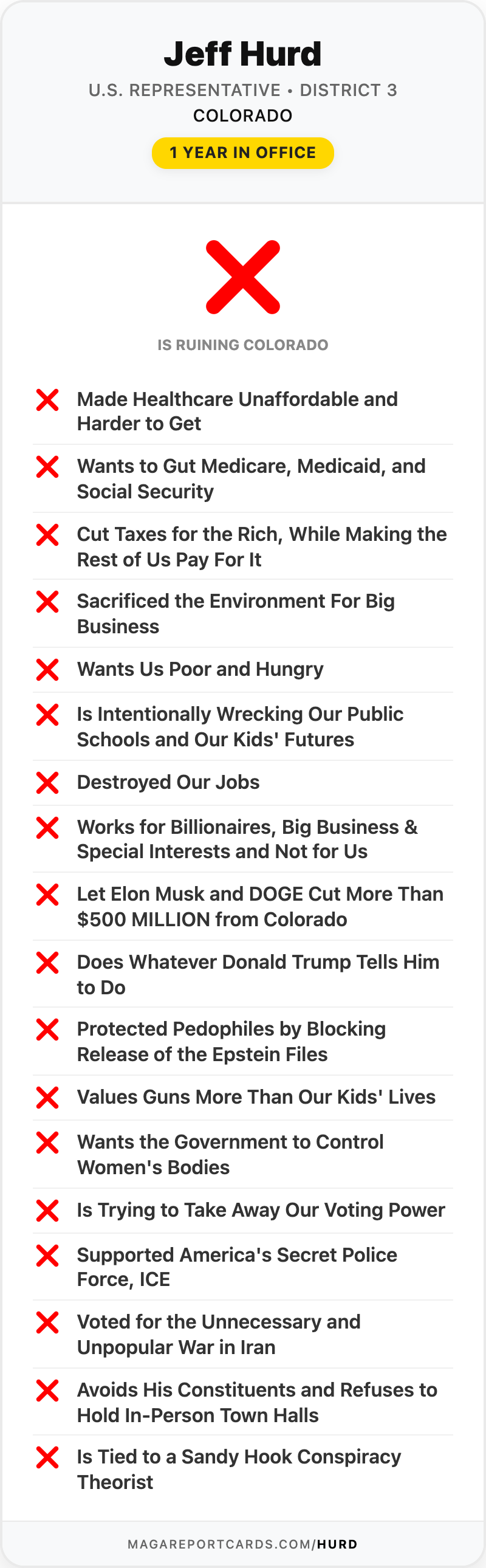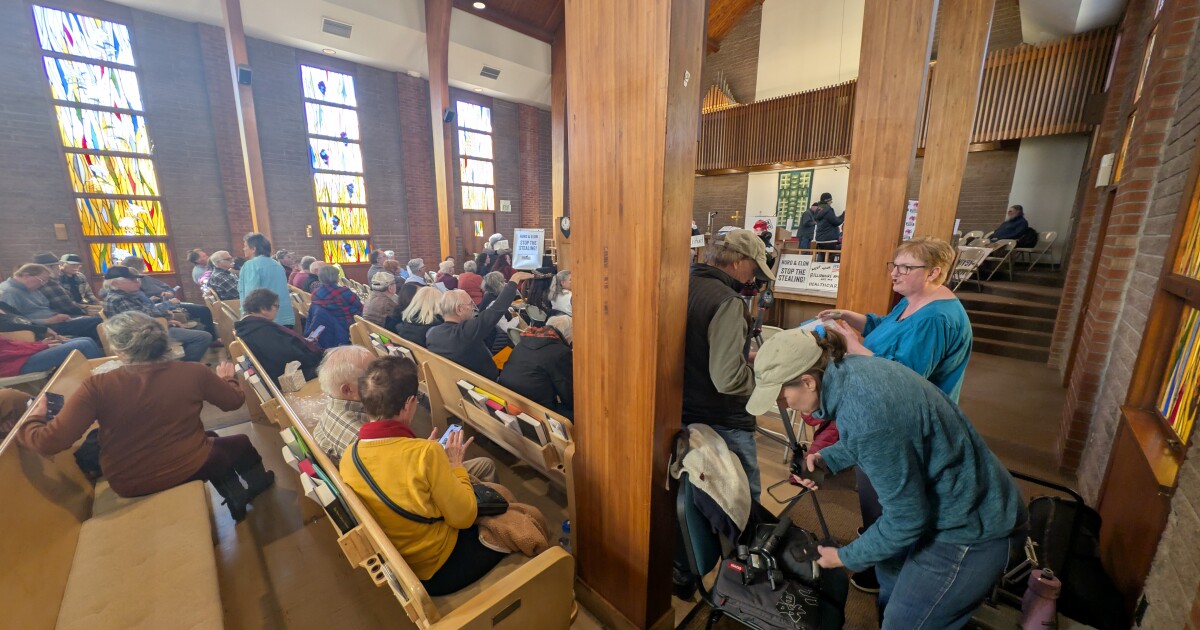
On Friday, February 21, 2025, about 400 people filled the First Congregational Church in Grand Junction. They had questions about rising child hunger, about cancer research being terminated, about Medicaid — which covers roughly 154,000 people in their congressional district. They had come to ask their brand-new congressman.
Jeff Hurd wasn't there. He never answered the invitation.
The four local Indivisible groups who organized it said they reached out to Hurd and his staff multiple times and never got a response. The local TV station that covered it asked Hurd's office for comment and didn't get one either. So the event went ahead without him, and the room did what rooms do when the chair is empty: they talked to each other about what was happening to them.
Hurd had been sworn in seven weeks earlier.
What he said when asked about it
Six days later, Colorado Public Radio's Ryan Warner asked him directly. Why didn't you respond, or attend?
Here is Hurd's full answer:
"Well, listen, I'm interested in hearing from my constituents. I am not interested in political theater and I want to have constructive dialogue. I think Indivisible, if you look at the funding sources for these sorts of organizations, left-wing pressure groups, George Soros, I think that they have an agenda that is not about communicating with the elected officials and helping to advance that constructive dialogue. So I certainly expect that I will be having town halls and hearing from my constituents. I would just rather do it in a politically productive way rather than political theater."
Four hundred of his own constituents drove into Grand Junction on a Friday to talk to him, and his explanation for standing them up was George Soros.
That's the tell. Not one word about the people who actually showed up — who they were, what they wanted to ask, whether any of them had a point. Just the organizers' funding, a billionaire's name, and a phrase — "political theater" — that does all the work of dismissing a room full of voters without engaging a single thing any of them said.
He also made a promise in that answer: "I certainly expect that I will be having town halls."
What happened next
He did hold town halls. By telephone.
Two weeks after the CPR interview, on March 11, 2025, Hurd held his first tele-town hall, taking questions on DOGE, energy policy and Ukraine.
This was not an improvised choice. The Colorado Sun's Jesse Paul reported on March 24, 2025 that the National Republican Congressional Committee had recommended telephone and virtual town halls to incumbents. His verdict on Hurd is four words: "Hurd heeded the advice."
The format stuck. In February 2026, a year later, Hurd held another telephone town hall — more than 12,000 constituents listening in, an hour of questions on voting laws, energy, immigration, tariffs and Colorado River water. He said he plans to keep hosting similar forums.
The difference between the two formats is not a technicality. In a room, anybody can stand up, and a follow-up question is just the next thing out of their mouth. On a phone line, someone in the congressman's office decides which callers get through, in what order, and when the hour is up. Twelve thousand people can "attend" and not one of them can insist.
By June 2026 it had become a campaign issue. The Aspen Times reported that both Democrats running for the seat "have also knocked Hurd for his lack of in-person town halls since being elected," and that his primary challenger says Hurd "has been largely absent when it comes to interacting with voters." His Republican challenger's line: "Jeff Hurd has hidden from the voters. We call him, 'never seen, never Hurd.'"
Meanwhile, people kept showing up anyway
The pattern of the empty church repeated all year, in smaller rooms.
In April 2025, dozens of protesters rallied outside his Pueblo office over the Medicaid cuts, and AFSCME members said he hadn't responded to any of their requests to meet. In May 2025, after he voted for that bill anyway, constituents came to his Grand Junction office to say so; his district director took notes and collected their letters, and afterward his office told the paper that Indivisible had never tried to arrange an official meeting.
The scheduling is the point. There is a version of this where a congressman schedules the meeting.
This is a playbook, not a personality
If Hurd's arrangement sounds familiar, it should. Arkansas's French Hill has a 90-year-old constituent who has stood outside his office every Thursday for a year asking for an in-person town hall — he does his by telephone too. Ohio's Mike Carey promised to post the call-in number for his telephone town hall and never did, then put out a press release celebrating that 12,000 people joined.
Same year, same party, same substitution: a number that can be reported to reporters, standing in for a room where anyone can raise a hand.
The standard
Nobody is entitled to a friendly audience. A member of Congress can walk into a hostile room, take the questions, disagree out loud, and leave — that happens, and it's how the job is supposed to work.
What Hurd did instead was decide in advance that the people who wanted to see him weren't really constituents, they were an "agenda." Once you believe that, you never have to be in the room.
Four hundred people came. He called it theater. Eighteen months later, they're still waiting.
Source
Interview: GOP Rep. Jeff Hurd speaks on DOGE, Medicaid and Nazi salutes — Kiara DeMare, Tom Hesse and Ryan Warner, Colorado Public Radio, February 27, 2025. Photo: Emily Hale / KVNF, via Aspen Public Radio.