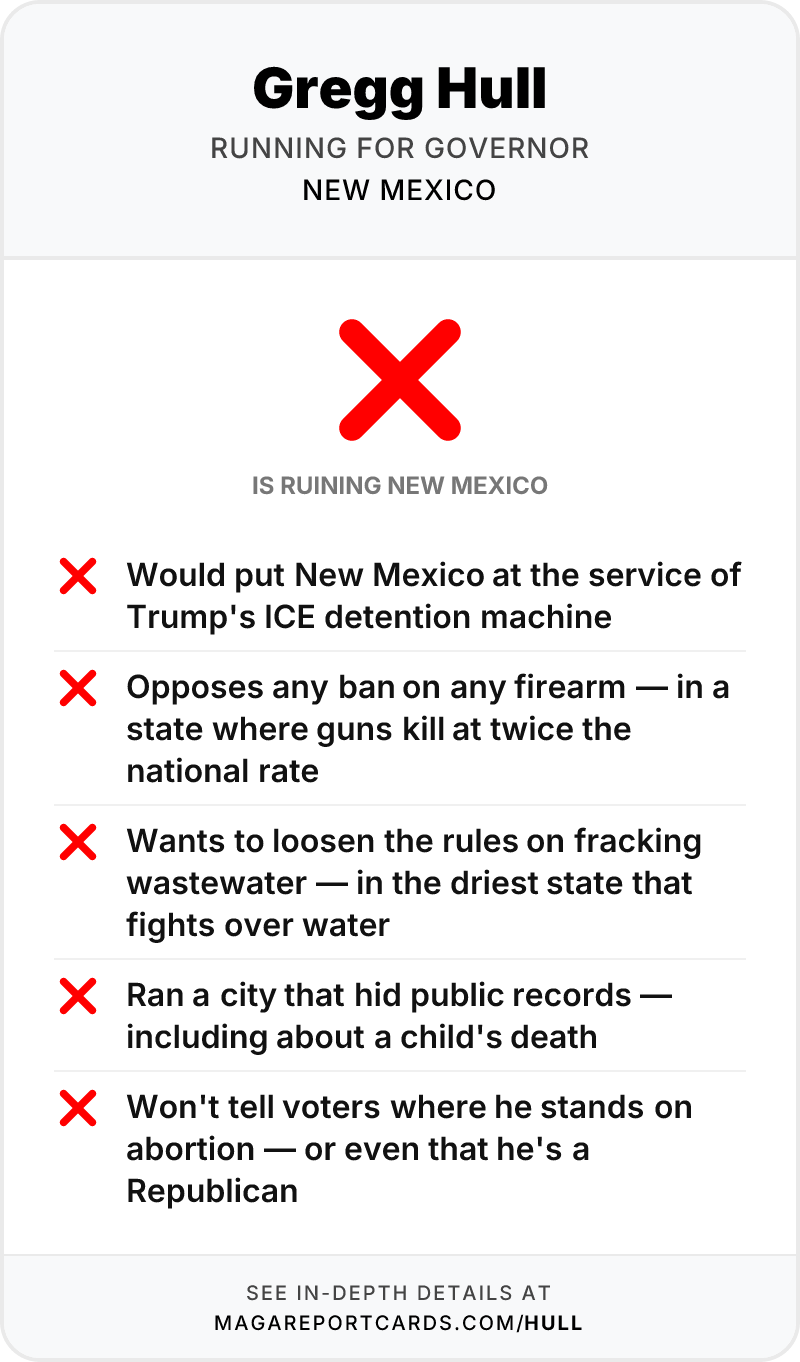
New Mexico is the most Medicaid-dependent state in America. That isn't an opinion — Medicaid covers about 42% of New Mexicans, the highest per capita enrollment in the country. About a third of New Mexico's children are on it. And roughly 70% of New Mexico adults on Medicaid work full- or part-time.
So when someone runs for governor of New Mexico, how they'd handle Medicaid isn't one issue among many. For a huge share of the state, it is the issue.
Source New Mexico asked Gregg Hull exactly that. The question was how he'd govern through the rest of Trump's presidency, given that the current governor has called multiple special sessions to deal with the administration's budget cuts.
Here is his full answer, as Source NM published it:
"We're going to have to figure out what we're going to need to do to deal with those budget cuts.
I'm going to be a big proponent for going in and looking at and making sure that the money we are spending on the Medicaid and Medicare programs are being appropriately spent. But also making sure that they're benefiting the rural communities the way that the programs are supposed to.
We're going to have to look at what resources we do have and manage those in a careful way. If that requires some scaling back, then we'll have to look at that. If you don't have the money, you don't have the money. But our goal would be to make sure that the most vulnerable in the state do get served."
"If you don't have the money, you don't have the money"
That sentence is doing a lot of work, so let's be clear about what it means and doesn't mean.
New Mexico's Medicaid squeeze is not a natural disaster. It was voted for. Trump's budget bill imposed work requirements of 80 hours a month for adults 19 to 64 and cut redetermination periods from 12 months to six — paperwork machinery that removes people who are eligible, not just people who aren't. The state's Health Care Authority estimated at least 88,000 New Mexicans will lose Medicaid coverage.
So "if you don't have the money" is a passive way of describing an active decision made in Washington by Hull's own party. A governor's job when that happens is to decide what to do about it.
New Mexico's answer so far has been to backfill. According to the advocacy group New Mexico Voices for Children, the state's 2027 budget funds coverage for almost 47,000 New Mexicans and reduces health care costs for up to 122,000 people statewide — a direct effort to absorb the federal cuts rather than pass them along.
Hull's answer, asked the same question, was to talk about auditing whether the money is "appropriately spent" and to leave the door open to "some scaling back."
What his own website promises
Now compare that with what Hull's campaign says about health care.
His healthcare page opens with a line about fairness: "Access to a doctor, an emergency room, or a specialist should not depend on your ZIP code." He promises to "Protect and foster rural healthcare systems to ensure communities can keep hospitals, clinics, and emergency services close to home," to advocate for "competitive reimbursement rates that allow providers to keep their doors open," and to recruit healthcare professionals to New Mexico.
Every one of those promises runs through Medicaid. Rural hospitals in New Mexico stay open because Medicaid pays them. "Competitive reimbursement rates" are Medicaid rates for a large share of rural patients. You cannot keep the emergency room open in a county where 42% of people are on Medicaid while scaling Medicaid back.
And here's the tell: his healthcare page contains no Medicaid proposals at all. Not a plan to protect it, not a plan to reform it — the program that covers four in ten New Mexicans simply isn't there.
The promise is on the website. The caveat is in the interview.
"Making sure the money is appropriately spent"
Hull's stated priority is auditing Medicaid and Medicare spending. It's worth knowing what New Mexico's own analysts found when they looked.
The Legislative Finance Committee examined why the state's Medicaid bill keeps rising and concluded it isn't enrollment — enrollment has been declining. It's the cost of health care itself. Per-member monthly costs went from $576 in 2020 to a projected $883 in the fiscal year just ended.
In other words, the money is going where you'd expect: to medical care that costs more than it used to. A governor can go looking for waste, and should. But an audit is not a plan, and "we'll look at it" is not a commitment to keep anyone covered.
What "the most vulnerable" leaves out
Hull's final line — "our goal would be to make sure that the most vulnerable in the state do get served" — sounds reassuring until you notice it's a narrowing.
Medicaid in New Mexico doesn't cover only the most vulnerable. It covers about 42% of the state, including working adults, a third of all children, and families who'd be uninsured without it. When a politician promises to protect "the most vulnerable" in a program that broad, the honest reading is that some people currently covered are going to be reclassified as not vulnerable enough.
Nobody should have to guess which group they're in.
Ask him now, not after
New Mexico's general election is in November. Hull has been evasive on other subjects — he left all 34 questions on a candidate questionnaire unanswered, covering abortion, health care, immigration, education and elections.
On Medicaid, at least, he said something. It just wasn't a promise.
In the state where more people depend on Medicaid than anywhere in America, the Republican running for governor won't rule out cutting it. New Mexicans deserve a straight answer. We deserve better.
Source
New Mexico Primary 2026: GOP governor candidate Gregg Hull — Joshua Bowling, Source New Mexico, April 10, 2026. Photo: Danielle Prokop / Source New Mexico.