Warren County, in northwestern Pennsylvania, has about 37,000 people, and half of them are over 50. It has a hospital, Warren General, and a pharmacy that has been open since 1917. It also sits in Glenn Thompson's congressional district.
Now a new report from The News Lab at Penn State, published by the Pennsylvania Capital-Star, shows what health care looks like there, with the Medicaid work requirements in Trump's budget bill set to start January 1.
Warren General's CEO, Dan Grolemund, estimates that more than 1,100 people in the county are set to lose their Medicaid eligibility. The bill made more than $900 billion in Medicaid cuts.
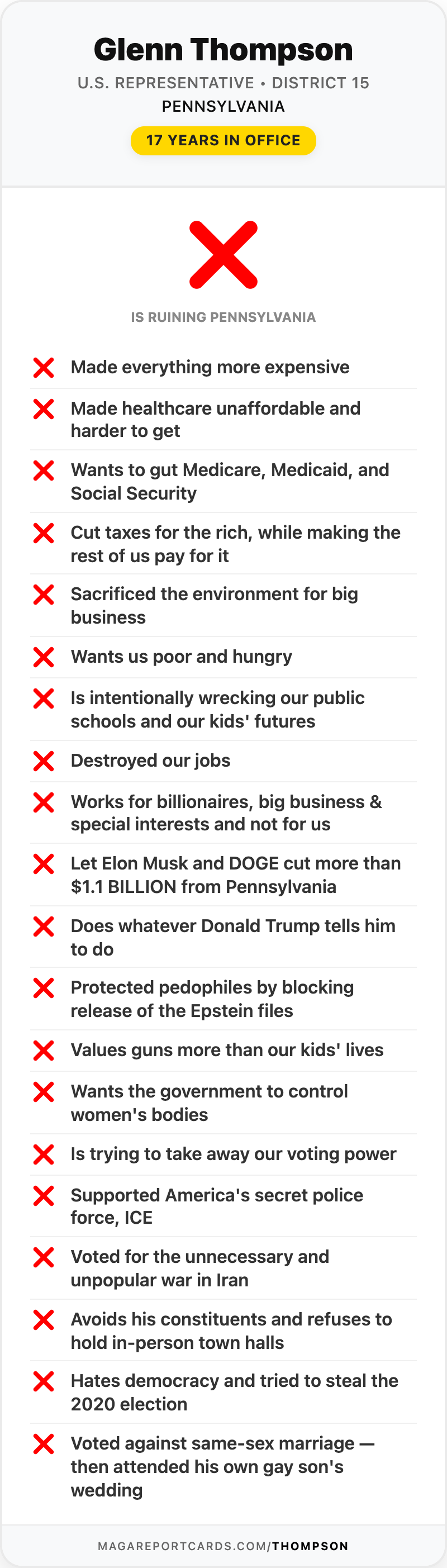
Thompson voted yes. He also has a special claim on that bill. He chairs the House Agriculture Committee, and he personally released the text that cut food assistance two months after promising "absolutely no reductions."
A county that was already hurting
Thompson's vote didn't land on a healthy system. It landed on one hanging on.
The report says rising costs, staff shortages and low payments have shut several of Pennsylvania's rural hospitals, and that nearly a third are at risk of closing in the coming years. Warren General is still open, but it has been cutting services to stay alive.
- In January, it closed its labor and delivery unit. Grolemund contacted 28 residency programs and used 10 national recruiters to find doctors. No one took the job. Patients now travel about 20 miles to Jamestown, New York, or more than 60 miles to Erie to give birth.
- A neighboring hospital is gone. The local hospital in neighboring Bradford closed in May.
- Staff is shrinking. In the past year, Warren General's full-time staff fell from 490 to 452.
- The money is razor thin. The hospital posted a $65,000 operating profit this past year, after losing a combined $9.5 million in the three years before.
Not all of this is Thompson's doing. The delivery unit closed because the hospital couldn't find doctors, and rural medicine has been losing workers for years. But a member of Congress who knows that picture should be fighting to send help. He voted to take more than $900 billion out of the program that keeps places like this open.
Grolemund is already planning around the hit. The hospital opened a new location in Bradford, which he expects will offset losses from the Medicaid cuts that begin in January.
People are already dropping out
The other half of this is the Affordable Care Act.
Pennie, Pennsylvania's marketplace, reports that 39% of the people enrolled in Warren County have dropped their coverage since Congress failed to extend the tax credits that helped pay for it. Premiums rose an average of 21.7%, the report says.
That is before the Medicaid work requirements begin.
Scott Newton and his wife, Kelly, own Gaughn's Drug Store, the old pharmacy in town. He can tell you what comes next.
"With my patients, if they are cut out of Medicaid, they don't have a way to pay for those medications, so I don't see them," he told The News Lab. "What is the trickle-down effect from that? It's going to increase the amount of emergency room visits, it's going to increase hospital traffic, the workload of every [provider]."
Across Thompson's whole district, Democratic staff on Congress's Joint Economic Committee estimated that 23,654 people will lose health coverage: 7,200 from the Affordable Care Act and 16,454 from Medicaid.
"Don't really value rural people"
Ruby Wiles has lived in Warren for more than 20 years. She takes care of her 27-year-old son, who has a chronic illness that has sent them to hospitals in Pittsburgh and Cleveland.
"I have big concerns that our hospital might go under because of reimbursements," she told The News Lab. "We have elected representatives and a president who don't really value rural people."
Thompson won reelection on Tuesday. The work requirements start in eight weeks.
What the record shows
Glenn Thompson voted for the budget bill that made more than $900 billion in Medicaid cuts, with work requirements starting January 1. In Warren County, in his district, the hospital's CEO estimates more than 1,100 people will lose eligibility, and 39% of marketplace enrollees have already dropped coverage. The county's hospital closed its delivery unit in January and neighboring Bradford's hospital closed in May.
Source
- In Warren County, a reflection of rural healthcare's turmoil, The News Lab at Penn State, via the Pennsylvania Capital-Star