In 2001, the Forest Service put 58.8 million acres of national forest off-limits to new road building. It's called the Roadless Rule, and what it does is keep new roads from being cut into the backcountry. The land stays public and stays open — it just stays roadless.
Wyoming has 3.3 million of those acres, spread across nine national forests.
Last year the Trump administration moved to erase the rule, and did the thing agencies do before a big change: it asked the public what it thought.
The public answered. More than 99% said don't.
Harriet Hageman read that result and introduced a bill to make the repeal permanent.
What the public actually said
The Forest Service ran a 21-day comment period in the summer of 2025. When it closed, regulations.gov showed 223,862 comments posted, on top of roughly 400,000 more submitted in bulk petitions — about 625,737 submissions in all.
The Center for Western Priorities pulled a random sample of 5,000 from the 183,000 that had arrived by the morning of the last day and coded them. The result: 99.2% opposed the repeal, 0.6% supported it, 0.2% were neutral, with a margin of error of 1.4 points.
"Across state lines and party lines, Americans spoke with one voice to tell President Trump to stop this attack on America's forests," the group's deputy director, Aaron Weiss, said.
This is not a new or partisan opinion. When the Clinton administration proposed the rule in the first place, it drew 1.6 million comments, more than 90% in favor. A 2019 Pew Charitable Trusts poll found 75% support — the same in rural areas as in cities.
What Hageman's bill does
On February 25, 2026, Hageman introduced H.R. 7695. Four Republicans signed on the same day: Troy Downing of Montana, Celeste Maloy of Utah, Pete Stauber of Minnesota, and Tom Tiffany of Wisconsin.
The bill does three things. It declares the 2001 rule to have "no force or effect" — writing the administration's repeal into statute. It goes further than the administration went: it says a future Agriculture secretary "may not take any action to propose, finalize, implement, administer, or enforce any rule substantially similar to the rule." And it orders the Forest Service to build "such permanent and temporary roads as the Secretary determines necessary" for restoration work, hazardous-fuels reduction and replacing existing roads.
That second clause is the point. An agency rule can be undone by the next agency. A statute can't. Hageman's bill is designed to take the question away from every future administration — and from the 223,862 people who just answered it.
The Wyoming Outdoor Council's public lands program manager, Gabby Yates, put it this way: "By sidestepping the already scant public process that the administration is using to rescind the rule, H.R. 7695 adds insult to injury and ignores hundreds of thousands of Americans who are currently opposing the rescission."
The wildfire argument, and what the Forest Service said about it
At a House Natural Resources subcommittee hearing on May 21, 2026, Hageman testified for her bill. She called the Roadless Rule an "environmental catastrophe."
"The Roadless Rule has been devastating to the Interior West," she said. "The Roadless Rule has been devastating to Wyoming."
Her evidence is wildfire. She told the subcommittee that nine of the ten "most catastrophic" national forest fires have happened since 2001, and, earlier in the hearing, called the claim that ending the Roadless Rule would mean more wildfires "absolutely wrong."
"The science and the facts and the history demonstrate, without question, that you are absolutely wrong," Hageman said.
Rep. Andrea Salinas of Oregon made that argument anyway, citing the Forest Service's own assessment and an analysis finding 85% of wildfires are human-caused.
The Forest Service's own associate chief, Chris French, was there too. His agency supports the repeal and supports Hageman's bill; he offered "technical assistance" to help pass it. And he still would not back her up on that point. It is a "longstanding fact," French said, that "most" wildfire ignitions are human-caused and "most are going to be associated with where humans go, including roads."
He added that severity can be worse in untreated roadless areas, and that "there are different facts you can pull out to support an opinion."
That's the agency on her side of the bill declining to say the thing she said "without question."
This is her second run at Wyoming's public land
Hageman has been fighting the Roadless Rule since it existed. Twenty-five years ago, as a private attorney, she litigated against it on Wyoming's behalf. That's a long-held conviction, and she's entitled to it.
But she is now the person Wyoming sends to Congress, and the last time she got out ahead of Wyoming on public land it went badly for her.
In 2025 she backed a provision in Trump's budget bill that would have required selling off federal land across 11 Western states, Wyoming included. Wyomingites showed up at her town halls furious. She did not pull her support: the amendment was stripped out in the Senate, and the Powell Tribune reported that "none of Wyoming's U.S. delegation stood against" it. Weeks later she was at a Converse County town hall saying she still wants to sell federal land.
The pattern is the same here. National hunting and angling groups have come out hard against ending the Roadless Rule, because roadless backcountry is where the elk and the native trout are. Wyoming conservation groups oppose it. Nearly everyone who bothered to file a comment opposes it. The people lined up behind the repeal are Western Republican officeholders and a timber industry that's been shrinking for decades — Gov. Mark Gordon and Sens. John Barrasso and Cynthia Lummis are all on record for it.
Hageman's response to that lineup isn't to argue the public out of its position. It's to write a law saying the public doesn't get asked again.
Why this matters right now
Hageman is running for Cynthia Lummis's open Senate seat, and Wyoming's primary is August 18, 2026 — one week from today. Her main opponent, rancher Sam Mead, is running on a pro-public-lands platform.
Hageman has a 0% score from the League of Conservation Voters for 2025 and a 1% lifetime score. She chairs the Natural Resources Subcommittee on Water, Wildlife and Fisheries. Her donors include Peabody Energy, the country's largest coal producer, and Koch's corporate PAC. We've written about her bill to kill the lawsuits towns file when energy companies wreck them, and about her resolution to strip California's power to limit vehicle pollution.
H.R. 7695 fits the set. What makes it different is who it's aimed at. The clean-air resolution was aimed at California. This one is aimed at the 223,862 people who filed a comment, and at every American who might file one in the future.
Wyoming has one voice in the House. Right now it is being used to argue that the public has already said too much.
Source
Wyoming's Hageman aims to block future 'roadless areas,' despite overwhelming support to keep public land pristine — Mike Koshmrl, WyoFile, May 21, 2026.
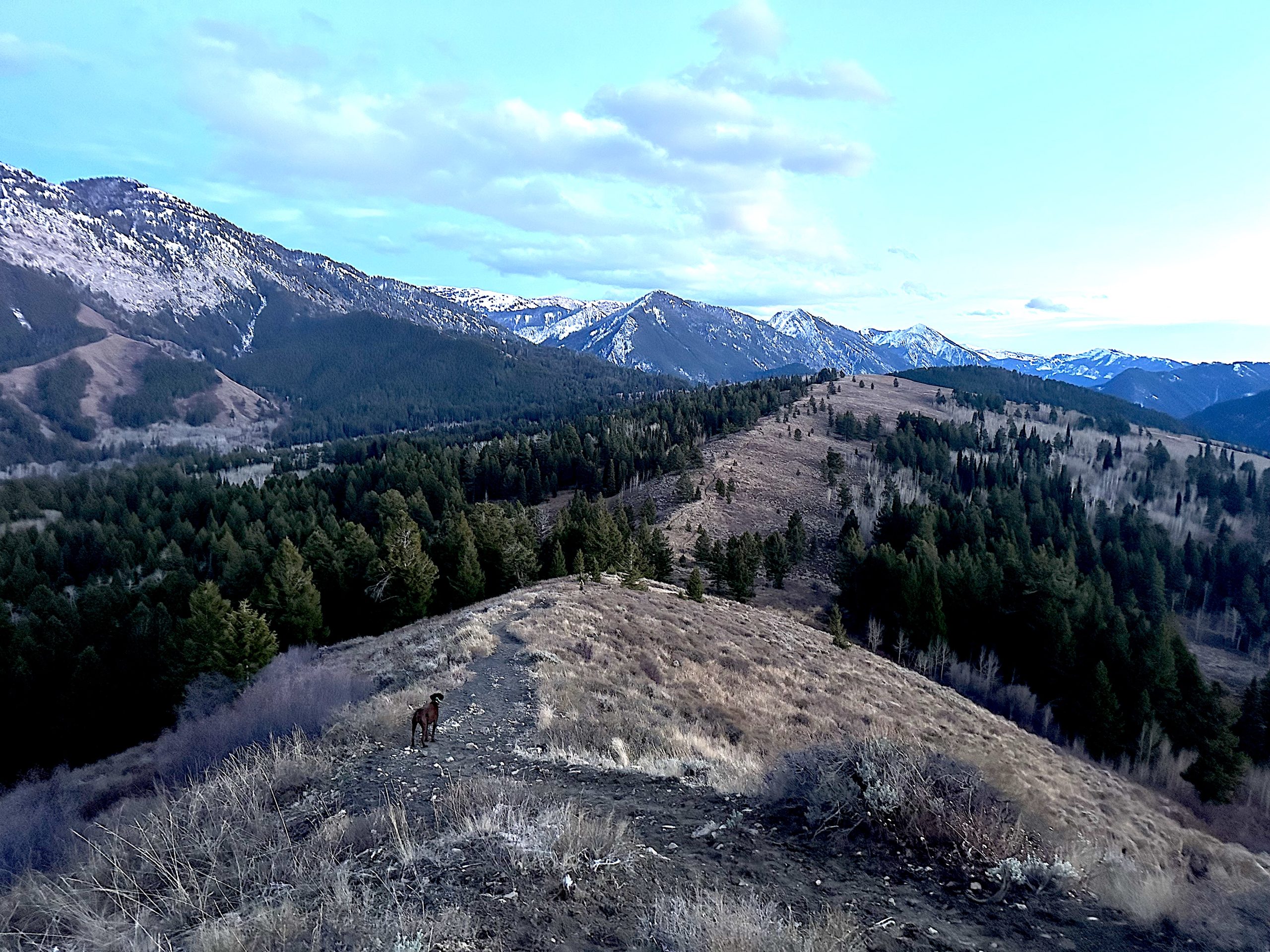
Photo: The northern Wyoming Range. Mike Koshmrl/WyoFile.