On September 4, 2026, President Trump ordered the Interior Department to decide within 90 days whether gray wolves should lose their protection under the Endangered Species Act.
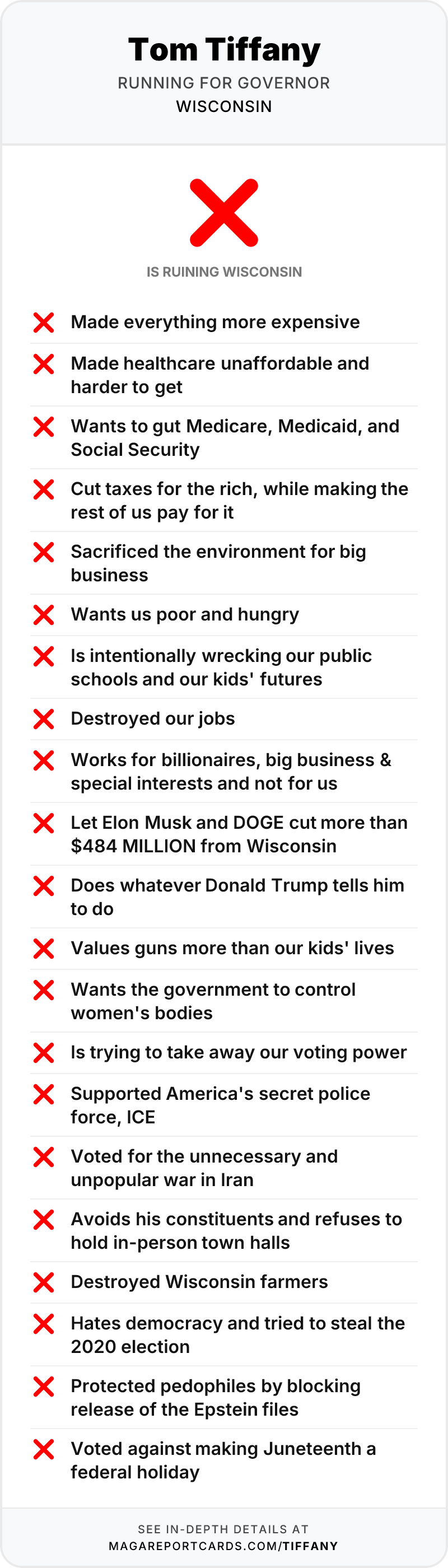
Tom Tiffany, the Republican nominee for governor of Wisconsin, put out a statement the same day:
"The gray wolf has recovered, and the impacts are being felt across rural communities in Wisconsin. Farmers are dealing with livestock depredations, families are losing pets, and wolves are showing up closer to homes. Wisconsin has successfully managed wildlife for generations. It is time to get out-of-state judges and bureaucrats out of the way and let Wisconsin responsibly manage its wolf population."
We know what Wisconsin managing its wolf population looks like, because it happened five years ago.
February 2021
Gray wolves were briefly delisted at the end of the Trump administration's first term. A hunting season opened in Wisconsin in February 2021.
The state set a quota of 119 wolves for licensed hunters, made 2,380 harvest authorizations available and sold 1,547 tags — roughly 13 for every wolf in the quota.
Hunters and trappers killed 218.
They did it in under three days. The Department of Natural Resources shut the season down early and still couldn't stop it in time, because the closure of a zone did not take effect until 24 hours after the DNR posted notice of it — so the killing continued while the notice ran.
That is what the management system Tiffany is describing produced the one time it was switched on: nearly double the state's own limit, in a weekend, with the agency legally unable to hit the brakes.
What it did to the population
Wisconsin's DNR said the population dropped 14% after the hunt.
Researchers at the University of Wisconsin–Madison — Adrian Treves, Francisco Santiago-Ávila and Karann Putrevu — put the real figure much higher: between 27% and 33% of the state's wolves were lost between April 2020 and April 2021, a total of 313 to 323 animals.
About a third of that loss wasn't the licensed hunt at all. It was hidden deaths — a majority of them, the researchers estimated, illegal killing that spikes when protections are relaxed. Santiago-Ávila described the pattern this way: "Those wolves disappear and you never find them again."
The finding is that the delisting itself killed wolves beyond the hunt, because it told people the animals were no longer valued.
This is Tiffany's signature issue
Tiffany is not a bystander cheering an executive order. He has been trying to do the same thing permanently by law. In January 2021 he introduced the Managing Predators Act, which would have stripped gray wolves in Wisconsin, Michigan, Minnesota and Wyoming of federal protection outright; it died in subcommittee. He is now the lead original cosponsor of the Pet and Livestock Protection Act, Lauren Boebert's bill ordering Interior to reissue the 2020 delisting rule, which passed the House 211–204 in December 2025 and is waiting on the Senate. His office says he authored it.
So the order is Trump doing administratively what Tiffany has been trying to legislate.
What the conservation groups say
Wolf delisting arrived bundled with a set of Trump orders aimed at beef and ranching, and the groups that work on this responded to the package together.
Western Watersheds Project made the point most directly about the economics Tiffany is invoking:
"The impact of wolves on the livestock industry [pales] in comparison to the impacts of recent trade agreements and the reality of ranching in the arid West under changing climate conditions."
Humane World for Animals said "the war on wolves needs to end, not escalate," and that the decisions should be "based on science, not political favors."
Food & Water Watch said the orders "will do nothing to reverse the last two years of Trump's disastrous food policy," pointing out that "consumer beef prices are at record highs, and ranchers can't make ends meet."
None of that says wolves never take livestock. They do. It says the wolf is being offered as the explanation for a squeeze that has other causes — and that Tiffany, running for governor, is happy to let it be.
The pattern on Wisconsin's natural resources
This is the same candidate who wants to break up the Department of Natural Resources "for sportsmen," when the state's own audit found 90% of that money already goes to them.
What the record shows
Tom Tiffany cheered Trump's order to strip gray wolves of federal protection and said Wisconsin has "successfully managed wildlife for generations." The last time Wisconsin managed wolves, in February 2021, hunters killed 218 against a state quota of 119 in under three days, and the DNR could not legally stop them. University of Wisconsin researchers estimated the state lost 27% to 33% of its wolves that year, roughly a third of it to hidden deaths, mostly illegal killing, that rose when protections came off. Tiffany wrote a bill to delist the wolf in 2021 and is the lead original cosponsor of the one that passed the House in December.
Sources
- Tiffany Applauds White House's Action to Delist Gray Wolves, Office of Rep. Tom Tiffany (September 4, 2026).
- Trump signs order pushing to remove gray wolf protections, Northern News Now (September 4, 2026).
- Harvest Exceeded in 2021 Wisconsin Wolf Hunt, Rocky Mountain Elk Foundation.
- February Wolf Harvest Season Feb. 22-28, Wisconsin Department of Natural Resources (February 22, 2021).
- February 2021 Wolf Hunting and Trapping Regulations, Wisconsin Department of Natural Resources.
- Wisconsin's Wolf Quota Was 119. Hunters Killed Almost Twice as Many., Backpacker.
- DNR: Wisconsin wolf population dropped 14 percent after controversial wolf hunt last year, Wisconsin Public Radio (September 30, 2022).
- Hunting and hidden deaths led to estimated 30% reduction in Wisconsin's wolf population, University of Wisconsin–Madison.
- Critics Warn Trump Beef Orders 'Won't Help Consumers or Ranchers' and Could Kill Protected Wolves, Common Dreams (September 4, 2026).