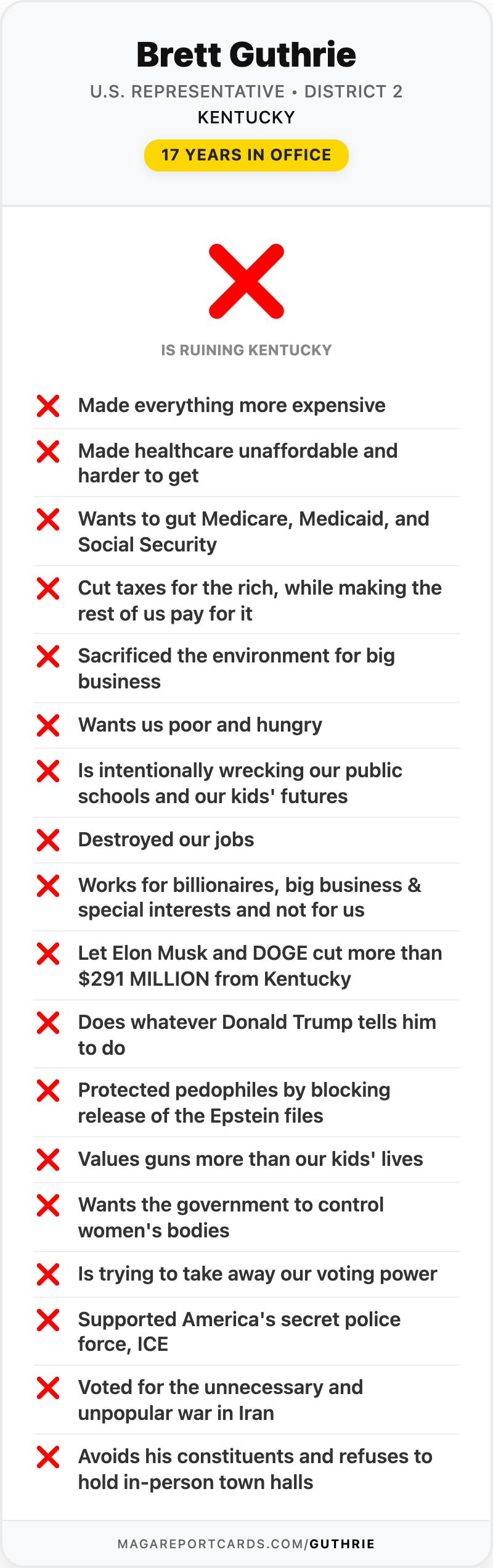
People in Kentucky's 2nd Congressional District have been showing up at county meetings with signs that say "listen to the people."
They are not there about Washington. They are there about data centers — the enormous warehouses of computers that run artificial intelligence, that drink electricity and water, and that require somebody to build new power plants to feed them. Somebody, meaning everyone else on the grid.
Their congressman is Brett Guthrie, and he is not a backbencher on this. He is the Chairman of the House Energy and Commerce Committee — the committee in Congress with jurisdiction over the electric grid. If there is one member of the House who could do something about what data centers do to a power bill, it is him.
Here is what his own district has done, and what he has done back.
The revolt in KY-02
E&E News laid out the count in June. In Guthrie's district:
- Breckinridge County passed a one-year moratorium in November 2025.
- Daviess County passed a one-year moratorium on construction.
- Meade County voted a data center proposal down after 3,000 people signed a petition against it.
That's three counties. Not activists bused in from somewhere — county governments in a deep-red district, hitting the brakes.
Maranda McDaniel, a Guthrie constituent who started the Daviess County petition, told E&E she was "really surprised" by how fast it took off. She also said something worth noting: she and the other organizers have been working county and city officials, and had not engaged with Guthrie's office at all.
The chairman of the committee that governs the grid, and the people in his district fighting a grid fight went to the county courthouse instead.
Meanwhile, in Hancock County, the Bitcoin mining company TeraWulf is planning to build on the site of a former aluminum smelter — a project that could draw as much as $14 billion and rank among the largest private investments in Kentucky history.
A Change.org petition against that one, quoted by E&E, gets at why people are uneasy:
"[The smelter plant] was a source of real, family-supporting jobs for Hancock County... More than 600 workers were left waiting and hoping production would one day return. Now, those hopes have been replaced with a very different proposal."
Six hundred jobs became a computer warehouse. That's the trade people are being asked to accept.
What Guthrie said
Asked about the pushback, Guthrie was careful:
"I hear from people, I do. I think it's fair to be concerned. Now, to say, 'don't do anything,' I think that can take our communities out of what could be the industry of the future. But anytime there's anything developing, it makes people anxious, and it's fair to have concerns."
And later in the same story:
"I do not minimize the concerns people have about data centers or just AI. You should be anxious about it."
That is a man who has heard his constituents and does not intend to do what they're asking.
What he did
Two things, and they point in different directions.
First, he asked the federal government to investigate the opposition. In June, Guthrie signed a letter asking the FBI and the White House science advisers to look into whether China is behind some of the campaign against data centers. "Americans deserve to know who is bankrolling the disinformation campaign that seeks to block critical infrastructure investments," he said.
We've written about that letter and the two advocacy-group reports it leans on — Bob Latta of Ohio signed it too, five weeks after telling a hearing that constituents' concerns "deserve to be taken seriously". Neither report establishes any link between a foreign government and a county meeting in Kentucky.
The head of the industry's own trade group, the Data Center Coalition, was more honest about it than the chairmen were. Asked about the China claims, Josh Levi told E&E: "I have no reason to disbelieve that there is some of that happening, but I also indicated we know that there's also organic opposition in communities."
Three thousand signatures in Meade County is organic opposition in a community.
Second, he moved a bill. On July 21, 2026, Guthrie's committee approved H.R. 9340, the Ratepayer Protection Act by 52-0. It was introduced by Gabe Evans of Colorado, with Kathy Castor of Florida as its lead Democratic cosponsor — not by Guthrie, who is not on it at all — but he has made it a priority and predicted a floor vote.
Guthrie's pitch for it: "As we continue to build the infrastructure needed to win the AI race with China to AI dominance, it's critical that the companies building data centers are the ones paying for their own electric bills."
That sounds like exactly what the people at those county meetings want. Read the bill and it is considerably less than that.
What the Ratepayer Protection Act actually does
It amends a 1978 law called the Public Utility Regulatory Policies Act, and the mechanism it uses is the one that law is known for: it creates a federal standard and then tells states to think about it.
From the bill text: within one year of enactment, each state regulatory authority "shall commence consideration... or set a hearing date for consideration" of the standard. Within two years, each "shall complete the consideration and make the determination."
Consider. Determine. Nowhere does the bill require a state to adopt the standard. A state utility commission can hold the hearing, decide against it, and be in full compliance with the law.
The bill goes further in the other direction, too. A whole subsection says the requirement doesn't apply at all if, before enactment, the state already "conducted a proceeding to consider implementation of the standard (or a comparable standard)" — or if the state legislature merely "has voted on" it. A proceeding that considered it and said no still counts.
So: a bill that requires states to hold a meeting, with an exemption for states that already held a meeting.
There is a reason it passed 52-0. The earlier, broader version of it carried endorsements from Microsoft and Google — the companies building the data centers. Before the markup, committee leaders narrowed it to cover data centers alone rather than every customer drawing 100 megawatts or more, and the industry's trade group objected to that change. Microsoft and Google have not publicly changed their positions.
Alphabet, Google's parent company, is the largest single organization on Guthrie's 2026 contributor list at $54,500 — all of it from people who work there, none from the company's PAC. Amazon accounts for $33,500, $10,000 of it straight from its PAC. Both are named on his own report card.
The bills are already going up
None of this is hypothetical for Kentuckians.
In February 2026, the Kentucky Public Service Commission approved rate increases for the state's largest electric utility: 4.73% for the average residential LG&E electric customer — about $5.14 a month — and 6.54% for Kentucky Utilities customers, about $8.73 a month. The utility had asked for more, and the commission cut it back.
Buried in the same order, per the Kentucky Lantern's account, were new regulations for handling the electricity load from power-hungry data centers. The state commission was already writing data center rules while Guthrie's bill was still asking states to consider writing them.
That's the shape of this whole story. The states, counties and utility commissions are the ones actually deciding what data centers pay. The one federal official with the most direct power over the grid asked the FBI about the people complaining, and moved a bill that tells the states to think it over.
The chairman's job
Guthrie has been in Congress since 2009 — 17 years — and he runs one of the most powerful committees in the House. He is the person who decides which bills his committee takes up and which ones it doesn't. He gets to set the agenda.
He used that agenda to hold a hearing, advance a bill that requires nothing, and go after "who is bankrolling" the opposition.
Three counties in his own district have already voted. They did not need a briefing from the FBI to figure out what they think.
Source
Amelia Davidson and Nico Portuondo, "Powerful House Republican getting pressure on data centers back home", E&E News by POLITICO, June 16, 2026. Photo: Francis Chung/POLITICO.