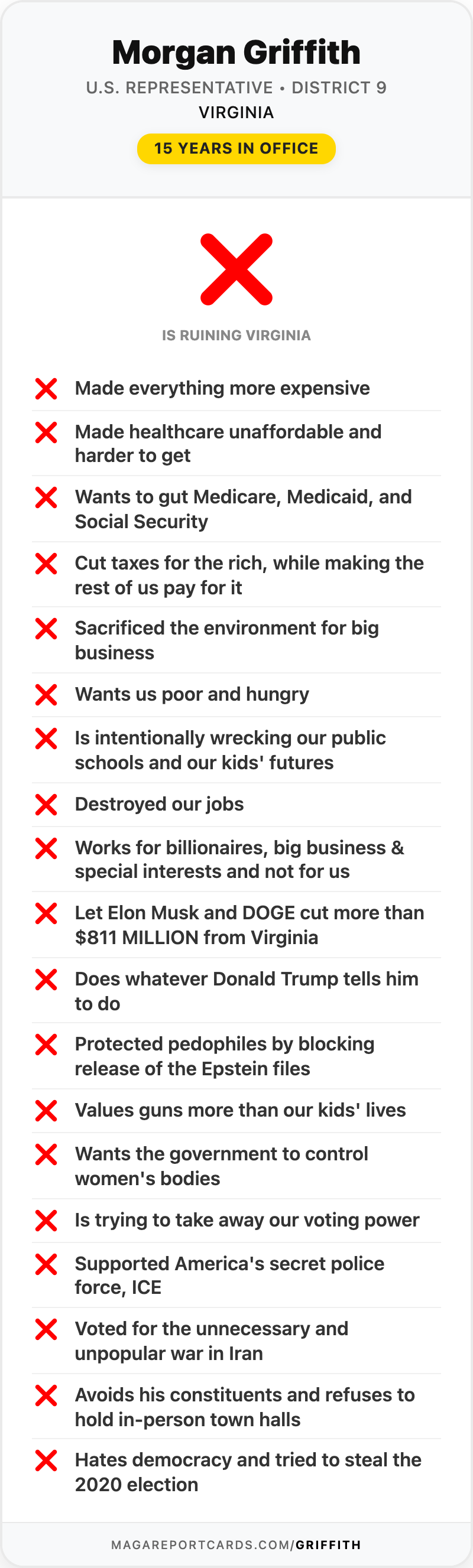
On July 16, 2026, Morgan Griffith introduced H.R. 9724, the End Birthright Citizenship for Territories Act.
The bill would strip automatic U.S. citizenship from children born on or after January 1, 2027 in Guam, Puerto Rico, the U.S. Virgin Islands and the Commonwealth of the Northern Mariana Islands, unless the child's parent is a U.S. citizen or a lawful permanent resident.
Six days later, The Guam Daily Post reported a detail the governor's office wanted people to notice. Of the 434 other voting members of the House and the six nonvoting delegates, the administration told the paper, not one had signed on as a cosponsor.
That was a day out of date when it ran, and it is the only thing in the story that was. The House record shows exactly one cosponsor — Ralph Norman of South Carolina, who added his name on July 21 — and he is still the only one.
One, out of 440. In a Republican conference that has spent two years competing to introduce the toughest immigration bill anyone can think of, Griffith wrote something that 439 of his colleagues looked at and walked away from.
We covered the bill's introduction alongside a similar effort from another Virginia Republican. What has happened since is that the Americans it would affect have been answering him — and he hasn't answered back.
Guam's leaders, across the aisle
Gov. Lou Leon Guerrero's administration told the Post it opposes H.R. 9724 and, in its own words, "We are actively working to have the bill withdrawn."
Asked what expectant parents on the island should know, the administration tried to calm people down: "Right now the security of their citizenship is the same. It remains legal. There is no change." It said it would "remain vigilant, proactive, and work collaboratively with fellow stakeholders to tamp this down" until Congress drops or defeats the bill.
That is a government having to reassure pregnant women that their babies will still be Americans.
Speaker Frank Blas Jr. is not a soft touch on immigration. He said plainly that he supports securing the border and prosecuting anyone who abuses birthright citizenship through illegal conduct. He still rejected Griffith's bill — because of the legal foundation it rests on.
"I wholeheartedly support the complete repeal of the Insular Cases."
The Insular Cases are the century-old Supreme Court rulings that let Congress treat the rights of people in the territories as optional. Griffith's argument for his bill depends on them: he contends that because citizenship in the territories comes from federal statute rather than the 14th Amendment, Congress can take it back.
Blas said he respects Griffith's aim of curbing immigration fraud but "cannot support reliance upon the Insular Cases as justification for legislation affecting Guam."
He also named the structural problem underneath the whole thing:
"That democratic deficit is unacceptable, and it is something to which I strenuously object."
Guam has no vote in Congress. Neither does Puerto Rico, the Virgin Islands or the Northern Marianas. A congressman from Salem, Virginia can propose ending the citizenship of their newborns, and there is no one in the room who can vote against him on their behalf.
Sen. William Parkinson introduced a resolution condemning the measure. Del. James Moylan, Guam's own nonvoting delegate in the U.S. House, announced his opposition after public pressure to take a stronger stand.
The invitation
The most striking response came from Vice Speaker Tony Ada, an Army veteran, who didn't issue a condemnation. He sent Griffith a formal invitation to come to Guam.
"This invitation is about ensuring Guam's people are seen, heard, and respected."
Ada offered to arrange meetings with health care providers, veterans, business leaders and residents — covering not only citizenship but Medicaid funding, energy resilience, disaster recovery and federal maritime policy. He tied the request to the island's 82nd Liberation Day, honoring the CHamoru people who lived through the Japanese occupation and the servicemembers who ended it, and to Guam's enlistment rate.
"Guam has consistently answered our nation's call to serve."
"The strongest federal policies affecting Guam are developed with Guam, not simply for Guam. Guam is not just a point on a map; we are an American community with a unique history, deep service to our country, and a rightful place in the national conversation."
Ada asked Griffith to consider a visit during Congress's August district work period. That period is happening right now.
He never asked them, and he isn't answering
Two sentences from the Post's reporting do more work than anything else in this story.
The first: "Neither Griffith's office nor his July 16 release has addressed whether he consulted territorial delegates before introducing the bill."
The second: "The Post sent Griffith a list of questions about the bill's origins and his response to territorial opposition. His office had not replied as of press time."
He wrote legislation to end the citizenship of American babies in four American places. He apparently did not talk to any of them first. When their newspaper asked him about it, he didn't respond.
That is exactly the "democratic deficit" Blas was describing, demonstrated rather than argued.
Even the advocates say the drafting is bad
Right to Democracy, which works on territorial rights, launched a survey and an FAQ in July to help residents figure out what the bill would actually do to them.
Co-director Neil Weare called the measure poorly crafted and said the uncertainty about its real effect makes public understanding all the more important. His co-director, Adi Martínez-Román, was blunter about why people are confused:
"This bill has caused much concern and confusion, as it is even written in a sloppy way."
The bill sits before the House Judiciary Committee with no hearing scheduled.
What this does for Virginia's 9th District
Nothing.
Griffith frames H.R. 9724 as a crackdown on "birth tourism." Set aside whether that's the right description of what the bill does. The people who will live with it are in Hagåtña and San Juan and Charlotte Amalie. The people who elected him are in Wise County and Bristol and Salem, where eight school-based health clinics closed last month and three rural hospitals are on a watchlist for closure.
He chairs the Energy and Commerce Subcommittee on Health. He is Co-Chair of the Coal Caucus. He has plenty of levers that touch his own district's actual problems.
Instead, he wrote a bill that exactly one other member of Congress will put his name on, aimed at Americans who have no vote, who have asked him to come talk to them, and who cannot get his office to answer the phone.
Source
Reported by Walter Ulloa for The Guam Daily Post: Guam leaders unite to oppose birthright citizenship measure (July 22, 2026). Photo: David Castro / The Guam Daily Post — U.S. and Guam flags at the 82nd Liberation Day observance, Asan Beach, War in the Pacific National Historical Park.