Bill titles are written by the sponsor. Nobody checks them. There is no truth-in-labeling rule in Congress, which is how you get a bill called the Enhancing Safety for Animals Act whose operative text removes a critically endangered animal from the endangered species list.
That is a real bill. Paul Gosar wrote it. And it is one of three.
Exhibit A: two "Protection Acts" that abolish protections
In September 2025, Gosar introduced two bills to wipe out two Arizona national monuments.
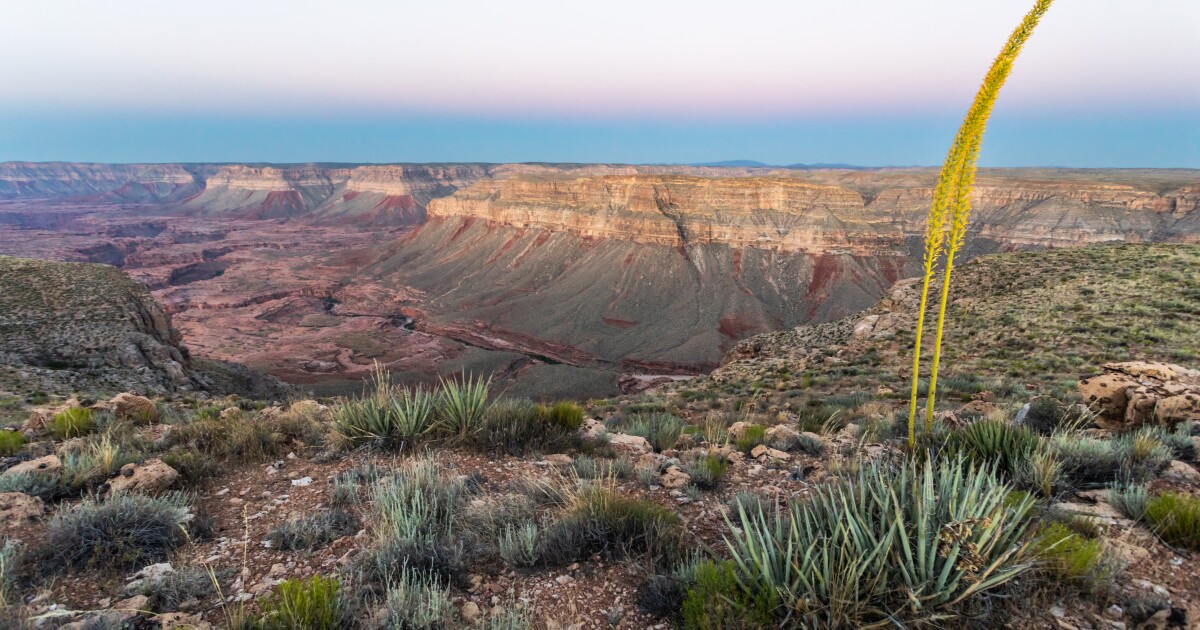
The first is the Northern Arizona Protection Act. It would nullify the Baaj Nwaavjo I'tah Kukveni – Ancestral Footprints of the Grand Canyon National Monument, roughly a million acres designated in 2023, on lands culturally significant to the Havasupai, Navajo and Hopi. The Sierra Club's Sandy Bahr, in a joint statement posted by the National Parks Conservation Association, notes that 14 Tribal nations had called for the protection.
The second is the Southern Arizona Protection Act. It would nullify Ironwood Forest National Monument — 189,600 acres northwest of Tucson, designated in 2000.
Neither bill protects anything. Both remove protection. The titles are the opposite of the text.
What the monuments actually block is specific. Baaj Nwaavjo I'tah Kukveni bars new uranium mining claims across the monument — existing operations like the Pinyon Plain Mine keep running. Ironwood Forest is being eyed for copper mining.
Gosar was clear about why. "The Antiquities Act was never intended to be a tool for radical environmentalists and their political cronies in Washington, D.C. to block access to America's abundant and much-needed resources," he said. In a statement quoted by KJZZ, he said federal lands "belong to the American people, not unelected bureaucrats or woke presidents who abuse executive authority to shut them off from productive use."
The Havasupai and Hopi, represented by the Native American Rights Fund, had sought to intervene in the Arizona Legislature's lawsuit over the monument.
Taylor McKinnon of the Center for Biological Diversity put it bluntly: "Gosar's bills mark a new low in his career of servicing industry's interests over the public's."
Exhibit B: the animal safety act that endangers an animal
H.R. 4255 is titled the Enhancing Safety for Animals Act of 2025.
You do not have to take anyone's characterization of it. Here is the bill's own description of itself, printed at the top of the first page:
"To remove the Mexican wolf from the lists of threatened species and endangered species published pursuant to the Endangered Species Act of 1973, and for other purposes."
Gosar introduced it on June 30, 2025. As introduced, Section 2(b) does the work: "Notwithstanding any other provision of law, the Mexican wolf (Canis lupus baileyi) is removed from the lists of threatened species and endangered species, as applicable, that are published pursuant to section 4 of the Endangered Species Act of 1973." Section 2(c) voids Fish and Wildlife Service rules outright — the 2015 rule listing the wolf as endangered and the 2022 rule governing its experimental population. The substitute the committee adopted voids a third.
It goes further than that. If the wolf is ever listed again, the bill forbids the Interior Secretary from even considering the wolf's status in Mexico when writing a recovery plan or deciding whether to change its status. Congress would be telling the biologists which facts they are allowed to look at.
How many Mexican gray wolves are there? The Arizona and New Mexico game and fish departments counted 319 in the wild in 2025, up from 286 the year before. The Fish and Wildlife Service's own recovery plan requires an average of at least 320 wolves over four years before downlisting is even on the table.
So: a population that has not yet reached the four-year average the recovery plan sets for even a partial downgrade, and Gosar's bill jumps straight to full removal — and does it by statute rather than through the agency. Earthjustice attorney Aaron Bloom said the bill shows "utter disregard for science, and the normal process that invites public engagement and allows for judicial review."
The bill's own findings section argues the wolf population "is thriving and will meet its recovery goals." Will. Future tense. The bill delists it now.
The House Natural Resources Committee advanced it on January 22, 2026. Sierra Club's Bradley Williams: "Mexican gray wolves are only here today because of the Endangered Species Act protections."
Delisting doesn't just remove a label. According to the Sierra Club, it would stop the captive releases that diversify the gene pool, end federal investigation of possible wolf kills of livestock, reduce the federal funding that compensates ranchers for those losses, shut down monitoring, and lift the federal ban on killing them.
Why the titles matter
There is a reason a member of Congress spends effort on a name.
The name is what goes in the press release, the constituent newsletter, the local news chyron. Most people will never read past it. A voter in Bullhead City who hears their congressman introduced the "Northern Arizona Protection Act" has been told something specific and false, using their own tax-funded communications office to tell it.
And Gosar is not a bystander to these bills. He sits on the House Natural Resources Committee, per the House Clerk's official member roster — the committee that marked up his wolf bill and would handle his monument bills. He writes the label and he sits on the panel that stamps it.
This is the same maneuver Utah's House Republicans defended when Trump stripped protection from nearly 3 million acres and they called it "a return to an appropriate application of the Antiquities Act as Congress intended." Take away the protection, then describe the taking as the protection.
What is actually at stake
Gosar has been in Congress since 2011. Fifteen years. In that time the record shows what he consistently spends that seniority on.
Nearly a million acres above the Grand Canyon that 14 Tribal nations asked to be protected as a national monument. A hundred and ninety thousand acres of Sonoran desert being targeted for possible copper mining. And 319 wolves — a subspecies down to seven animals when the captive breeding program was established, and one that has grown every year for a decade under the law Gosar wants Congress to switch off for it.
He calls all three of those bills protection and safety.
Read the text. The text does not lie; only the cover does.
Source
- Groups Denounce Gosar Bills to Nullify Baaj Nwaavjo I'tah Kukveni National and Ironwood Forest National Monuments — Earthjustice, September 2025
- Earthjustice Strongly Opposed to Rep. Gosar Legislation to Delist Mexican Gray Wolf — Earthjustice, January 21, 2026
- Photo: Amy S. Martin, via KNAU