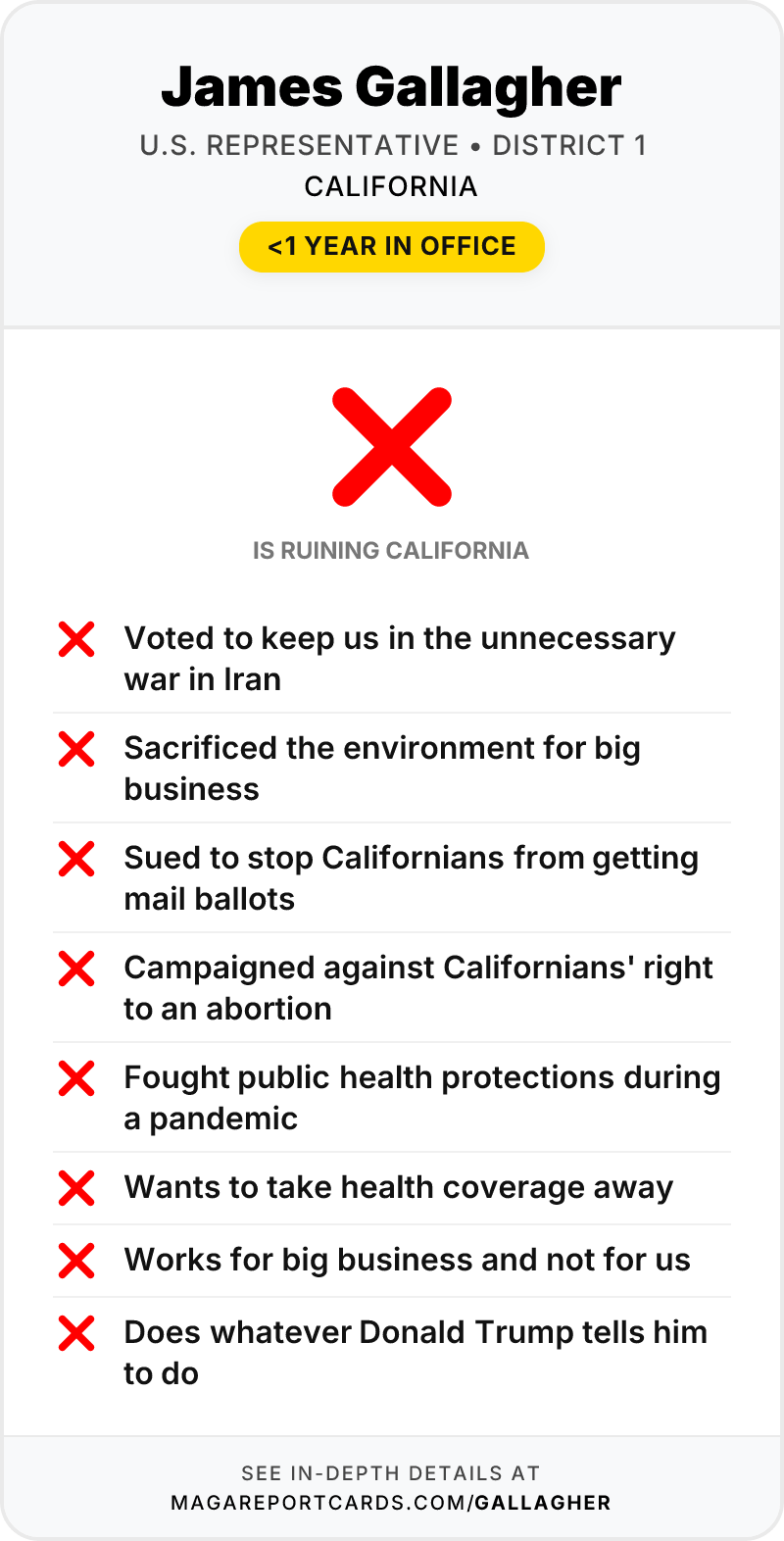
The congressional district James Gallagher now represents includes Paradise, California — the town destroyed by the 2018 Camp Fire, the deadliest wildfire in California history.
Gallagher spent eleven years in the California State Assembly representing that area, more than three of them as Republican Leader. In that time he compiled one of the worst environmental records in the state.
California Environmental Voters scored him at 0% for 2022 and 11% for his lifetime. On that same scorecard they flag him two ways: as a member of the "Polluter Caucus," and with the note that he "has accepted oil money."
Zero percent is not a bad year. Zero percent means that in a year the scorecard tracked more than a dozen environmental bills, he was not on the right side of any of them.
What the votes were
These weren't obscure procedural calls. The 2022 scorecard marks him against, among others:
- SB 1137 — the bill the scorecard titles "Ending Neighborhood Oil Drilling"
- AB 1931 — "Protecting Californians from Toxic Lead Pipes"
- AB 2201 — the "Community Drinking Water Protection Act"
- AB 2550 — "Restore Clean Air for the San Joaquin Valley"
- AB 2597 — "Healthy and Heat Resilient Homes"
- AB 1279 — "Committing to Carbon Neutrality"
Lead pipes. Drinking water. Clean air in the San Joaquin Valley. Heat protection in homes, in a part of California where summer heat kills people.
The oil-money note matters most on the SB 1137 vote. By California Environmental Voters' own account, Gallagher voted against ending oil drilling in neighborhoods — while taking money from the industry that does the drilling.
Who else is writing the checks
Gallagher's most recent donors, as logged by CalMatters' Digital Democracy project, include Waste Management and affiliated entities, Western United Dairies PAC, the California Water Association PAC, Tenet Healthcare, Eli Lilly, Biocom California PAC, FanDuel, and Live Nation.
That is a portfolio, not a constituency.
The part that's genuinely hard
There is a real case on the other side, and his constituents deserve to hear it stated fairly rather than caricatured.
Gallagher has done substantive work for wildfire survivors. He authored the law that made PG&E fire-victim settlement payments tax-free, and he introduced a bill declaring the Legislature's intent to make sure the Fire Victim Trust is fully funded. His complaint that victims were "not getting compensated in a timely fashion" is a legitimate grievance, and it is not the position of someone simply carrying water for utilities.
His district is also rural, poor in places, and pays some of the highest energy costs in the country. A representative from Butte and Glenn counties can honestly argue that climate rules written with Los Angeles and San Francisco in mind land hardest on people who have to drive sixty miles for groceries.
Both things are true at once. He fought PG&E for fire victims, and he voted against clean air for the San Joaquin Valley and against getting lead out of drinking pipes. An 11% lifetime score is not the record of someone making careful case-by-case judgments about which rules burden rural California. It's the record of someone voting no.
What it means now that he's in Congress
He isn't in Sacramento anymore, and the tools are bigger.
Last month Gallagher put an amendment on the House floor that would have opened a study into how federal authority can "preempt or otherwise mitigate" state fuel policies — a roadmap for Washington to override California's own rules. It failed 212-216.
That is the 11% lifetime score with a federal lever attached.
Meanwhile the thing his district actually faces has not gone away. Northern California burns every summer. Paradise is in his district. The Camp Fire is the reason a lot of his constituents live where they live now.
Californians deserve a representative who protects the air and water where they live. We deserve better.
Source
James Gallagher's California Environmental Voters scorecard — 0% for 2022, 11% lifetime, listed in the Polluter Caucus and noted as having accepted oil money. Donor records from CalMatters Digital Democracy. Camp Fire figures from FRONTLINE. Official portrait, 119th Congress.