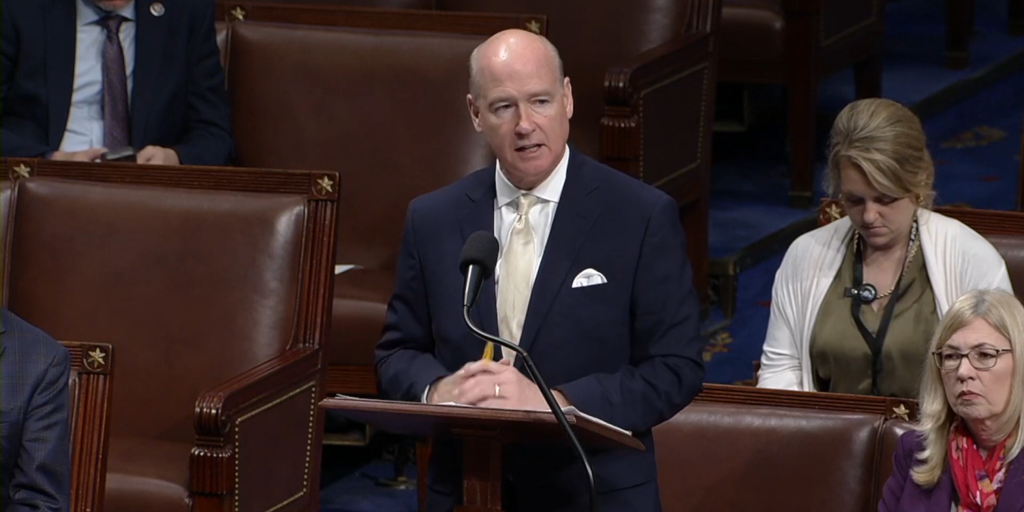
In February 2024, Russ Fulcher and Sen. Jim Risch led a brief to the U.S. Supreme Court in the case of Moyle v. United States. They rounded up 93 House members and 24 senators to sign it.
The question in front of the Court was narrow and enormous: when a pregnant woman arrives at an Idaho emergency room in a medical crisis, does federal law still require the hospital to stabilize her — even if the treatment she needs is an abortion, and Idaho law makes that a felony?
Here is how Fulcher described the case in his own press release:
"The case of Moyle v. United States and Idaho v. United States involves an elective, induced abortion which is against Idaho law."
That is not what the case was about. Elective abortion was never what the United States was asking for. The case was about women whose water broke months before viability, women bleeding, women going septic — and doctors who did not know how close to dead a patient had to be before they could act without going to prison.
We know exactly what happened while Fulcher's side was winning, because Idaho's largest hospital system counted.
Six people, three months
The federal law at issue is EMTALA — the Emergency Medical Treatment and Labor Act, signed by Ronald Reagan. It requires any hospital that takes Medicare money to stabilize anyone who shows up in an emergency, regardless of ability to pay. It was written to stop "patient dumping."
A federal judge had blocked Idaho from enforcing its abortion ban in EMTALA emergencies. On January 5, 2024, the Supreme Court put that block on hold while it took the case — so from January until late June, Idaho's ban applied in the ER.
Dr. Jim Souza, chief physician at St. Luke's Health System, described what that did to his doctors:
"Is she sick enough? Is she bleeding enough? Is she septic enough for me to do this abortion and not risk going to jail and losing my license? When the guessing game gets too uncomfortable, we transfer the patients out at a very high cost to another state where the doctors are allowed to practice medicine."
The numbers he gave in April 2024:
- All of 2023, with the injunction in place: one pregnant patient airlifted out of Idaho.
- Three months without it: six.
"If we annualize that, we can anticipate up to 20 patients needing out of state care this year alone," Souza said. And he was blunt about what it costs the patient: "Putting somebody in a whirlybird and flying them to another state creates an obvious delay in care that puts the patient's health and life at risk."
Six Idahoans in a medical emergency were put on aircraft and flown to another state because the doctors standing in front of them were afraid of a felony. That happened during the window Fulcher's brief was asking the Court to make permanent.
What the Court actually did
On June 27, 2024, the Supreme Court dismissed the case without ruling on it and put the block back in place, 6-3. Justice Ketanji Brown Jackson, who would have decided the case rather than dismiss it, called the result delay rather than a victory.
So Fulcher lost — but only for a while, and only on the merits nobody reached.
After the 2024 election, Trump's Justice Department moved to dismiss the government's case entirely, on March 5, 2025. That dissolved the injunction protecting Idaho doctors. St. Luke's had seen it coming and filed its own suit against Idaho Attorney General Raúl Labrador.
On March 20, 2025, U.S. District Judge B. Lynn Winmill issued a new order shielding St. Luke's doctors from prosecution. He cited the six airlifts as proof of the harm. And he wrote this:
"When EMTALA passed, these 'undesirable' patients were the indigent. Today, they are pregnant women."
On the state's argument that doctors just have to use good-faith judgment about whether a patient will die, Winmill was withering:
"The Defense of Life Act plainly requires that an abortion is 'necessary to prevent the death.' If 'imminent' is not the standard, how close must the woman be to death for the abortion to be 'necessary'? There is no way for physicians to know this, and the price of falling on the wrong side of the line is a felony conviction."
Read the order's limits carefully. It protects St. Luke's and its providers only, because St. Luke's is the only plaintiff. St. Luke's runs 8 of the 39 Idaho hospitals that take Medicare. If you are pregnant in Idaho and your emergency happens at one of the other 31, you are relying on a doctor with no court order behind them.
That's the Idaho Fulcher fought for.
Idaho's law has no health exception
Idaho's ban applies at every stage of pregnancy. It has an exception to prevent the patient's death. It does not have one to protect her health.
A physician who gets it wrong faces two to five years in prison, loss of their medical license, and civil penalties. The Idaho Legislature has repeatedly declined to add a health exception despite doctors asking for one. St. Luke's says the laws have already driven physicians to practice in other states.
The most common scenario doctors describe is a patient whose water breaks before the fetus can survive. Left alone, it can turn into an infection that damages the kidneys and reproductive organs and can end her ability to have children at all.
None of that is elective.
This is a pattern, not a one-off
Fulcher's abortion record is not a matter of interpretation. He has:
- Cosponsored the Life at Conception Act, which would extend constitutional personhood from "the moment of fertilization" — with no carve-out for embryos created through IVF.
- Called the fall of Roe "a momentous victory for life," adding: "I am proud that Idaho has already enacted legislation that prohibits abortion upon the repeal of Roe."
- Cosponsored a bill making states' federal family-planning money conditional on reporting abortion data to the CDC.
He is also hard to ask about it. Fulcher takes constituent questions by telephone, on calls where the questions are screened.
Republicans who've lived this from the patient's side describe it exactly the way Souza's doctors did. Florida Rep. Kat Cammack says her own ectopic-pregnancy care was delayed because the ER feared prison — and she still wrote a bill to put doctors in prison. The fear is not a misunderstanding of these laws. It is what these laws do.
The bottom line
Russ Fulcher did not just vote for something. He organized it. He put his name at the top of a brief, gathered 117 members of Congress behind it, and asked the Supreme Court to rule that an Idaho hospital may send a woman in a medical emergency away untreated.
For nearly six months in 2024 he effectively got his wish, and Idaho's biggest hospital system responded by putting patients on aircraft.
He described that case to Idahoans as being about "elective, induced abortion." Six people in helicopters say otherwise.
Sources
- U.S. Congressman Russ Fulcher and Senator Jim Risch Lead Bicameral Amicus Supporting Idaho's Pro-Life SCOTUS Case — Fulcher's own office, February 27, 2024
- As emergency airlifts for pregnant patients increases in Idaho, U.S. Supreme Court abortion case starts — Boise State Public Radio, April 24, 2024. Photo: Getty Images via NPR.
- New court order shields certain Idaho doctors from prosecution for emergency abortion care — Idaho Capital Sun, March 21, 2025