An ectopic pregnancy is when a fertilized egg implants somewhere it cannot survive — most often in a fallopian tube instead of the uterus. It is almost never viable. Left alone, it grows until the tube ruptures, and the woman bleeds internally. Treated in time, it is routine. One shot of medication, or a short surgery, and the patient goes home.
Doctors have a phrase for a death from this. "A death related to ectopic pregnancy should really be a never event," Dr. Alice Abernathy, an OB-GYN, told ProPublica.
It is no longer a never event. On September 9, 2026, ProPublica published an analysis of death records showing that almost 200 women died after an ectopic pregnancy from 2020 to 2025 — about twice the roughly 100 who died in the previous six years.
Where the women are dying
The deaths are not spread evenly across the country. ProPublica separated the states that ban abortion at six weeks of pregnancy or earlier from the states that never enacted a ban at all, and compared the death rates for 2023 through 2025. Six states whose bans came later, were struck down quickly or never took effect are in neither group.
| Ectopic pregnancy deaths per million live births | |
|---|---|
| States with a strict abortion ban | 13.1 |
| States without a ban | 7.1 |
The eighteen states in the first group are Alabama, Arkansas, Florida, Georgia, Idaho, Indiana, Iowa, Kentucky, Louisiana, Mississippi, Missouri, North Dakota, Oklahoma, South Carolina, South Dakota, Tennessee, Texas and West Virginia.
In those states the death rate is close to twice what it is in a state that did not pass a ban.
Texas: 310 more patients who hemorrhaged
Deaths are the end of the line. Before a woman dies after an ectopic pregnancy, she hemorrhages.
ProPublica looked at Texas hospital records and found that 310 more patients suffered substantial blood loss after an ectopic pregnancy in 2023 and 2024 than in 2018 and 2019 — an increase of about 29%.
Those cases will never appear in a death count. They are the near misses, and there are far more of them than there are deaths.
Why a ban would touch this at all
Many of these states' bans say in terms that they do not apply to ectopic pregnancy. Treating one is not an abortion under those laws.
That is not the mechanism. The mechanism is what happens in an emergency room at 2 a.m. when the ultrasound is ambiguous and the doctor is doing arithmetic about a felony.
"Seeing a mass is not the only reason to have high suspicion for an ectopic pregnancy," emergency physician Dr. Rebecca Nerenberg told ProPublica. Early on, an ectopic pregnancy often does not show up clearly on a scan. Experts told ProPublica that doctors should be able to treat when other symptoms are present — plateauing pregnancy hormone levels, bleeding, abdominal pain — because the downside of waiting is a ruptured tube and catastrophic bleeding. Under a criminal ban, waiting for certainty starts to look like the safer choice — for the doctor.
Texas passed the Life of the Mother Act in 2025 to clear this up. The state medical board's guidance still turns on what the ultrasound shows, which is the exact situation where the scan shows nothing yet.
We have a Republican member of Congress who lived this
The mechanism is not a theory. It happened to a sitting Republican congresswoman, and she has described it herself.
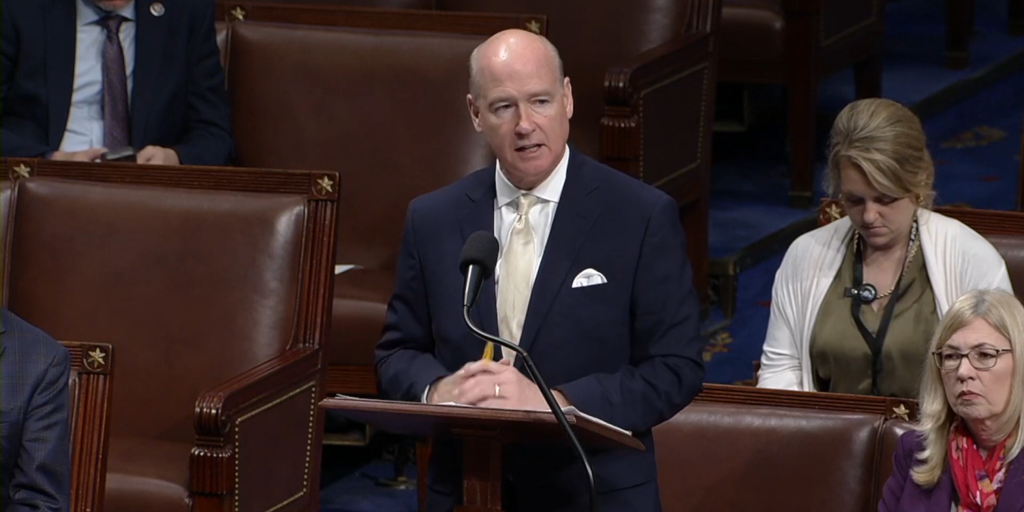
In May 2024, Kat Cammack was five weeks pregnant in a Florida emergency room when doctors found the pregnancy was ectopic and her life was at risk. They knew what she needed. By her own account they hesitated because they "were worried about losing their licenses or going to jail." She looked up the Florida statute on her phone and called the governor's office. Hours later she got the drug.
Cammack was a member of Congress with the governor's number. She still waited. Florida is one of the eighteen states in the top row of that table.
Her conclusion was that the law was fine and the doctors were misinformed. ProPublica has now counted what happens to women who do not have the governor's number.
The people who wrote these laws are still going
The eighteen bans are state laws, but the Republicans who run for federal office keep promising to take them national.
Todd Blanche told a private prayer call he would work to make the Dobbs decision "permanent in every single state" before being confirmed as Attorney General. Cammack's own Dismemberment Abortion Ban Act would make a standard second-trimester procedure a federal crime punishable by two years in prison, with no exception for rape, incest or the patient's health. Tom Tiffany backed a national ban and then deleted it from his website when he started running for governor.
None of them are proposing to ban treatment for ectopic pregnancy. That was never the danger. The danger is the criminal penalty sitting next to the doctor's decision, and every one of these proposals adds more of it.
What the record shows
Almost 200 women died after an ectopic pregnancy in the United States from 2020 to 2025, roughly double the number in the previous six years. In the eighteen states that ban abortion at six weeks or earlier, the death rate for 2023 through 2025 was 13.1 per million live births, against 7.1 in states without a ban. In Texas alone, 310 more patients suffered substantial blood loss after an ectopic pregnancy in 2023 and 2024 than in 2018 and 2019. These bans make exceptions for treating an ectopic pregnancy. They did not have to ban it — attaching a prison sentence to the decision was enough.
Source
"Ectopic Pregnancy Deaths Have Nearly Doubled. It's Worse in States With Abortion Bans," ProPublica, September 9, 2026. Chart: ProPublica.