The House Transportation and Infrastructure Committee spent fifteen hours marking up the big five-year highway bill. Sometime in the small hours of May 22, 2026, with the room mostly empty and the cameras mostly off, Vince Fong offered his amendment.
It was adopted 35 to 30. When the sun came up, the biggest rideshare companies in America had something they had been paying lobbyists for years to get: a rule saying they cannot be sued when their drivers hurt someone.
Consumer Watchdog, the Los Angeles group that has tracked Uber's liability fights for years, headlined its response with the time on the clock: "House Committee Votes at 2 AM to Give Uber Immunity."
What the amendment actually says
The bill is H.R. 8870, the BUILD America 250 Act — a $580 billion, five-year reauthorization of federal highway, transit, rail and safety programs. It is the kind of bill that has to pass. That is exactly what makes it a good place to put something that couldn't pass on its own.
Thirty-four members of California's congressional delegation later wrote to House leadership asking them to strip Fong's language out. Lofgren's office, announcing the letter, quoted the provision directly. A rideshare company, it says,
"shall not be liable under the law of any State or political subdivision thereof [...] for any harm to persons or property that results or arises out of the use, operation, or possession of a motor vehicle by an app-based driver."
The words "any harm" are doing an enormous amount of work there.
The members spelled out what it means in practice: the company would have immunity "no matter the red flags from any criminal background check, motor vehicle background check, customer complaint, safety test, or internal complaint."
So a company could run the background check the law requires, see a red flag in it, put the driver on the road anyway, and be immune when that driver kills someone. As the letter puts it: "Though a rideshare company would still have to follow local laws regarding background checks, it would be immune from liability if it chose to ignore red flags in the background check."
That is not a technical fix. That deletes the reason a company screens its drivers at all.
Mechanically, the change reclassifies Uber and Lyft as operators of a "digital network" rather than common carriers — the legal category bus companies fall into, which is what makes them answerable for their drivers' conduct. It also overrides any state law that says otherwise. After that, a passenger would have to prove the company itself was criminal or "grossly negligent," a far higher bar than the one that exists now.
The case that shows what this means
Consumer Watchdog pointed to a Santa Barbara crash it documented in a report called "A License To Kill".
An Uber driver who was on probation for his second DUI conviction went on a drunken rampage and killed two people — Gilberto Arteaga-Gutierrez and Silvia Velasco. He was allegedly driving as fast as 120 mph in a 40 mph zone with a blood alcohol level more than twice the legal limit. Used nitrous containers were found in his car, according to a civil suit. He was sentenced to 15 years to life.
Uber had run a background check and hired him anyway. The company is still fighting its liability in that case.
Under Fong's language, it wouldn't have to fight. It would simply be immune.
"Representative Fong should be ashamed of himself for putting Uber riders in his district in jeopardy," said Jamie Court, Consumer Watchdog's president, "because a limited liability system will allow Uber to continue to do inadequate background checks so it can have more drivers on the road."
Who this is for
The numbers explain why Uber wanted this so badly.
According to the California delegation's letter, Uber faces more than 3,000 sexual assault claims in federal court nationwide over allegedly failing to put adequate safety protections, driver screening, or rider safeguards in place. In California alone, the company faces roughly 550 cases over its alleged failure to protect female drivers from sexual assault, stalking, kidnapping or false imprisonment.
Between 2017 and 2022, Streetsblog reports, Uber received a report of sexual assault or misconduct once every eight minutes.
Fong's amendment does not make any of that safer. It makes it uncollectable.
Nearly 1,900 survivors of assault or abuse by Uber drivers signed a letter to Speaker Mike Johnson and Minority Leader Hakeem Jeffries asking them to pull the language:
"No court case can take away the pain and trauma we have endured — that will stay with us forever. But we are worthy of the right to try and hold these rideshare platforms legally accountable for failing to protect us when they told us to trust them to get home safely."
On June 10, 128 members of the Democratic Women's Caucus sent their own letter, warning the amendment would "disproportionately harm women and girls."
Fong did not respond to Streetsblog's request for comment.
The lobbying, and then the check
This did not come out of nowhere. Uber spent almost $1 million lobbying Congress on the surface transportation bill, and Lyft spent about $250,000. Uber's political action committee also put $14,500 into the re-election campaigns of seven members of the House transportation committee.
Then there is Fong's own campaign account.
Search the Federal Election Commission's records for contributions from the Uber Technologies, Inc. Separate Segregated Fund to Vince Fong for Congress and you get exactly one result. It is dated May 29, 2026 — $1,000, reported on his second-quarter filing.
Fong's amendment cleared committee on May 22. Uber's PAC's first check to him ever landed seven days later.
A thousand dollars is not much money, and we are not going to pretend it bought anything. That is rather the point. The lobbying is where the real money went. The check is the receipt — the moment a company that had never given this congressman a dollar decided he was worth being on file with, one week after he did them the biggest favor of the session.
He is proud of it
Fong is not hiding this. The day the bill cleared committee, his own office listed it as a win, under the heading "Rep. Fong's amendment limiting vicarious liability for ride-share companies."
His justification, in his office's words:
"Roughly one-third of a ride-share fare in California, and nearly one-half in Los Angeles, goes toward government-mandated insurance costs. This amendment helps reduce transportation costs by curbing limitless, frivolous litigation against ride-share companies."
Notice the frame. Lawsuits brought by people who were injured or assaulted become "frivolous litigation." The insurance that pays those people becomes a "cost." And the fix is not cheaper insurance — it is making sure there is nothing left to insure against.
Uber says the same thing in the same words. Its spokesperson told Streetsblog the change is needed because rideshare companies "are too often sued simply because of their high insurance coverage."
Joanne Doroshow, who runs the Center for Justice & Democracy at New York Law School, had the short answer to that: "Of course they're at fault. It's their platform. They are the ones connecting drivers to passengers."
If Fong's real concern were the price of a ride in Bakersfield, there are a dozen ways to go at that. He picked the one that ends with survivors having no case.
We have seen this move before
Earlier today we wrote about how Roger Williams slipped an exemption for car dealers into a rental-car safety law — a law that existed because two sisters died in a rented car under an active safety recall. He offered the amendment on the House floor before midnight, on a voice vote, telling his colleagues in the same breath, "I am a second-generation auto dealer." It got him an ethics investigation and was stripped out of the final law.
The template is the same: a big bipartisan bill nobody wants to blow up, a late-night vote, a short amendment that reads like plumbing, and an industry that walks away immune. The only thing that changes is which industry.
What this costs the Central Valley
Fong represents Bakersfield and a long stretch of the southern Central Valley — a district where a lot of people drive for a living and a lot of people have no other way to get to a shift, a clinic, or the airport.
Those are the people on both ends of this. The drivers who get assaulted on the job. The riders who get hurt. Under his amendment, both lose the same thing: any way to make the company that put them in the same car pay for what it knew and ignored.
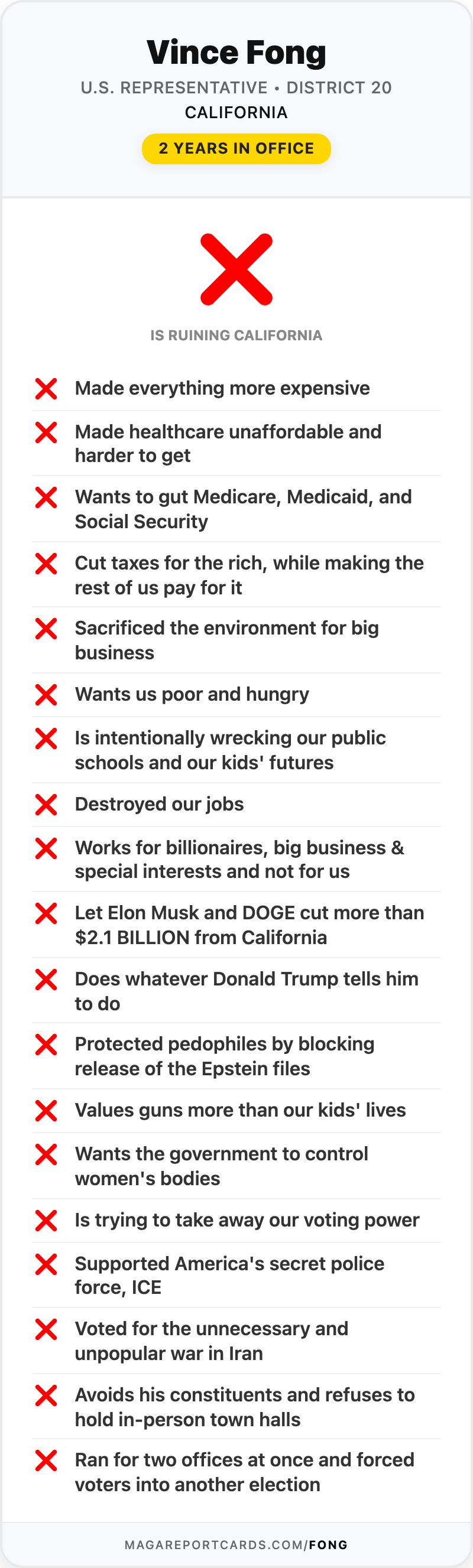
It fits how he has handled the rest of the job. He voted for the federal law that cut Medicaid in California, then went on television to blame Sacramento for the premium increases that followed. As of March 2025, local news reported he had not held a town hall for his constituents — which is the sort of place someone might have gotten to ask him about any of it.
H.R. 8870 is now waiting on the House Rules Committee with the provision still in it. Thirty-four California members — Fong's own delegation — have asked the Speaker to take it out.
Fong is the reason it is there.
Source
"Uber and Lyft Want Congress to Let Them Off the Hook," Aaron Short, Streetsblog USA, June 24, 2026. Photo: Adam Fagen, via Streetsblog USA.