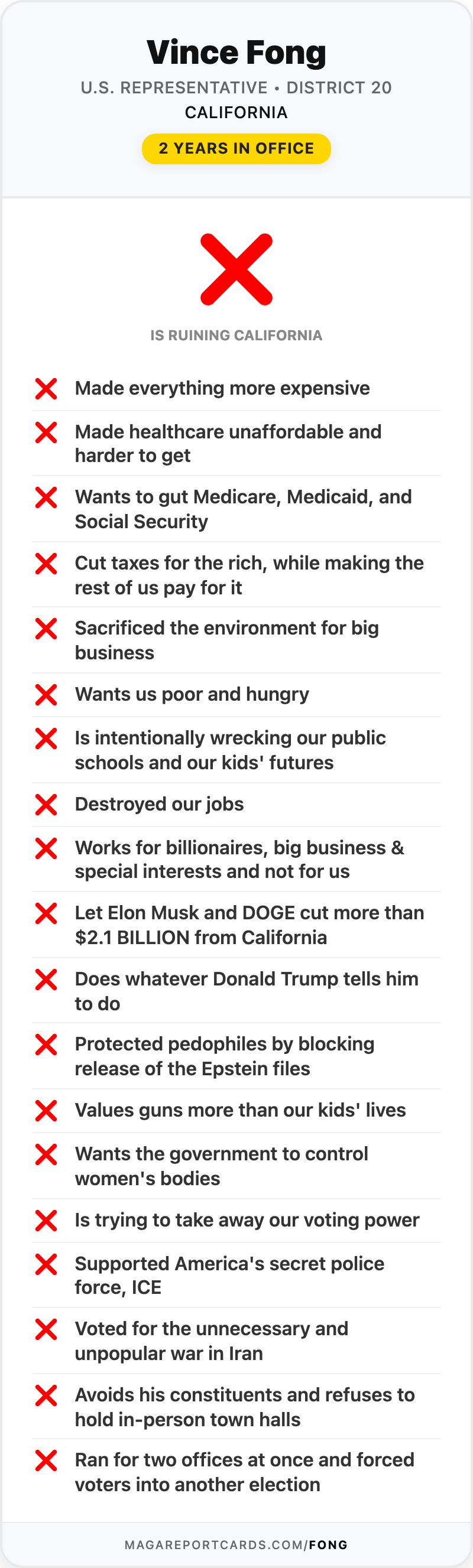
Bakersfield Congressman Vince Fong is asking the Trump administration to block California's new tax on health plans. He told KCRA on August 2 that it's a shell game:
"Gavin Newsom is going to try to bail out or cover up his budget deficit by taking health care funds that were supposed to be dedicated to Medicaid in California. That's why he should be rejected."
And he made the case in cost-of-living terms: "While it sounds wonky and arcane, it affects everybody." Health plans are expected to pass the cost to customers — about $100 a year per person, or $400 for a family of four, according to the industry's own trade group.
That number is real. Here's the part Fong left out of the interview.
The rule that forces private plans to pay is in the bill he voted for
California has taxed health plans for years to help fund Medi-Cal. It's called the Managed Care Organization tax, and it's a standard tool — the state collects money from health plans, uses it to draw down federal Medicaid matching dollars, and puts the combined total into Medi-Cal. Red states and blue states both do this. In December 2024, the federal government approved California's version, securing an estimated $7.2 billion for Medi-Cal.
The old California tax charged Medi-Cal plans at much higher rates than commercial plans. That's why your private premium wasn't affected.
Then Congress passed H.R. 1 — Trump's budget bill. As CalMatters reported, that law imposed new restrictions on state provider taxes, prohibiting states from taxing Medicaid plans at a higher rate than commercial plans.
So California rewrote the tax. Senate Bill 125 now charges every health plan the same flat rate: $8.85 per enrollee per month, whether that enrollee is on Medi-Cal or on a private plan through work.
That is precisely why private premiums go up. Not because Newsom decided to hit commercial insurance. Because a federal law said California isn't allowed to do it the old way anymore.
Vince Fong voted for that federal law. On July 3, 2025, on the motion to concur in the Senate amendment to H.R. 1, the House Clerk's roll call records his vote as Aye.
He voted for the rule. The rule produced the premium increase. He is now on television warning Californians about the premium increase.
What the money actually pays for
Fong describes the tax as Newsom "taking health care funds that were supposed to be dedicated to Medicaid."
Look at where the money goes. The redesigned tax raises roughly $2.3 billion a year. About $2 billion goes to existing Medi-Cal services. Roughly $300 million funds rate increases for the doctors who provide primary care, maternal care, and mental health care to Medi-Cal patients.
That is not a diversion away from Medicaid. That is Medicaid.
Consumer advocates have raised a fair concern — that money like this can end up backfilling the state's general budget instead of improving care — and that's a legitimate thing to watch. But it isn't Fong's argument. His argument is that the money is being pulled out of health care, and the budget documents say the opposite.
Why California needs the money in the first place
Here's the context that makes this more than a technical dispute.
That same bill Fong voted for — H.R. 1 — cut Medicaid. In California, CalMatters projects that 3.4 million Californians will lose Medi-Cal coverage, and that the state will lose $28 billion in federal Medicaid funding over the coming decade.
So the sequence looks like this:
- Fong votes for a bill that takes $28 billion in Medicaid money out of California and pushes 3.4 million people off coverage.
- The same bill bans the financing structure California had been using to fund Medi-Cal.
- California redesigns the tax to comply — which raises private premiums, exactly as the new federal rule requires.
- Fong goes on TV to say the premium increase is Newsom's fault and asks Washington to kill the replacement too.
If Washington grants his request, California doesn't get the $400 back. California gets a bigger hole in Medi-Cal — roughly $2.3 billion a year — on top of the $28 billion already gone.
Who lives in California's 20th District
Fong represents Bakersfield and a large stretch of the southern Central Valley — farmworker communities, oil-field towns, and rural counties.
When Medi-Cal money dries up, it doesn't only hit people on Medi-Cal. It hits the hospitals and clinics that serve them, which close service lines or shut down entirely. Everyone in the county then drives farther for an emergency room, whatever insurance they carry. Statewide, 3.4 million people losing Medi-Cal is 3.4 million people whose care still has to be paid for somehow.
A representative from that district has every reason to fight for more Medi-Cal money, not less. Fong voted to take $28 billion out, and is now lobbying the administration to block the state's attempt to replace $2.3 billion of it.
The honest version of his complaint
There is a real argument buried in here, and Fong could have made it: that the new tax structure is a bad deal for commercially insured families, and that the fix is to change the federal rule that caused it.
He isn't asking for that. He isn't asking to repeal the provider-tax restriction he voted for. He's asking Robert F. Kennedy Jr.'s HHS to deny California's waiver, which would kill the funding without undoing the rule.
That's not consumer protection. It's blaming the state for the consequences of his own vote — and then trying to make them worse. We deserve better.
Source
"Why Congressman Vince Fong is urging the Trump administration to reject a health tax in California," KCRA, August 2, 2026, with reporting on the tax's structure from CalMatters and the roll call from the Office of the Clerk, U.S. House of Representatives.