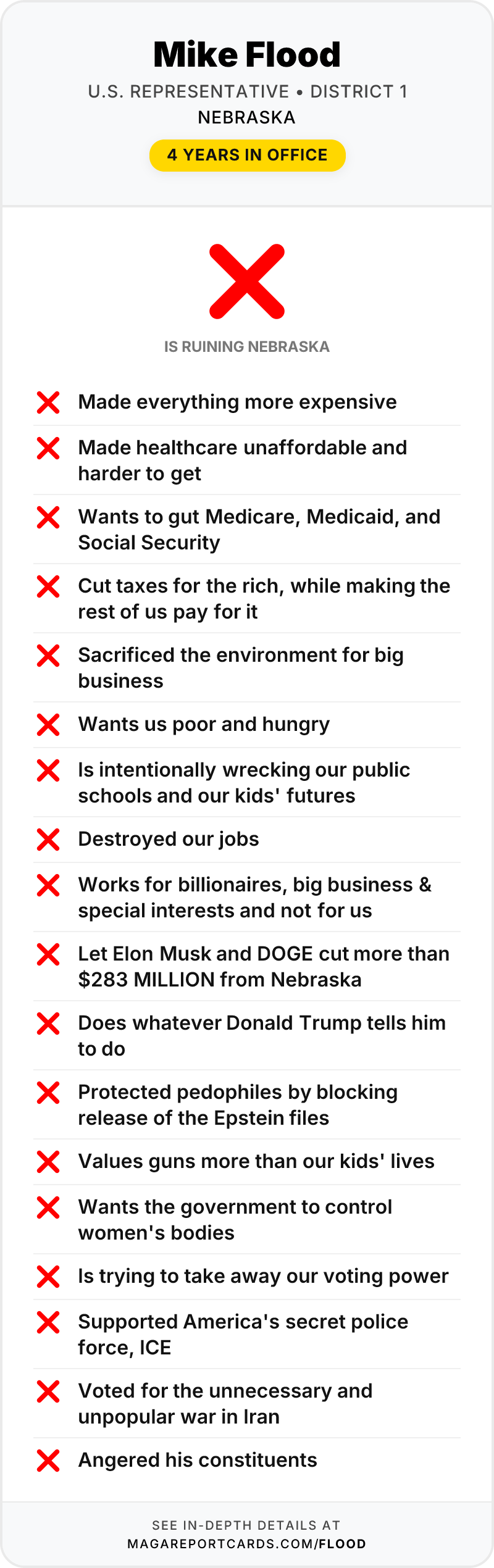
Most members of Congress have a donor problem. Mike Flood has something rarer: he owns the media.
Flood started a radio station in Norfolk, Nebraska during his second year of law school. By the time the Nebraska Examiner checked in in April 2023 — nine months after he was sworn into the U.S. House — Flood Communications had grown to 18 radio stations and seven low-power TV stations across Nebraska, operating together as News Channel Nebraska, plus Telemundo Nebraska and the Spanish-language station Radio Lobo.
That Examiner story was about the company buying two more stations, from its longtime owners, one of them a retiring conservative radio commentator, while its founder sat in Congress.
The count has grown since. The FCC's own licensing database today lists twelve FM and seven AM radio stations plus seven low-power TV stations — 26 in all, and seven FM translators on top of that — every one of them licensed to a company that appears on Flood's financial disclosure. None of the licenses is outside Nebraska.
He still owns it, and it still pays him
This isn't a past life he left behind. It's on his own paperwork.
Flood's annual financial disclosure for 2024, filed with the Clerk of the House on August 11, 2025, lists nine companies — eight of them described on the form as radio station broadcasting, one as employment services:
| Company | Value | 2024 income to Flood |
|---|---|---|
| Flood Communications of Omaha, L.L.C. | $1,000,001–$5,000,000 | $50,001–$100,000 |
| Flood Communications West, L.L.C. | $1,000,001–$5,000,000 | $100,001–$1,000,000 |
| Flood Communications, L.L.C. | $500,001–$1,000,000 | $15,001–$50,000 |
| Red Beacon Communications, L.L.C. | $250,001–$500,000 | $15,001–$50,000 |
| Flood Communications of Beatrice, L.L.C. | $250,001–$500,000 | — |
| Flood Broadcasting, Inc. | $100,001–$250,000 | — |
| Flood Digital Networks LLC | $50,001–$100,000 | — |
| Flood Multimedia of Columbus, L.L.C. | $50,001–$100,000 | — |
| Flood Communications Tri-Cities, L.L.C. | — | — |
Add up the ranges and the media holdings are worth somewhere between $3.2 million and $12.4 million, and they paid him between $180,000 and $1.2 million in partnership income in a single year.
And he isn't a passive shareholder. In Section E of the same filing — the section for positions held — he lists himself as a Member of each of these companies, ten entries in all.
Then he co-chairs the caucus for his own industry
In the 119th Congress, Flood is a co-chair of the Congressional Broadcasters Caucus. Its stated purpose is to educate Congress about the challenges broadcasters face and highlight the importance of local radio and TV stations.
He is a broadcaster. His companies hold the licenses for 26 Nebraska stations. He is advocating for himself, in a room he helps run, and it's listed on his official House website four lines below the 4-H Caucus.
Then it stopped being abstract.
On March 27, 2026, Flood and his fellow caucus co-chairs led a letter to the Federal Communications Commission — signed by 87 more members of Congress — pressing FCC Chairman Brendan Carr and his fellow commissioners to set "a firm timeline" for the national transition to NextGen TV.
The FCC is the agency that issues and renews the licenses for Flood's seven television stations.
The letter's argument is a broadcast-industry argument, made in broadcast-industry terms:
"Broadcasters and device manufacturers alike need regulatory certainty to make long-term investments and fully realize the potential of this technology... broadcasters cannot spark that demand until they regain access to their full channel capacity."
Whether the FCC is right or wrong about NextGen TV isn't the point. The point is who was asking. A sitting congressman who co-owns television stations wrote to the regulator of television stations to ask for a rule change that television station owners want.
Why the media part matters more than the money part
The dollar figures are the smaller half of this.
News Channel Nebraska describes itself as "the only in-state, independent television network of its kind" and "one of the largest news operations in Nebraska." Its Spanish-language sister operation is billed as the state's only local Spanish-language network TV station.
So in much of Nebraska — especially the rural counties where the local paper has thinned out or closed — a large share of the local news reaching people is produced by a company their congressman founded, still owns a piece of, and still draws six or seven figures from.
That's the actual problem. Not that Flood personally spikes stories — there's no evidence of that. It's that the arrangement makes the question unanswerable from the outside. A voter in Norfolk or Beatrice or Columbus who wants to know whether their news is being shaped by the person they're voting on has no way to check. They just have to take his word for it.
Local news is how people find out what their representative did. Owning it is not the same as any other business.
It's legal. That's the point.
Nothing here is hidden. It's on his House disclosure, on his committee page, on a press release. When the four co-chairs launched the caucus on March 20, 2025, Flood said this:
"As someone who grew up in the broadcasting world before coming to Congress, I know firsthand how critical this kind of advocacy is for broadcasters."
He's right that he knows firsthand. That's the conflict, stated out loud. Note the tense, though: that release describes his broadcasting career entirely in the past, as something that happened "prior to their elections to Congress." The financial disclosure he filed five months later says he's still a member of every one of those companies — ten entries in Section E, because one of them is listed twice — and still collecting partnership income from four of them.
The National Association of Broadcasters, the industry's lobby in Washington, put out a statement in the same release thanking the four of them for relaunching the caucus.
We keep finding the same machine in different industries. Diana Harshbarger vice-chairs the health subcommittee that oversees the FDA, takes money from compounding-pharmacy lobbies, and asked the FDA to loosen the rules on peptides — the products her family's business sells. Flood's version is cleaner and more direct: he skipped the donors and owns the industry himself.
To his credit, Flood does something most of his colleagues won't — he holds real, in-person town halls, and Nebraskans have used them to confront him about everything from SNAP cuts to a court-stripping provision he admitted he hadn't read before voting for it.
Someone should use the next one to ask him about the FCC letter.
Sources
- Media company founded by U.S. Rep. Flood adds two stations, plans Sandhills news bureau — Paul Hammel, Nebraska Examiner, April 16, 2023.
- Rep. Mike Flood, Financial Disclosure Report for calendar year 2024 — Clerk of the U.S. House of Representatives, filed August 11, 2025.
- FCC station lists for Nebraska — FM, AM and TV query results, retrieved September 10, 2026. Search each for "FLOOD" and "RED BEACON."
- Alford, Broadcasters Caucus Co-Chairs Lead 91 Lawmakers in Urging FCC to Set Firm Timeline for National Transition to NextGen TV — Office of Rep. Mark Alford, March 27, 2026.