Most members of Congress who vote to hand a federal agency an unconditional check can at least claim they didn't know what conditions to ask for.
Brian Fitzpatrick can't. He wrote them down himself, two months earlier, in his own bill.
April 2: the bill
Fitzpatrick spent 15 years as an FBI special agent before Congress. He teamed up with Democrat Tom Suozzi of New York, who had overseen the country's 11th largest police department as Nassau County executive, and on April 2, 2026, the two of them introduced the Reforming ICE and Protecting America Act.
Its premise was simple: fully fund the Department of Homeland Security, and in exchange hold ICE to the same rules as every other law enforcement agency in the country.
Here is what the two former law-enforcement officials said ICE needed:
- Body cameras, visible identification, standardized uniforms and training — and a limit on masks.
- Independent investigations of officer-involved shootings.
- Probable-cause and warrant requirements in key enforcement contexts, including protection against the knowing detention of U.S. citizens without probable cause.
- Guardrails at sensitive locations — limits on civil immigration enforcement at schools, health care facilities, places of worship, polling places on election day, childcare facilities, and private homes, absent a warrant and outside exigent circumstances.
- Enforcement focused on violent offenders and the most serious threats to public safety.
Fitzpatrick's own words announcing it:
"This debate began with a legitimate call for real ICE reform, yet after weeks of political deadlock, no serious solution emerged. The right course was clear from the start: keep the Department of Homeland Security fully funded and confront the problem before us with real reform. That is precisely what this bill does. It is time to do what should have been done from the beginning: govern, reform, and protect."
Nobody made him write that. It is his analysis, from his own experience as a federal agent, of what a law enforcement agency operating without cameras, without identification and without independent review looks like.
June 9: the vote
Sixty-eight days later, the House took up S. 2, the Secure America Act — the funding bill with none of that in it.
The clerk's record of Roll Call 214 shows what happened at 5:23 PM on June 9, 2026:
| Aye | No | |
|---|---|---|
| Republicans | 214 | 0 |
| Democrats | 0 | 211 |
| Independent | 0 | 1 |
| Total | 214 | 212 |
It passed by two votes. Not one Republican voted no.
Which means every single Republican yes vote was decisive — and Fitzpatrick, the author of the reform bill, was one of them. Had he voted no, the tally would have been 213–213. A tie fails.
For the second time in just over a year, the bill would have failed without his vote. The first was Trump's budget bill, which passed the House 215–214 with his yes in May 2025 before he voted no on the final version once the outcome was settled.
What he voted to fund
The bill gives ICE $38.5 billion on top of the $75 billion it already had, Customs and Border Protection $22.6 billion, and $5 billion for the Homeland Security Secretary to spend at his own discretion — running through September 30, 2029. As TIME put it, the bill "passed without imposing any new restrictions on how immigration agents should operate."
September 30, 2029 is the part to sit with. That date runs past the end of Trump's term. The reforms Democrats had spent the whole DHS funding fight demanding — body cameras, a limit on masks, warrants before agents enter homes — are the same reforms in Fitzpatrick's own bill. By funding the agency for three more years without them, the House gave up the leverage to demand them at all.
He did not just decline to attach his reforms. He voted to remove the main lever Congress had for insisting on them.
What it looks like without the guardrails
Read Fitzpatrick's list backwards and it tells you what he thinks is wrong right now.
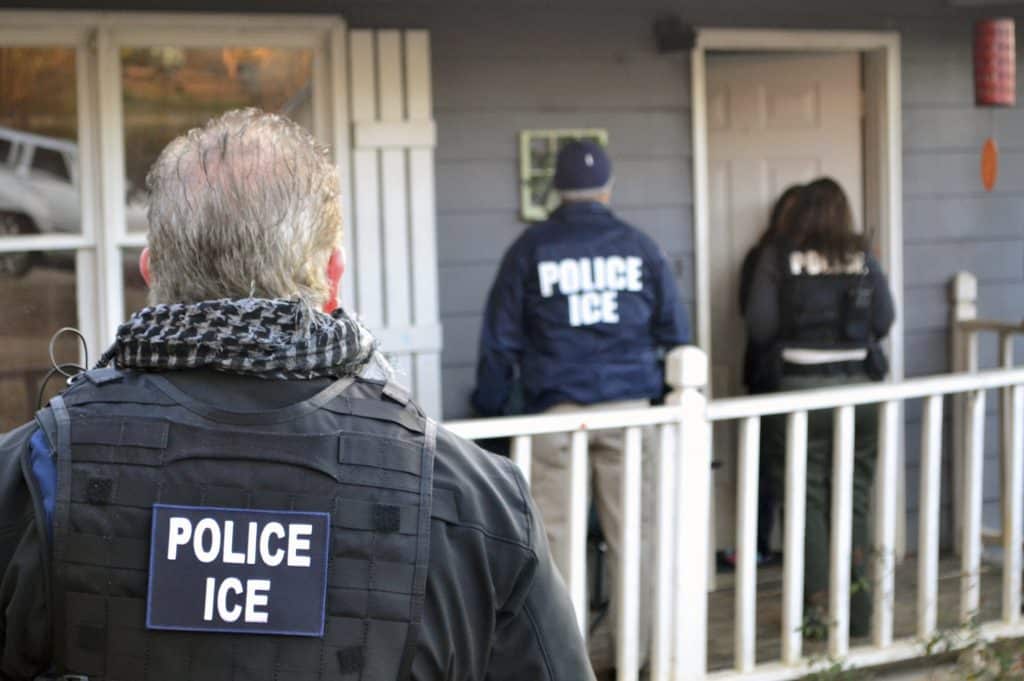
You do not write a provision requiring visible identification and limiting masks unless agents are operating unidentified. You do not write a provision for independent investigations of officer-involved shootings unless the agency is currently investigating its own. You do not write protections against the knowing detention of U.S. citizens without probable cause unless U.S. citizens are being detained. And you do not list schools, hospitals, churches, childcare centers and polling places by name unless enforcement is happening in them.
That is a former FBI agent's assessment of the agency, written by him, in April. In June he voted to fund it through 2029 without changing any of it.
The response from his own district was immediate. The Bucks County Beacon's account of the vote quotes his Democratic opponent saying Fitzpatrick had voted "to give a $70 billion blank check for Trump's ICE with no accountability or safeguards," and the ACLU's Kate Voigt calling it "unconscionable that the House would vote to write yet another blank check for ICE and Border Patrol's campaign of chaos without any reforms."
The article carries no statement from Fitzpatrick explaining the vote.
The pattern
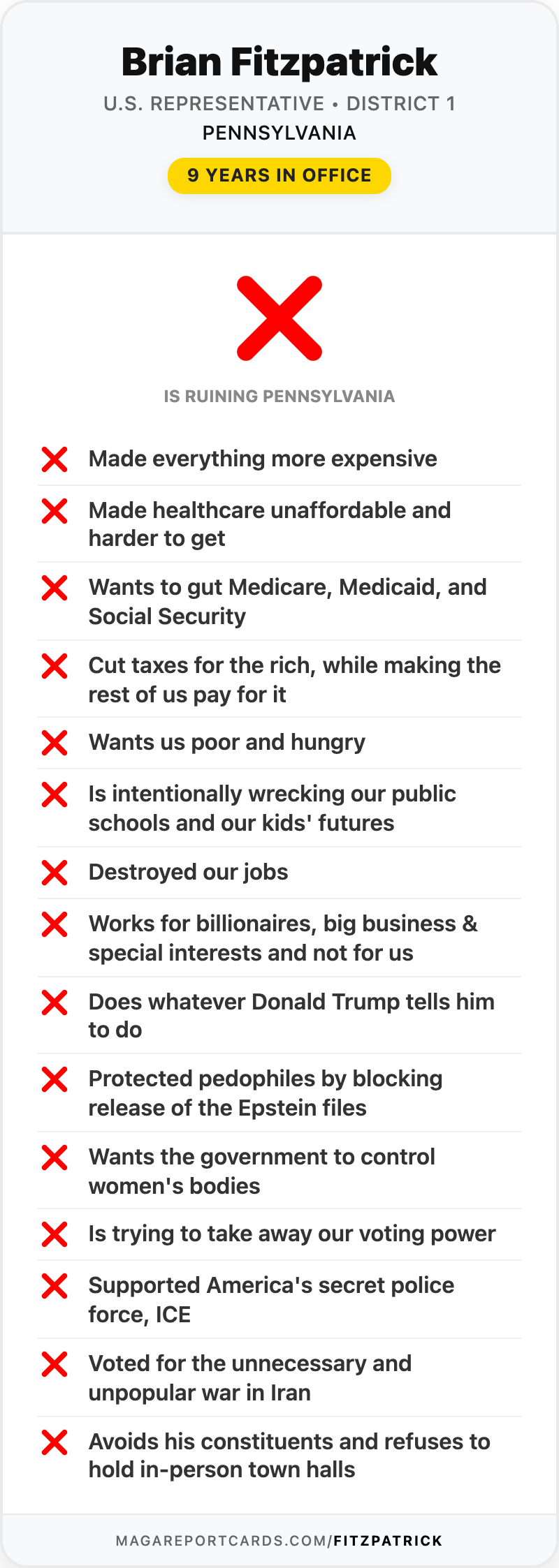
Fitzpatrick's political identity is built on being the reasonable one, and some of it is real: he carries a 76% League of Conservation Voters score for 2025, with a 71% lifetime score — numbers no other House Republican comes close to. His district, Bucks County, is one of the most competitive in America, and the brand is the whole strategy.
But the record shows a specific shape to it. On the votes where his single vote decided the outcome, he has gone with his party. On the votes that were already decided, he has gone the other way and issued a statement.
The ICE vote is the clearest version yet, because this time he didn't just vote the wrong way on someone else's bill. He wrote the right bill, said out loud what needed fixing, and then supplied the vote that made fixing it unnecessary.
Source
Melinda Rizzo, "Rep. Brian Fitzpatrick's Vote Gives Trump $70 Billion to Spend on Mass Deportation Operations Without Any Guardrails", Bucks County Beacon, June 10, 2026. Photo: Bryan Cox/ICE via AP. The bill's provisions are from Fitzpatrick and Suozzi's own announcement, April 2, 2026.