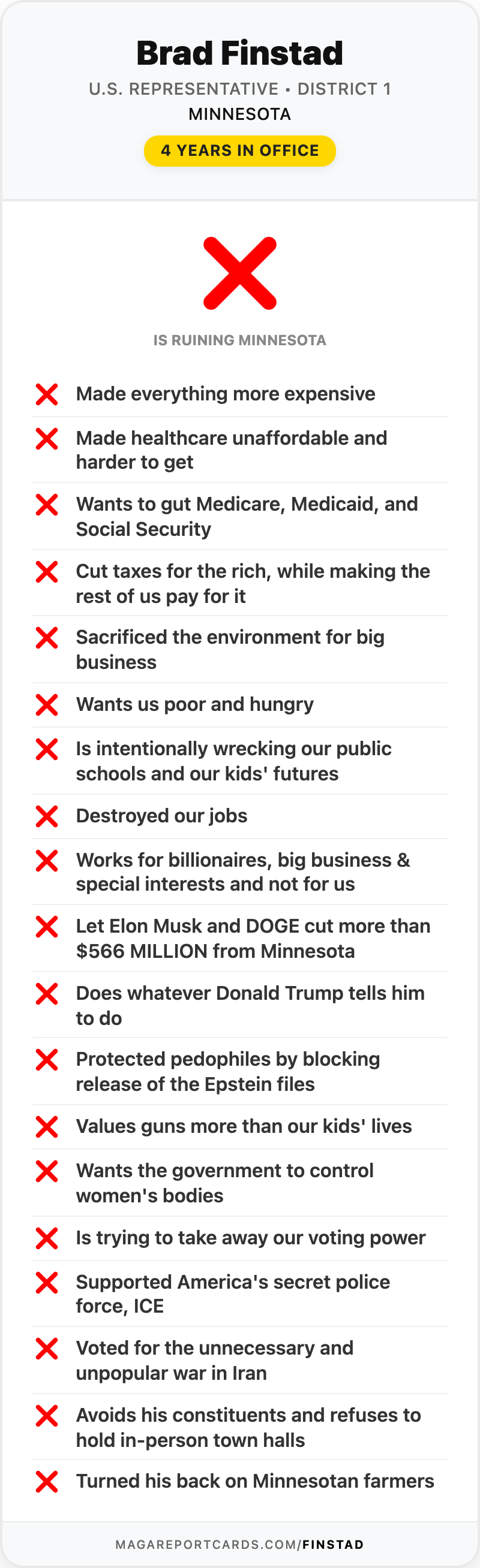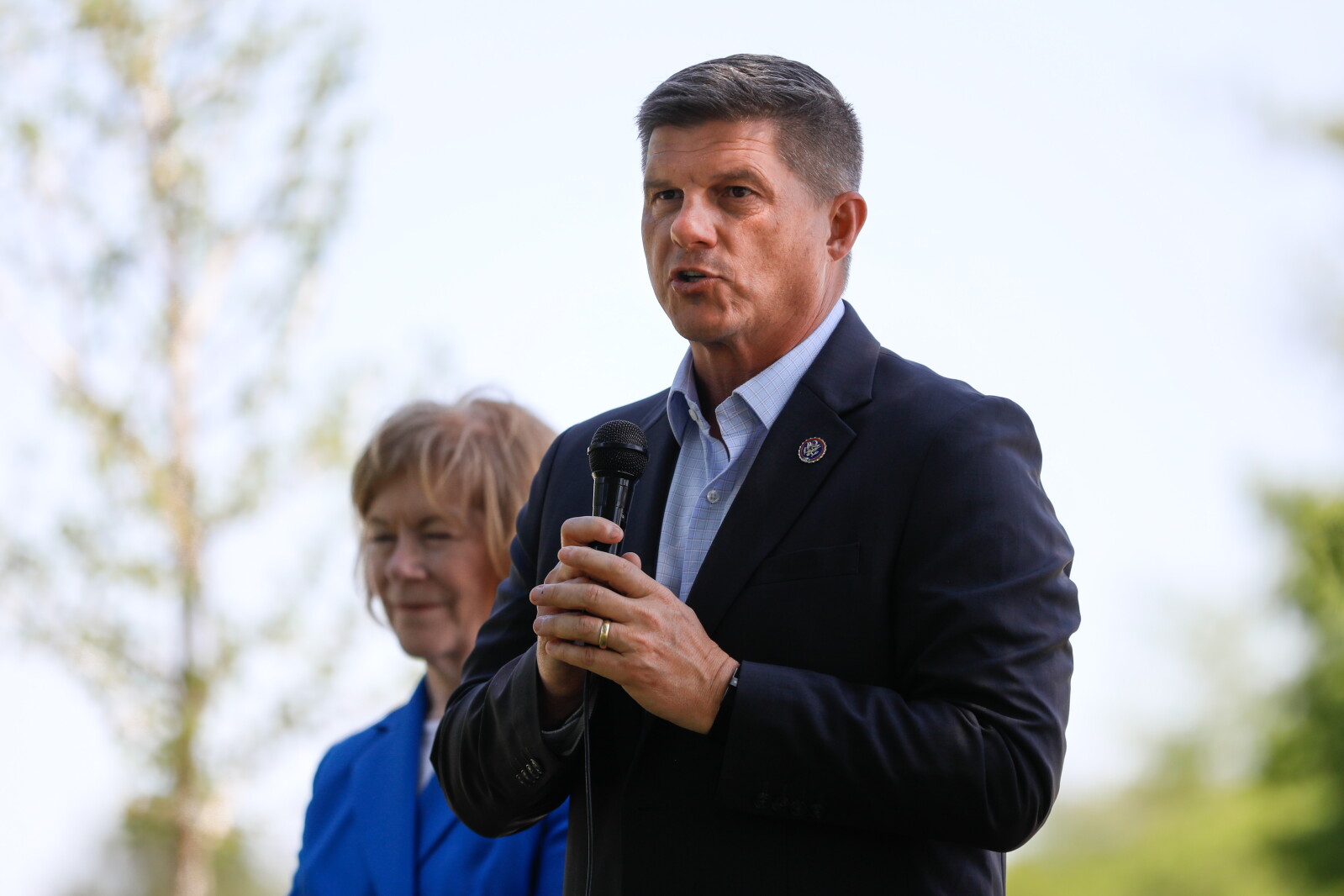
In late June 2026, Brad Finstad sent a letter to Minnesota's education commissioner asking him to look into "the influence of the Southern Poverty Law Center's Learning for Justice program and related social justice frameworks being integrated into the Rochester Public School District."
It made the local news, which is what letters like this are for.
Then people started checking it, and three separate problems turned up. The school district says it never adopted the program. The official he wrote to has no authority over what any Minnesota district teaches. And the evidence in the letter came down to a footnote in a four-year-old document that the school board never voted on.
Nobody from Finstad's office had called the district to ask.
The district's answer
Rochester Public Schools put out a written response, reported in full by KIMT. The first thing it says is that nobody asked them anything:
"Neither Representative Finstad nor any member of his staff contacted Rochester Public Schools (RPS) before sending the letter to ask whether Learning for Justice curriculum, materials, or frameworks are currently being used in RPS or have been used in recent years. If they had reached out to inquire, Finstad's staff would have been informed that Rochester Public Schools has not adopted, approved, or implemented Learning for Justice as curriculum, required instructional materials, or a formal instructional framework."
The second thing it says is that he wrote to the wrong office:
"In Minnesota, local school districts are responsible for selecting curriculum and instructional materials that align with state academic standards. The Minnesota Commissioner of Education does not select or approve the curriculum used by local school districts. For that reason, Rochester Public Schools would have been the appropriate entity to contact for accurate information about what is being taught in RPS classrooms."
That is not a spin point. It's how Minnesota law works. Curriculum is a local decision. Finstad asked a state commissioner to account for something the state commissioner does not decide.
Superintendent Kent Pekel made the same point more bluntly to the Post Bulletin: if Finstad wanted to know how Learning for Justice is or isn't used in Rochester classrooms, he could have simply called, rather than writing to a commissioner to "ask about an issue over which he has no authority or influence."
Pekel added one more line: "He has not visited our schools once."
The evidence was a footnote
So what was the letter actually built on?
According to Finstad's office, Rochester school board documents show that social studies curriculum in the district "has been informed by Learning for Justice."
Pekel says that reference was "essentially a footnote" in a supporting document for an information-only agenda item at the February 8, 2022 school board meeting. Learning for Justice was listed alongside three other items under the heading "Informing our Practice" — material about how to teach, not what to teach.
"There was no vote taken and no decision on the agenda that night," Pekel said.
Meanwhile, the district had just approved new social studies curriculum at its most recent board meeting. Pekel said those new materials did not include anything created by Learning for Justice, and that he had confirmed the materials are not formally part of the current Rochester curriculum.
Finstad's office pushed back on one piece of this. Spokeswoman Jenny Luepke said Learning for Justice materials are written by the SPLC, and pointed to a March board document showing the district aligns its counselors with the American School Counselor Association model, which she said has integrated SPLC standards. Pekel's position is that the Learning for Justice materials — formerly branded Teaching Tolerance — are promoted by the SPLC rather than written by it.
That's a real disagreement about sourcing. It is not evidence that a Rochester classroom is teaching anything. And a phone call to the superintendent would have surfaced all of it before the letter went out instead of after.
There is one loose thread, and it's fair to name it. A conservative think tank, the Center of the American Experiment, later published an account from an unnamed former district staffer who says she was handed Teaching Tolerance handouts at a January 2024 staff training. The group's own editor's note concedes the date "has not been independently verified through a district record or session agenda," and the material described is adult professional development, not student curriculum. Even taken at face value, it is not what Finstad's letter alleged.
What the letter said about kids
The letter didn't stay on process. Finstad wrote that Learning for Justice content often pushes "leftwing activism, gender ideology and queer theory, white privilege and transgenderism."
He also told the commissioner that "public school should be politically neutral, but instead the Southern Poverty Law Center's Learning for Justice program is able to integrate far-left content and materials into our K-12 schools."
Read that sentence next to the district's answer. The program he says "is able to integrate" content into Rochester schools is a program Rochester schools say they never adopted.
Finstad's letter also cited the SPLC's legal trouble. That part is accurate as far as it goes: a federal grand jury in Alabama indicted the SPLC on April 21, 2026 on charges of wire fraud, false statements to a bank, and conspiracy to commit money laundering. An indictment is an accusation, not a verdict — the organization has pleaded not guilty. And whatever happens in that Alabama courtroom, it says nothing about what is being taught in a Rochester social studies class.
This is the second letter this summer
Finstad has a method now, and it doesn't take long to see it.
Six weeks after the Rochester letter, he wrote to Minnesota's secretary of state raising the "potential" of noncitizens registering and voting. We checked that one: a ten-year study Minnesota's own secretary of state cites had turned up three cases out of 13.3 million votes cast, and not one of them involved a person in the country illegally.
Both letters follow the same pattern. Pick a national conservative talking point. Address it to a Minnesota official who can't do much about it. Announce it. Let local TV carry the headline. Nobody has to prove anything, because a letter isn't a finding — it's a question, and a question can't be wrong.
His opponent said as much. DFL nominee Jake Johnson told KIMT:
"This is what people hate about politics. Congressman Finstad is abusing taxpayer resources by directing his congressional office to find and launch baseless attacks to support his reelection campaign."
Finstad is not the only Republican who has decided that the real problem in a classroom is the teacher. North Carolina's Virginia Foxx answered a fourth grader's persuasive essay by telling him to ask his teacher to explain propaganda, and that his teachers were "too interested in indoctrinating you."
What southern Minnesota is actually dealing with
Finstad represents one of the most agricultural districts in the country, and his constituents are in a genuine crisis. In July 2025 alone, 306 Minnesota farmers filed for the state's Farmer-Lender Mediation program — four times as many as the same month a year earlier. He spent ten months calling the tariff damage "short term" while it kept getting worse.
He does not hold in-person town halls. When constituents in New Ulm and Rochester turned up at his offices in early 2025 asking for one, the Mankato Free Press could not find any record of Finstad ever having held one. Asked why he won't, he said such events let agitators "come with their pitchfork and scream and have a hissy fit in front of the cameras" — and in June 2026 he added, "I don't regret saying it at all."
So he won't stand in a school gym in his own district and take questions from the people who live there. But he will write to a state commissioner in St. Paul demanding an accounting of what a Rochester teacher is putting in front of a ninth grader — without calling the school, without visiting the school, and without checking whether the thing he's asking about is in the building at all.
The superintendent's offer is still open. Pekel said Finstad is welcome anytime to come see what Rochester is teaching and how, at a school "where our community's young people are doing amazing things."
Finstad has not taken it.
Source
Addie McCabe, "Finstad asks MDE for clarity on 'far-left' education materials; Rochester schools push back," KTTC, June 24, 2026. Additional reporting from Brian Todd at the Post Bulletin and KIMT. Photo: Post Bulletin / Forum Communications.