About 3,000 people lived at the Li'l Abner Mobile Home Park in Sweetwater. Working-class families and retirees, many of them elderly. Some had poured more than $100,000 of their savings into homes that were called "mobile" but could not actually be moved.
In November 2024 they were told the park was closing and everyone had to be out by mid-May 2025. The developer offered $14,000 to anyone gone by January 31, or $3,000 to anyone gone by the end of April. About 200 residents sued. They lost. Last October, sheriff's deputies came to carry out the evictions, and local TV filmed people weeping outside homes they'd spent their lives paying for.
While that was happening, Mario Diaz-Balart said nothing publicly at all.
He had, however, been busy behind the scenes. And on March 22, 2026, Florida Bulldog published what nearly a year of records digging turned up: $400,000 that quietly moved from the for-profit developer who cleared the park to the political committees of the two Miami Republican congressmen who steered $10 million in federal grants to his replacement project.
$250,000 of it went to Diaz-Balart's.
The sequence
Read these dates in order. That is the whole story.
September 2021 — Raul F. Rodriguez, CEO of CREI Holdings, the company that owns the Li'l Abner property, and his wife give the maximum allowed to Mario Diaz-Balart for Congress.
March 2022 — Rodriguez uses another company he operates, Luar LLC, to send $80,000 to the National Republican Congressional Committee.
April 29, 2022 — exactly one month later, Diaz-Balart writes a four-sentence letter to the leaders of the House Appropriations Committee asking for an earmark for "Sweetwater's Affordable Housing Project." The letter doesn't name the project, doesn't name the developer, doesn't describe it, and doesn't say how much he wants. His congressional website says the ask was $20 million.
December 2022 — the letter pays off. $4 million in Community Project Funding for CREI's Abner III, plus $8 million more that Diaz-Balart requested for the City of Sweetwater to build the roads and sewers needed to make the Sweetwater affordable housing project possible.
March 11, 2024 — Miami-Dade's housing department publishes a public notice saying it intends to ask HUD to release the $4 million to CREI.
March 22, 2024 — eleven days later — Rodriguez contributes $250,000 to the Mario Diaz-Balart Victory Fund.
April 16, 2025 — Miami-Dade pays the $4 million to CREI Holdings.
Where the $250,000 went
The Mario Diaz-Balart Victory Fund is a joint fundraising committee, which is how a single donor writes one very large check that gets split among several committees, each up to its own legal limit. Diaz-Balart controls it.
Federal Election Commission records show the $250,000 was cut up the same day it arrived:
- $150,000 to the NRCC — $108,700 of it into the committee's "legal proceedings account," $41,300 into operations
- $6,600 to Mario Diaz-Balart for Congress — the maximum his campaign account could legally accept
- $5,000 to his leadership PAC, Maintaining Republicans in Office
- $88,400 left sitting in the Victory Fund, where most of it still was at the end of last year
This is the part worth understanding. A campaign can only take $6,600 from one person. A joint fundraising committee is the legal machinery that turns a $6,600 relationship into a $250,000 one.
"No financial interest"
To request an earmark, a member of Congress has to certify in writing to the Appropriations Committee that he has no financial interest in it. Diaz-Balart signed that certification.
He owned no piece of Abner III, so on the narrow question the form asks, the certification was accurate.
But Florida Bulldog quotes the House Ethics Manual on what happens next:
"Nevertheless, a political contribution tied to an official action may raise other considerations. It is impermissible to solicit or accept a campaign contribution that is linked to any action taken or asked to be taken by a Member in the Member's official capacity – such as an earmark request that a member has made or been asked to make. Accepting a contribution under these circumstances may implicate the federal gift statute or the criminal provisions on illegal gratuities or bribery."
Nobody has charged Diaz-Balart with anything, and the reporting does not allege a crime. What it documents is a pattern of timing that the House's own ethics guidance specifically warns members about.
Asked to explain any of it, Diaz-Balart's office didn't respond. Florida Bulldog reported that neither he nor Rep. Carlos Gimenez — whose committees took the other $150,000 — returned multiple phone and emailed messages to their spokespeople. Rodriguez didn't respond either.
What the public paid for
Here's the part that should sting for anyone in Miami-Dade struggling with rent.
For-profit companies aren't allowed to receive earmarks directly — Congress wrote that rule after the earmark corruption scandals of the 1990s and 2000s put several members in prison, and banned earmarks outright in 2011 before quietly bringing them back in 2021 under the friendlier name "community project funding." So the money is routed through Miami-Dade's Housing and Community Development department, with CREI as the "subrecipient."
And what did about 3,000 displaced people get in exchange for that public money?
Abner III is an eight-story, 326-unit building. About 40% of the units — 130 of them — are set aside for households earning up to 80% of the area median income. The other 60% go to households earning up to 120% of area median income, which in Miami-Dade is roughly $120,000 for a two-person household and $146,000 for a family of four. Forty percent of the units are restricted to people 55 and older.
Those are not the rents of the people who were carried out of Li'l Abner. This is "affordable housing" priced for households making six figures, built where a community of working-class and elderly renters used to live, partly with federal money that a congressman requested in a four-sentence letter that named neither the project nor the developer.
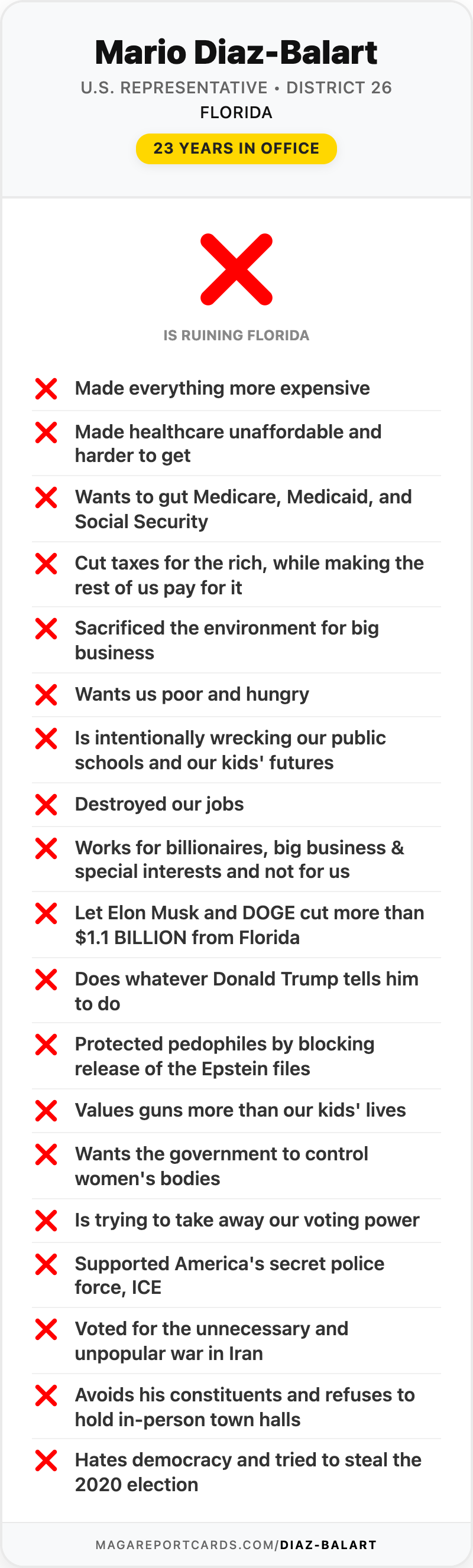
Twenty-three years, and this is what he did with them
Diaz-Balart has represented parts of Miami-Dade since 2003. The Li'l Abner site sat in his district — then numbered the 25th — when he wrote the 2022 letter; Florida's redistricting moved it into Carlos Gimenez's 28th, which is where it was through the evictions. He is now Vice Chair of the House Appropriations Committee and chairs its subcommittee on National Security, the Department of State and related programs — one of the most powerful spending jobs in the House. Earmarks are the currency of that job, and he is very good at getting them.
His own report card already documents how he uses the rest of that power: he wrote a 2026 foreign affairs budget that cut spending 22% and called himself "proud" of it, and he has taken more than $1 million from pro-Israel PACs and tens of thousands each from the weapons makers whose budgets he personally writes.
This is not new territory for Congress, either. In California, a 33-year Republican incumbent has spent two decades steering federal projects toward roads and bridges near real estate he owns — with the LA Times catching him at it in 2006 and again in 2024. The rules are permissive enough that this keeps happening in daylight.
When 3,000 people were being put out of their homes, and every TV station in South Florida was covering it, Mario Diaz-Balart had nothing to say. He'd already said what he had to say — in a four-sentence letter, in 2022.
Source
Congressmen snag millions for Abner developer, get big donations — Dan Christensen and Cassidy Winegarden, Florida Bulldog, March 22, 2026. Photo: CBS News Miami, via Florida Bulldog.