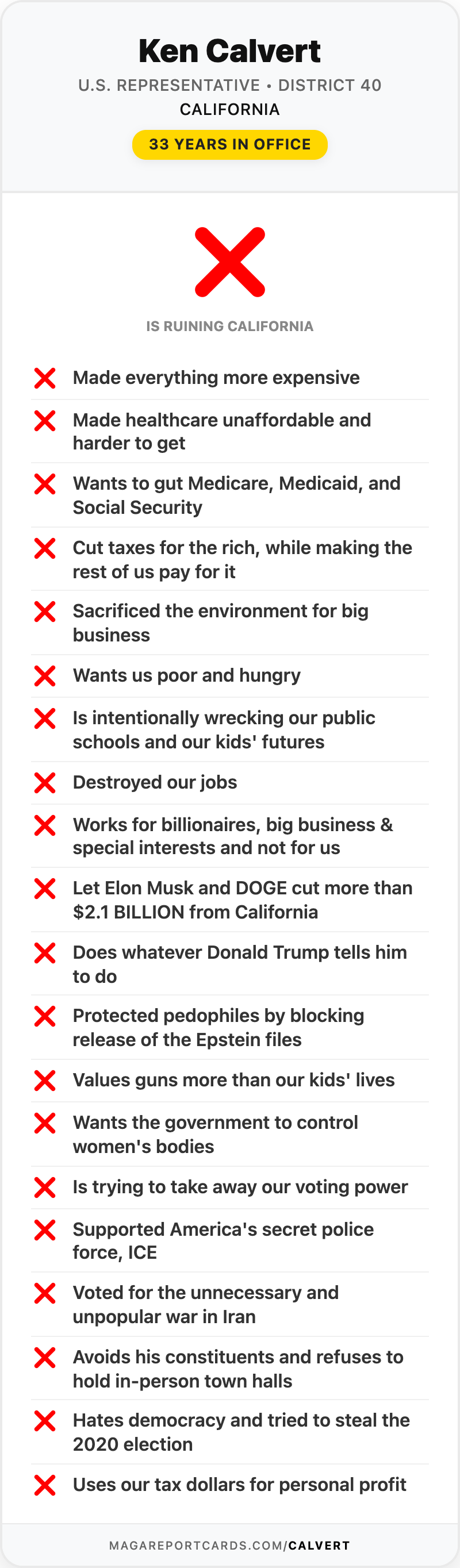
In June 2026, in the middle of a bitter fight against another Republican for a redrawn Southern California seat, Ken Calvert made his case to the Washington Examiner. It came down to one sentence.
"I'm the only real, true Trump conservative. I've been endorsed twice by the president. I work with him, and not only that, I've done more in bringing federal dollars back to California than any member of Congress, I think, in history."
That is his pitch. He moves money. He has been doing it since 1993, longer than any other Republican in California's congressional delegation, and he is very good at it.
He is also, according to two decades of reporting by the Los Angeles Times, a man whose federal projects keep turning up near real estate he happens to own — and who has twice been caught not telling anyone he owned it.
2005: the four-acre lot
In 2005, Calvert and a business partner named Woodrow Harpole Jr. paid $550,000 for a dusty four-acre parcel just south of March Air Reserve Base in Riverside County.
While he owned that land, Calvert used earmarking to secure $8 million for a planned freeway interchange improvement 16 miles away on the same Cajalco Road corridor, plus another $1.5 million to support commercial development of the area around the airfield. President Bush signed the highway bill carrying the $8 million on August 10, 2005.
Less than a year after buying the lot, without cutting the weeds or hauling off the old septic tank parts scattered on it, Calvert and his partner sold it for $985,000.
A 79% profit. On weeds.
The Times noted that a map of Calvert's real estate holdings and his partner's showed many of them near transportation projects he had backed with federal money — and that better roads had helped drive the region's explosive growth. It also noted something else: his financial disclosure for 2005, the year he bought the land, had not been filed when the story ran.
Calvert's answer then is worth reading twice.
"Because of the political atmosphere in Washington, D.C., people are trying to manufacture controversy, even where there isn't any."
And:
"They haven't passed a law against investing yet."
And:
"All my life in public service, I've never done anything to enrich myself, using the position I hold."
Ethics lawyers quoted in that same story did not agree that there was nothing here. Stanley Brand, a former general counsel to the House of Representatives, said members in Calvert's position should "either sell their property interests in the immediate area or recuse themselves from any related earmarks." Brett Kappel, another ethics lawyer, said an earmark like this "could be perfectly legitimate, but it raises an appearance issue when you have a member who is a property owner, and he or she earmarks funds to benefit development in an area in which the member has an ownership interest." Kappel named two things that would help a lawmaker in that position: that the project had been requested by a local government agency, which the Times says both of these were, and that the member disclose the earmark and the property holding.
The FBI apparently agreed it was worth a look. In November 2007, Roll Call reported that agents had examined Calvert's personal financial records that July, and that Calvert had "sparked investigators' interest last year by sponsoring a transportation earmark near property he owned." He was never charged with anything.
2024: the same story, nineteen years later
Congress banned earmarks in 2011, partly because of scandals exactly like this one. Congress brought them back in 2022.
Calvert got right back to work. Since the practice returned, he has funneled more than $100 million into projects in his Riverside County district, the Los Angeles Times reported in July 2024 — including $9 million for bottlenecks and toll lanes on Interstate 15, $2 million to widen a traffic-choked bridge in Corona, and $5 million for a planned rail line between Los Angeles and Palm Springs.
About $16 million of those planned improvements fall within several miles of rental properties Calvert owns.
His portfolio, per his own disclosures: 10 commercial rental properties around Corona, 20 acres of land in Riverside County, two properties in Arizona, and homes in Corona and Washington. The California properties are valued at as much as $26 million and produced between $320,000 and $805,000 in rental income in a single year. They include an automotive repair center, self-storage facilities, and strip malls. He owns most of them jointly with business partners.
And then the part that is hardest to explain away. The Times found that Calvert had failed to disclose the purchase of a commercial rental property in Corona in 2016 — a building on East 6th Street housing auto-body shops and smog-check stations, from which he had been reporting $15,000 to $50,000 a year in income since 2021.
That building sits about a mile from the bridge that got $2 million in earmarked funds through his office.
His spokesman confirmed the building was bought for $2.25 million in September 2016 and that Calvert's 11% stake was worth $247,000. Calvert said the building was in bad shape and wasn't rentable for years. Asked about it by reporters, he said he would file an amended disclosure.
The watchdog group End Citizens United then filed an ethics complaint over the undisclosed properties — with the Office of Congressional Ethics, according to the group's own announcement. Calvert filed six years' worth of amended financial disclosures.
Six years.
"If I wanted to make money, I wouldn't have ran for Congress"
That is what Calvert told the Times in 2024. He also said this:
"I enjoy investing. They haven't made it illegal to invest. Real estate is something I know, and I get a little bit of income. ... I don't think there's anything wrong with that."
He is right that it isn't illegal. That is the whole point, and it's the same defense he gave in 2006, nearly word for word — they haven't passed a law against investing yet.
Noah Bookbinder, who runs the watchdog group Citizens for Responsibility and Ethics in Washington, told the Times it seemed "pretty unlikely" Calvert broke Congress's conflict-of-interest rules, which he described as "pretty loose, and pretty permissive." Then he said the thing that actually matters:
"It gets tougher when you think about the appearance of a conflict. If you have significant income coming from rental properties which could be affected by your decisions, it raises a question of what's motivating you."
That's it. Nobody has to prove Calvert sat down with a map and drew a circle around his own buildings. The question is simpler and worse: when a congressman with a real estate portfolio worth as much as $26 million in his own district decides which roads and bridges get federal money, how would anyone — including him — ever know for sure what he was thinking?
This isn't a one-off in Congress, either. We've written about a Michigan Republican whose campaign paid his half-brother's business more than $400,000 while that brother helped sell the congressman's luxury condos. The rules are permissive enough that this keeps happening in plain view.
What it costs the rest of us
Here is the part that gets lost in the ethics-lawyer language.
Calvert sits on the House Appropriations Committee and chairs its defense subcommittee, which means he is one of a small number of people who decide where federal money goes. He has been in that world for 33 years. When he tells voters he brings home more federal dollars than anyone in history, he is describing real power over real money.
The people of Riverside and Orange counties are entitled to have that power used on their behalf — on their hospitals, their roads, their schools, their water. What they are not entitled to know, under the current rules, is whether the reason a particular bridge got widened was that it needed widening, or that it happened to sit a mile from a building the congressman quietly owned and hadn't reported.
He was asked about this in 2006, and again in 2024. The answer never changed and it was never really an answer. It's just: they haven't passed a law against it. In the campaign he is running right now, the money is his opening pitch.
Thirty-three years is long enough to have learned why people keep asking.
Sources
- Rep. Calvert's Land of Plenty — Tom Hamburger, Lance Pugmire and Richard Simon, Los Angeles Times, May 15, 2006
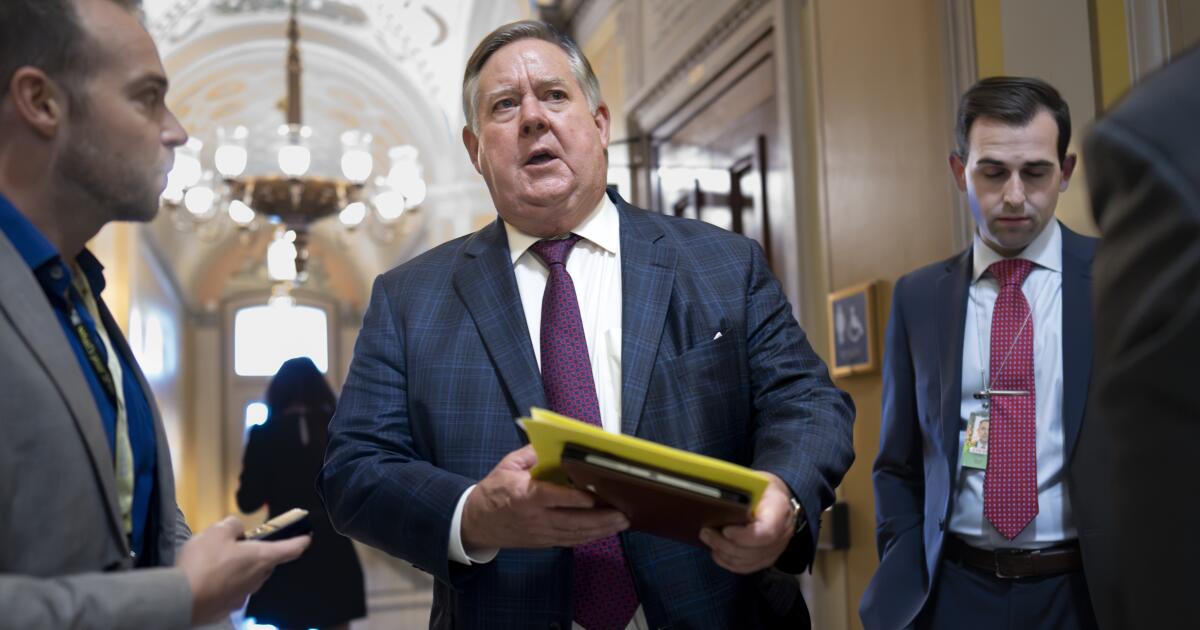
- Rep. Ken Calvert has secured millions for his Riverside County district. Do his own properties benefit? — Laura J. Nelson, Los Angeles Times, July 22, 2024. Lead photo: J. Scott Applewhite / Associated Press.