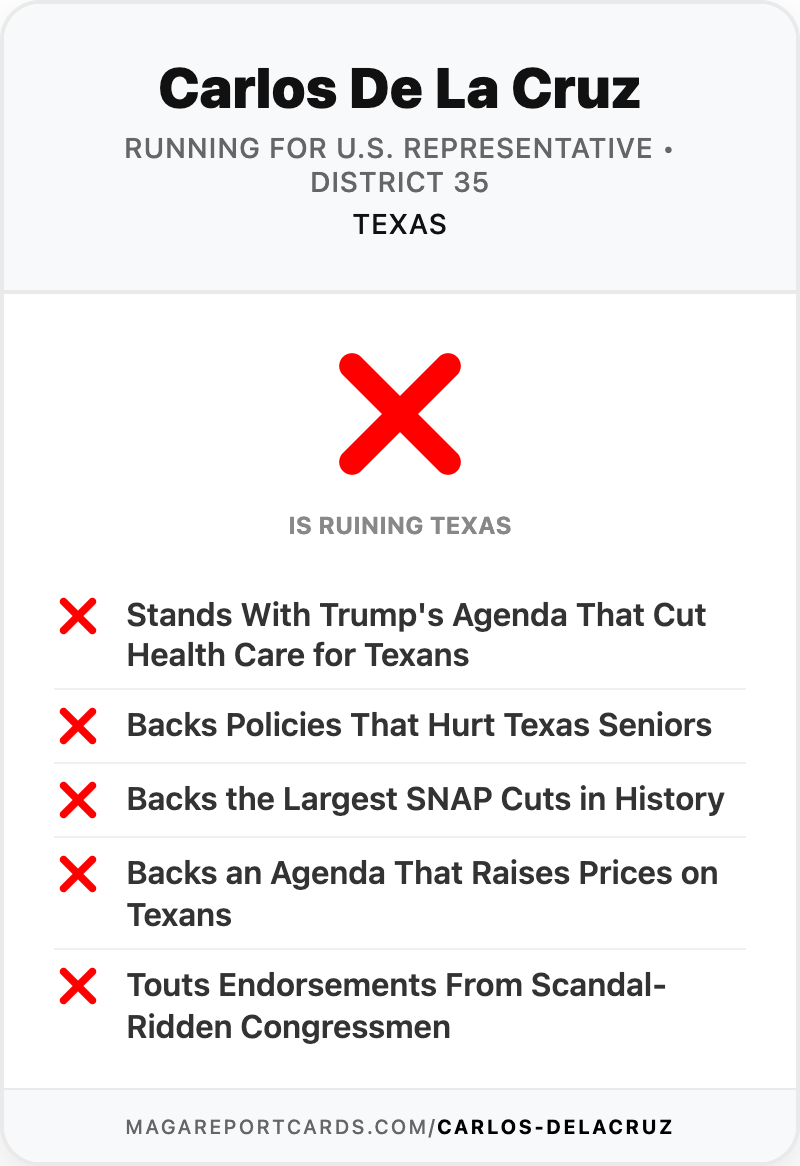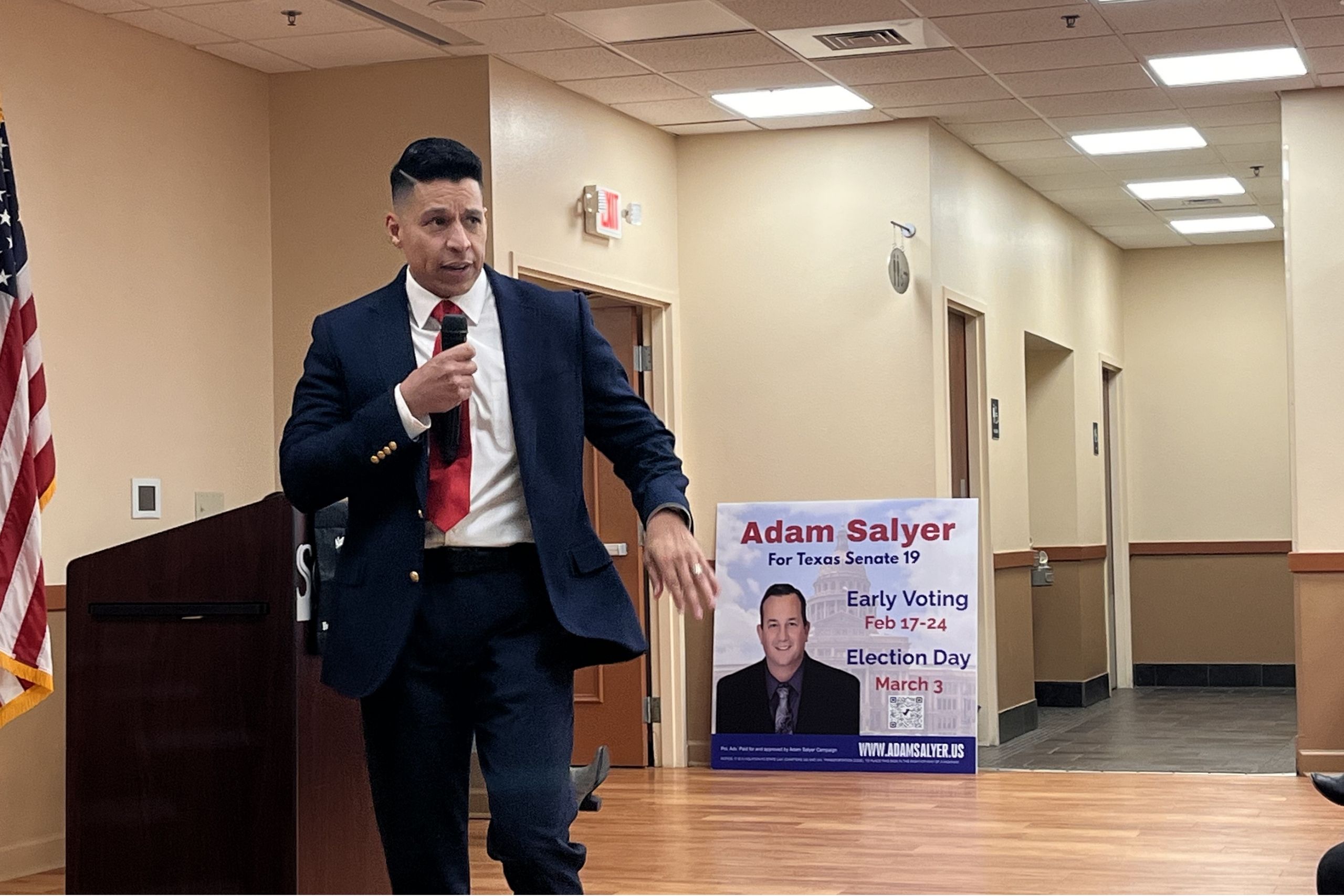
On May 2, 2026, Health and Human Services Secretary Robert F. Kennedy Jr. was booked to be in San Antonio, raising money for a congressional candidate.
The candidate was Carlos De La Cruz, the Republican running in Texas's redrawn 35th Congressional District. The Republican Party of Bexar County promoted the event. The invitation said Kennedy would give remarks. It did not say where the event was being held.
De La Cruz was delighted. Here is the part of his statement the San Antonio Report quoted:
"It's an honor to have Robert F. Kennedy Jr. in our corner and here in Texas — another sign of the momentum we're building with President Trump's endorsement... I look forward to working with him in Washington to ensure America's children and families are stronger and healthier."
Hold on to that last part — to ensure America's children and families are stronger and healthier — because six weeks earlier, a federal judge had blocked what Kennedy was actually doing to America's children, finding it likely broke the law.
What Kennedy had just done to children's vaccines
The timeline matters here, so let's walk it.
In June 2025, Kennedy fired all 17 members of the Advisory Committee on Immunization Practices — the federal panel of doctors and scientists that had set America's vaccine recommendations for decades — and replaced them with a group that has largely expressed skepticism of vaccines.
In December 2025, the CDC rolled back a decades-old recommendation that all newborns get their first hepatitis B shot within 24 hours of birth.
Then on January 5, 2026, the CDC announced what one Stanford infectious disease doctor called "the most significant weakening of childhood vaccine recommendations, I would say, in modern American history." The agency cut the list of vaccines recommended for all children from 18 diseases down to 11. Shots for flu, RSV, hepatitis A, hepatitis B, rotavirus and some forms of bacterial meningitis were moved off the universal list.
Doctors were blunt about what this would mean. Dr. Helen Chu, an infectious disease professor at the University of Washington, called it "alarming, unnecessary, and will endanger the health of children in the United States."
On March 16, 2026, U.S. District Judge Brian E. Murphy in Boston blocked the whole thing. The preliminary injunction halted the new schedule, put Kennedy's hand-picked advisory committee appointments on hold, and temporarily blocked every decision that committee had made. Kennedy's changes, the judge found, likely violated the Administrative Procedure Act. There is, the judge wrote, "a method scientific in nature and codified into law through procedural requirements." He continued:
"Unfortunately, the government has disregarded those methods and thereby undermined the integrity of its actions."
The American Academy of Pediatrics, which brought the case, called the ruling "a historic outcome for children, communities, and pediatricians everywhere."
Six weeks after that ruling, Carlos De La Cruz's county party was promoting a fundraiser with Kennedy, and De La Cruz was putting out a statement saying he looked forward to working with him to make America's children healthier.
Two Texas children are dead
This is not an abstract argument about federal advisory committees. Texas has already paid for it.
Starting in late January 2025, West Texas had a measles outbreak — part of what the American Academy of Pediatrics would later call the nation's worst in 30 years. By the time the Texas Department of State Health Services declared it over on August 18, 2025, the state had confirmed 762 cases. Ninety-nine people were hospitalized.
Two school-aged children died. Both were unvaccinated. Neither had any known underlying condition.
Measles is one of the diseases still on the CDC's shortened list — but the outbreak is the clearest possible illustration of what happens when vaccination rates fall in a community. The CDC says two doses of the MMR vaccine are about 97% effective at preventing measles. Children get measles when they aren't vaccinated.
That is the state where De La Cruz is running. That is the state where he called it "an honor" to have Kennedy in his corner.
He is not the only Texas Republican to make that choice. In August, Attorney General Ken Paxton opened a formal investigation into the American Academy of Pediatrics — the same group that had just beaten Kennedy in court — accusing the nation's pediatricians of "Deceptively Promoting Childhood Vaccines for Financial Gain." The AAP's response noted that the country was in the middle of its worst measles outbreak in 30 years, with more than 750 cases in Texas, while its attorney general went after doctors who recommend vaccines.
What De La Cruz says he'll do about health care
De La Cruz doesn't have a voting record yet. He has never held office. So the fair question is what he's actually telling voters he'd do.
When the San Antonio Report asked him what Congress should do to make health care affordable and accessible, his answer was market competition over government control, more pricing transparency, and keeping medical professionals in underserved communities.
That's it. No position on the vaccine schedule. No position on what happened in West Texas.
Meanwhile, the agenda he has built his entire campaign around — being, in his words, "Trump's wingman in Congress" — is the agenda the Congressional Budget Office projected would leave at least 17 million more Americans without health insurance by 2034 — 11.8 million of them from Trump's budget bill itself, the rest from the enhanced Affordable Care Act subsidies lapsing and other administration cuts. More than 4.4 million Texans rely on Medicaid.
So the picture is this. A first-time candidate in a state where 4.4 million people rely on Medicaid, raising money with the cabinet secretary whose dismantling of children's vaccine protections a federal judge had just blocked, in a state that buried two children who died of a disease we have known how to prevent for sixty years.
And his statement about it was that he looks forward to working with Kennedy "to ensure America's children and families are stronger and healthier."
Why it worked
It's worth being clear-eyed about why this fundraiser was booked at all.
De La Cruz was in a tough runoff against state Rep. John Lujan, a sitting legislator the Texas Legislature had effectively drawn the new district for. De La Cruz lost the March primary to Lujan and needed outside firepower to close the gap. He got Trump's endorsement at the eleventh hour, then House Speaker Mike Johnson and Majority Whip Tom Emmer wrote checks, then Kennedy was booked to fly in.
It worked. De La Cruz raised about $220,000 between February 12 and March 31 — more than any other congressional candidate in the Bexar County area — and won the May 26 runoff 58% to 42%.
He'll be on the November ballot against Democrat Johnny Garcia, who won his own runoff 64% to 36%. Voters in TX-35 get to decide whether "an honor to have Robert F. Kennedy Jr. in our corner" is the health care answer they were looking for.
Source
RFK Jr. raises money for San Antonio congressional candidate — Andrea Drusch, San Antonio Report, April 29, 2026. Photo: San Antonio Report.