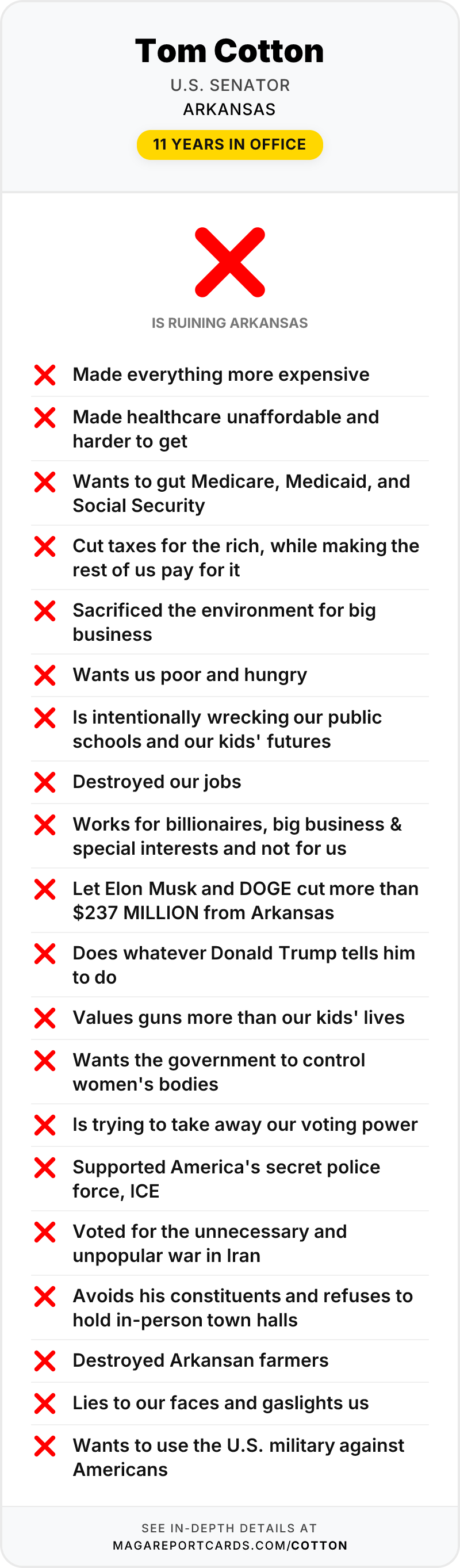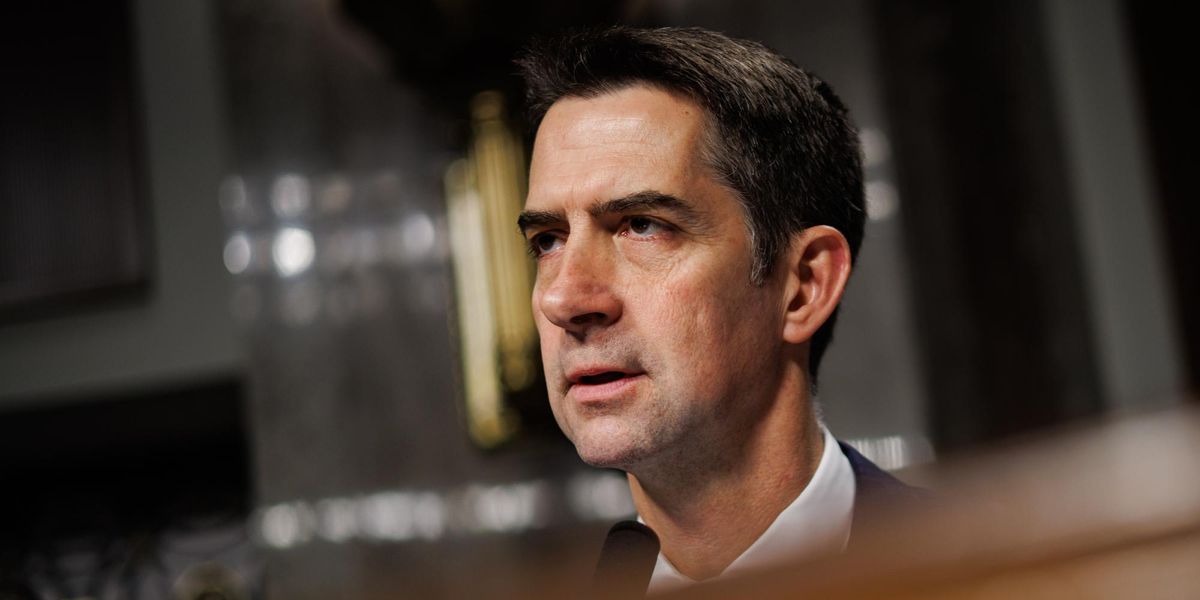
Every year Congress passes a bill setting the rules and the budget for America's spy agencies. This year, Tom Cotton wrote it. He is the chairman of the Senate Intelligence Committee, and the Intelligence Authorization Act for Fiscal Year 2027 — Senate bill 4615 — is his bill. His committee sent it to the Senate floor on May 20, 2026, and he filed the committee's written report on August 5.
It runs 192 pages. Most Arkansans will never read a word of it. But there is one section in it worth knowing about, because it changes who decides what America does with its own secrets.
What Section 622 does
The section is called "United States-Israel Intelligence Sharing Enhancement." Here is what it requires, according to the Washington Times' read of the bill:
- The president must expand and enhance intelligence sharing with Israel — across terrorism, cyber threats, sanctions evasion, missile defense, early warning, and other regional security topics.
- The president may suspend, reduce, or limit that sharing only on the basis of "a specific and identifiable national security concern."
- If he does, he must document the decision and notify the congressional intelligence committees within 15 days.
- The requirement extends to countries that normalized relations with Israel under the Abraham Accords. The bill defines those by cross-reference to federal law, which names the agreements with the United Arab Emirates, Bahrain and Morocco.
- The president must also file a report every year for five years on the state of the sharing, including progress toward "seamlessly integrating Israel into regional air and missile defense." That report is unclassified, though it may carry a classified annex.
Israel is not the only country in the bill. Section 620 does much the same thing for Ukraine, on the same standard and with the same 15-day report, and Section 621 gives the director of national intelligence 48 hours to tell Congress about any cutback to a "country of significant concern," which the bill defines as Israel, Ukraine, Taiwan and whoever else a president adds to the list. What Section 622 adds on top of that is an order to go the other way. Ukraine's section tells the president to continue the intelligence support already flowing. Israel's tells him to expand and enhance it.
That is not a small thing. Sharing intelligence is one of the few levers an American president has that costs nothing and gets attention. It is how you tell an ally, without a press conference and without cutting off weapons, that you want them to stop doing something. Section 622 makes using that lever a paperwork event with a report to Congress attached.
The former CIA officer who says this is backwards
Paul R. Pillar spent 28 years in the U.S. intelligence community, retiring in 2005 as the national intelligence officer for the Near East and South Asia. Writing in Responsible Statecraft on June 10, 2026, he laid out why he thinks Cotton has this exactly wrong.
His argument has three parts. First, on intelligence specifically, Israel has a documented history of passing American secrets on to third parties — including countries the United States treats as adversaries. Second, shared intelligence can be used in ways that cut against American interests, particularly during an active regional war. Third, locking the arrangement into statute strips the executive branch of the flexibility it needs to manage a sensitive relationship.
You don't have to agree with all of that to see the problem with writing it into law. The whole point of a lever is that you can pull it.
Cotton's position on tying a president's hands depends on who's being tied
Here is the part that should bother Arkansans regardless of what they think about Israel.
For most of this year, senators have tried again and again to make the president come to Congress over the Iran war — the war Trump started in February 2026 without a vote. The Senate has now voted thirteen times on some version of ending it. Cotton voted no every single time it mattered. The position he took, on the Senate floor, was that the war was "well within the president's constitutional authority and duty as commander-in-chief" and that a resolution ending it "would handcuff our military force."
Then he wrote Section 622, which is Congress second-guessing a commander in chief on national security — in advance, in writing, with a mandatory report.
The difference isn't a principle about executive power. The difference is which way the constraint points.
This is the same senator who spent a decade attacking Obama's Iran deal and then went nearly silent when Trump signed a similar one. The pattern is consistent: the rule bends to fit the outcome.
Follow the money
Cotton is not a random senator with opinions about the Middle East. He is the biggest recipient of pro-Israel political money in Arkansas's congressional delegation.
TrackAIPAC's tally of Federal Election Commission records, dated July 5, 2026, puts the total at $1,127,943 from pro-Israel PACs. The next-highest Arkansan on that list is John Boozman at $191,516 — Cotton has taken almost six times as much as his own state's senior senator. Steve Womack is at $134,837, Bruce Westerman at $79,146, French Hill at $71,443, Rick Crawford at $25,398.
That is money to the man who, as chairman, decides what goes into the intelligence bill. He is the one who picks the sections. He is the one who writes them. Nobody had to lobby a committee to get Section 622 in — the chairman put it there.
We've written before about how a handful of donors came to own the Republican Party's foreign policy, including the $37 million primary that took out a sitting Republican congressman who wouldn't vote the way the lobby wanted. Section 622 is what the money buys once it stops needing to threaten anybody. It buys the pen.
What this has to do with Arkansas
Nothing. That's the point.
There is no version of this that lowers a grocery bill in Jonesboro or keeps a hospital open in Helena. Cotton has not held a real, open town hall in Arkansas in nine years. In 2025 he skipped an angry town hall to attend a $7,000-a-plate fundraiser instead. In January 2026 the state's largest paper ran a guest column headlined "Hill, Cotton back on radar, but not for Arkansas constituents."
He found the time to write Section 622.
The bottom line
Tom Cotton used the most powerful position he has ever held — chairman of the committee that oversees every American spy agency — to write a foreign government's intelligence access into United States law, and to make it harder for any future president to change his mind about it.
He did it after taking more than a million dollars from PACs that wanted exactly that.
And he did it while telling us, thirteen times over, that Congress has no business telling a president what to do about war.
We deserve better.
Source
Paul R. Pillar, "Senate wants to force US to share sensitive intel with Israel", Responsible Statecraft, June 10, 2026. Photo: Samuel Corum/Sipa USA, via Responsible Statecraft.