James Comer runs the congressional investigation into how the federal government handled the Jeffrey Epstein files. As chairman of the House Oversight Committee, he decides who gets called, in what format, under what rules, and whether the public ever sees it.
We know what Comer looks like when he wants answers. We watched him do it for two years to the Biden family — subpoenas, depositions, an impeachment inquiry, a nearly 300-page report.
The Epstein investigation does not look like that.
The Attorney General Didn't Have to Be Sworn In
In March 2026, the Oversight Committee voted to subpoena Attorney General Pam Bondi over the Justice Department's handling of the Epstein files. She was scheduled to sit for a deposition on April 14. That deposition never happened; she was removed as attorney general around that time.
She finally appeared on May 29 — and by then the terms had changed.
Instead of a deposition, Comer agreed to a voluntary, closed-door transcribed interview. She was not sworn in. It was not videotaped. She brought Justice Department lawyers with her, including Assistant Attorney General Harmeet Dhillon, attending as agency counsel rather than as her personal attorney. The committee would release a transcript, but no video.
Every one of those is a choice, and every one of them made the session weaker. Not under oath means no perjury exposure. No video means no clip of a witness pausing, deflecting, or looking at her lawyer. Agency counsel in the room means someone is there to object.
Robert Garcia, the top Democrat on the committee, said afterward:
"We continue to be incredibly disappointed of the decision to not have this interview videotaped and then released to the American public."
And on the central question, it didn't matter what anyone asked. According to the transcript, Bondi declined to answer questions about President Trump's involvement in the handling of the files — including when she and Trump first discussed the Epstein investigation.
The chairman had subpoena power. He used it to get a conversation.
He Won't Call the People the Reporting Points At
In June 2026, The New York Times reported that Vice President JD Vance and other top advisers had repeatedly met in the White House Situation Room in 2025 to discuss public demands for the Epstein records.
Garcia wrote to Comer asking him to bring White House officials in. As he put it to reporters:
"We have reporting now, I think pretty substantial reporting, that the vice president is leading meetings in the Situation Room about the Epstein files, so they have a responsibility to come forward and explain to us why the hell that's happening."
Asked directly about Vance and White House Chief of Staff Susie Wiles, Comer told Spectrum News he would not call them in. His answer was about Democrats, not about the meetings:
"All they go and imply is the Epstein files is just three million pages about Donald Trump and his cabinet, and that's not true. We're bringing anybody."
"We're bringing anybody" was said in the same interview in which he ruled out calling the vice president.
He is willing to lean on witnesses outside the White House. When Alan Dershowitz skipped a scheduled transcribed interview in July, Comer wrote to him that "your counsel failed to provide a reason for your refusal to testify" and that "this is unacceptable," and warned that the committee would "explore all available tools at its disposal, including the use of the compulsory process" if Dershowitz didn't appear on September 2.
So the chairman does know how to threaten a subpoena. He just doesn't aim it at the White House.
He Stopped Holding Hearings on Epstein
In May 2026, Democrats on the committee flew to Palm Beach and held their own field hearing with Epstein survivors — because, as members of the minority, they can't schedule an official one.
Rep. Maxwell Frost explained why they had to:
"We want to host this here in D.C., but James Comer doesn't want to call any more hearings, because he knows that we would be able to successfully issue more subpoenas to move this investigation forward."
Frost said the committee had shifted to round tables, "which are unofficial hearings that are actually off the record, not under oath", and accused Comer of "obstructing this investigation and completely doing everything he can to help the White House cover this up."
That word — "unofficial" — is the whole design. A formal hearing creates a record, a transcript, and a procedural path to more subpoenas. A round table creates a conversation nobody has to answer for.
The Pattern Started With the First Subpoena
This isn't new as of 2026. It showed up in the very first round of Epstein subpoenas.
In July 2025, two of Comer's subcommittees told him to issue two subpoenas. He moved on them at very different speeds.
On July 22, a subcommittee adopted Tim Burchett's motion to subpoena Ghislaine Maxwell. Comer issued that subpoena the next day.
The subpoena for the Justice Department's actual Epstein files didn't go out until August 5 — "nearly two weeks after Republicans on one of the panel's subcommittees joined with Democrats and voted to direct committee Chair James Comer, R-Ky., to subpoena the DOJ," as NPR reported.
One day for the convicted associate already sitting in federal prison. Nearly two weeks for the Trump administration.
There's one more. In March 2026, Comer went on Fox News and said the federal government "asked New Mexico to stop their investigation" of Epstein's ranch — a state criminal probe shut down in 2019, during Trump's first term, when the Justice Department was run by Attorney General William Barr. Comer said it out loud, on television, as chairman of the committee with subpoena power.
He has not hauled in the officials who made that call. New Mexico eventually had to sue the Justice Department itself to get at its own investigation.
Compare It to the Investigation He Wanted
The contrast isn't hypothetical. Comer ran a very different investigation, in the same chair, with the same tools.
For nearly two years he co-led an impeachment inquiry into Joe Biden and his family. Depositions. Subpoenas. Public hearings. It ended in August 2024 with a nearly 300-page report from his committee and two others that rehashed familiar allegations and recommended no specific articles of impeachment, leaving the next step to the full House. Biden was never impeached.
And when the shoe was on the other foot, Comer said the quiet part plainly. In January 2023 he announced an investigation into classified documents found at Biden's home — then said days later that his committee would not investigate Trump's handling of classified documents at Mar-a-Lago:
That was 2023. Nothing in 2026 suggests he changed his mind.
Why This Matters to People in Kentucky
It's easy to read all this as a Washington fight between two parties over a chairman's calendar. It isn't.
The Oversight Committee is one of the only tools the public has to force the federal government to explain itself. It's not a partisan asset — it's a public one. When the person holding it decides in advance which side of the building he won't point it at, the tool stops working for everybody, including the people in Kentucky's 1st District who sent him there.
The survivors of Jeffrey Epstein have spent years being told the government will get to the bottom of it. Comer says so himself — "the government has failed the survivors of Epstein," he told Spectrum News, "and that dates back several administrations."
He is right about that. He is also the person currently in charge of doing something about it, and he's the one who decided the attorney general didn't need to raise her right hand.
Comer isn't hard to find on this. He's just hard to ask — he skipped a town hall his own constituents organized in July 2025 after they reached out to his office eight times trying to find a date.
We've seen this shape before, one floor up in the same party. House Majority Whip Tom Emmer amplifies one Oversight Committee investigation while saying nothing about the Epstein one. The difference is that Emmer only has to stay quiet. Comer is the one holding the gavel.
Source
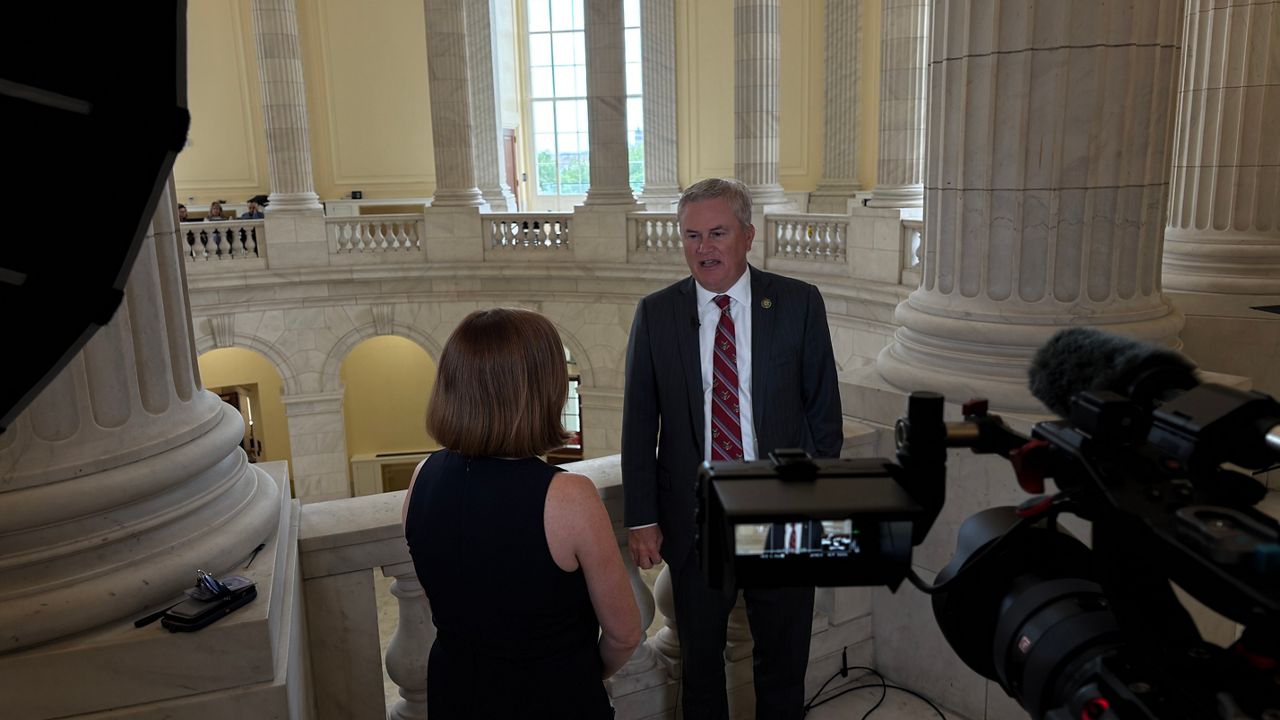
Spectrum News, "Rep. James Comer rejects calls for White House officials' Epstein testimony" (June 2026). Photo: Thomas Lau/Spectrum News.