Ben Cline spent Monday, November 23, holding town halls across Virginia's 6th District — in Waynesboro, then Roanoke, then Harrisonburg. They came days after he was picked to lead the Republican Study Committee, the biggest bloc of conservatives in the House.
At the Harrisonburg stop, according to the Daily News-Record, the main topic was the future of Social Security and Medicaid. A voter asked whether he would support a cap on taxing Social Security. Cline didn't answer. He changed the subject to how bad things will get:
"We need to have a conversation about saving Social Security. The president elected in 2028 will be in office when the Social Security trust fund goes bankrupt."
Then he floated one way to "save" it:
"Do we make it means-tested?"
What "means-tested" means for you
Means-testing Social Security means cutting or cancelling the benefits of retirees whose income is above some level. It sounds like it only hits the rich. It doesn't work that way.
Social Security isn't welfare. You pay into it with every paycheck, and you get back benefits based on what you paid in. Means-testing breaks that promise: you'd pay in your whole working life, and then the government would decide whether you'd earned "too much" to get your money back.
And there's a math problem. There aren't enough rich retirees to save much money. The Center on Budget and Policy Priorities, citing a Center for Economic and Policy Research analysis, found that only about 2% of Social Security benefits go to retirees with $100,000 or more in other income. To save real money, a means test has to reach down into the middle class. (That analysis is from 2011, but the reason behind it hasn't changed: rich retirees are a small group, and their checks are capped.)
The paper's account doesn't say where he'd set the line. That's the problem with floating it at a town hall. Every retiree in the room has to wonder whether it's them.
This isn't a one-off
Cline has been here before. In 2023 he led the Republican Study Committee task force that wrote its budget — the one that would have raised the age for full Social Security benefits to 69, a cut of about 13% for future retirees. Now the caucus has elected him its chair, starting in January.
The trust fund problem is real. If Congress does nothing, the paper reported, benefits would be cut by about 22% when the fund runs dry. But there are two ways to fix it: cut what retirees get, or bring more money in. When a voter asked Cline about the money side — taxes — he skipped it. When he talked about solutions, he talked about cuts: means-testing, and trimming federal spending, which he admitted is hard: "It's hard to tell Congress to stop spending."
He defended the Medicaid cuts, too
The town hall also turned to Medicaid. Cline voted for Trump's 2025 budget bill, which cut Medicaid. He defended it, saying it only changed the program instead of taking coverage away. "If you are able-bodied, you have to work 80 hours a month," he said.
His own district tells a different story. Two months after the bill passed, Augusta Health's medical group — part of the Fishersville hospital system in Cline's district — closed two primary care clinics and an urgent care clinic, pointing to the budget bill as the reason. Patients in Buena Vista, Churchville and Weyers Cave now have to travel farther for a doctor. About 21% of people in Cline's district are on Medicaid.
Across the state, analysts say about 350,000 Virginians could lose health insurance because of what the Republican Congress and the Trump administration did.
The paper noted that the bill includes a $50 billion rural health fund, with $190 million for Virginia. We've looked at that money before: Cline and two other Virginia Republicans took credit for the grant after voting for the same law, which Virginia's Medicaid agency estimates will cost the state's health facilities $26 billion.
Who got in the room
Even getting to ask Cline a question was hard. The Daily News-Record reported that the tickets showed as "sold out" within an hour of being announced, which made many people think there was no point in trying. Cline said in a social media post that the label was there so his staff could verify that people signing up lived in the area. Outside the Harrisonburg courthouse, when Cline passed about a dozen protesters, he told them: "Everybody who applied got in, so you should have applied."
Sixty-five people signed up for the Harrisonburg event. Fewer than half showed up.
What the record shows
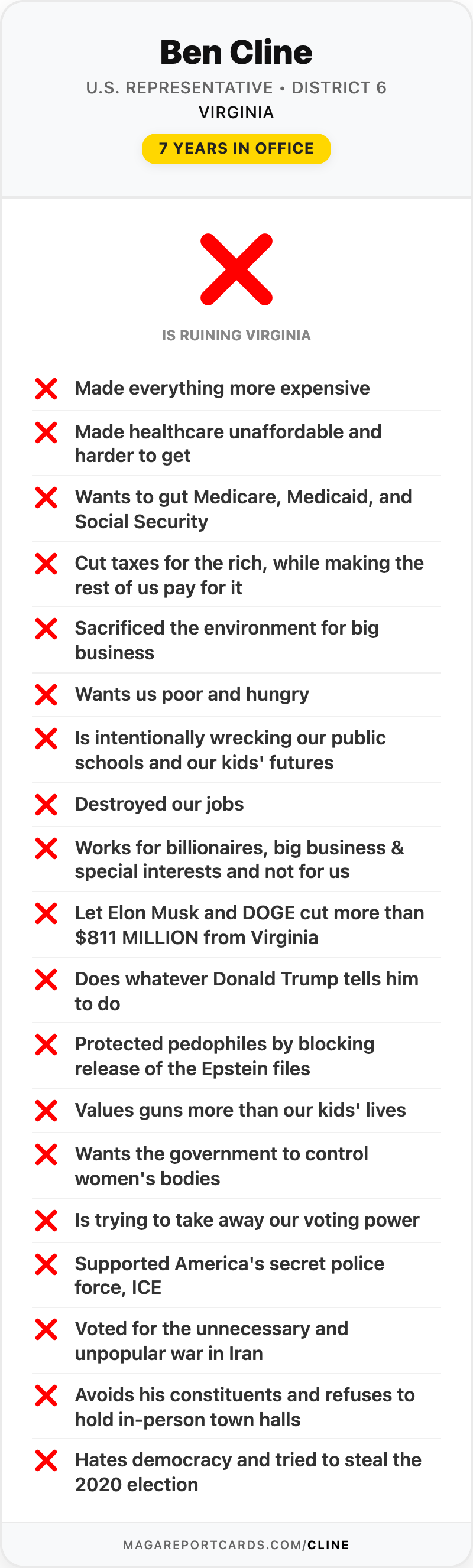
Ben Cline, the incoming chair of the Republican Study Committee, was asked at his town hall about a cap on taxing Social Security. He didn't answer. Instead he floated means-testing benefits — a cut that would have to reach middle-class retirees to save much money. He once led a budget that would have raised the full retirement age to 69. At the same town hall he defended the Medicaid cuts he voted for, even though Augusta Health's medical group closed three clinics in his district in response to them.
Source
- Rep. Ben Cline explains views on Social Security and Medicaid — Daily News-Record