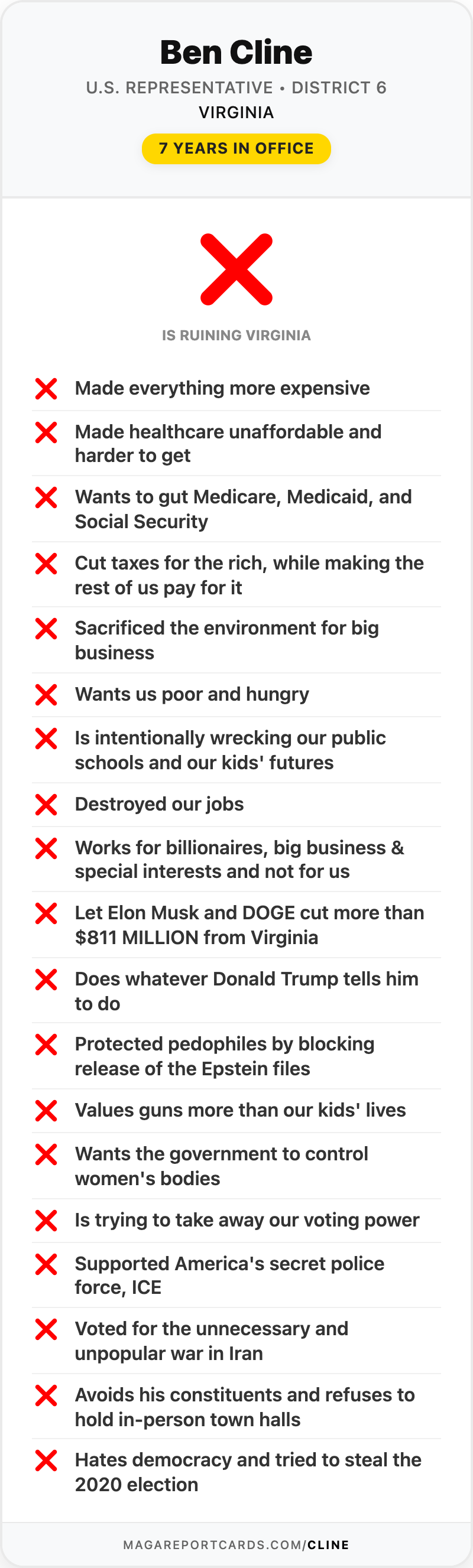
In June 2020, Ben Cline put his name on a resolution condemning the movement to defund the police, and said this about it:
"The United States is grounded in the Rule of Law and calls from the left to 'Defund the Police' are reckless and antithetical to any functioning society... The brutal killing of George Floyd was a tragedy but dismantling our police departments is simply not the answer."
That's from the press release announcing the resolution, dated June 15, 2020.
Nearly six years later, on March 25, 2026, Cline introduced a bill to take federal police funding away from police departments.
Not all of them. Just the ones that won't sign a contract with Immigration and Customs Enforcement.
What the bill actually says
It's called H.R. 8077, the 287(g) Cooperation Act of 2026. It is barely a page long, and the operative paragraph reads:
"Any State or political subdivision of a State that maintains a law enforcement agency that, not later than 180 days after the date of enactment... has not entered into a written memorandum of agreement with the Secretary of Homeland Security under this subsection is ineligible to apply for or receive any grant under the 'Community Oriented Policing Services' program or any successor program administered by the Department of Justice."
Read that carefully, because the reach is bigger than it first looks.
It isn't limited to sanctuary cities. It isn't limited to Virginia. Every state, and every county, city and town in the country that runs a police department, gets 180 days to sign an agreement handing some of its officers' time over to federal immigration enforcement. Miss the deadline and the whole jurisdiction is cut off from any COPS grant. The bill applies to fiscal year 2027 "and each fiscal year thereafter," and it tells the Attorney General to set up procedures for checking, before any grant is awarded, whether the agency has signed.
What COPS money actually pays for
The Community Oriented Policing Services office is the part of the Justice Department that helps local departments hire cops. By its own account it has invested over $20 billion in policing since Congress created it in 1994, and its flagship program, the COPS Hiring Program, exists to pay for hiring or rehiring full-time sworn officers at state, local, tribal and territorial agencies.
That is the money Cline's bill would use as a lever. Sign with ICE, or lose your officer-hiring grants.
Almost every police department in America would be on the wrong side of it
Here's the scale.
There were 17,541 state and local law enforcement agencies in the United States when the Justice Department last counted them, in 2018.
As of August 6, 2026, the date stamped on its own count, ICE reported it had signed 2,179 memorandums of agreement under 287(g), covering 39 states and 2 territories. Some agencies hold more than one, so the number of participating departments is smaller still — and eleven states have none at all.
So the overwhelming majority of police departments in this country have not signed a 287(g) agreement. Under Cline's bill, all of them lose access to federal hiring grants unless they sign one inside six months.
That is a plan to defund the police. It's just conditional.
The reason he wrote it
On February 4, 2026, Virginia Governor Abigail Spanberger issued Executive Directive One, ending the 287(g) agreements that state law enforcement agencies had entered under her predecessor.
Her reasoning, as she put it: "Taking Virginia law enforcement state agency personnel and basically giving them over to ICE is something that ends today."
The directive covered four state agencies — the Virginia State Police, the Department of Corrections, the Department of Wildlife and the Marine Resources Commission. It did not touch local sheriffs. Nearly two dozen local Virginia agencies kept their agreements, untouched.
Cline's response was a bill aimed at every local police department in the United States.
He was explicit about the mechanism. Speaking to WHSV, he said:
"Using the power of the purse, Congress can dictate how funds that they give to localities are used and what, if any, contingencies are put in place."
And:
"We're going to make sure that they can't receive these federal funds unless they're entering into these kinds of 287(g) agreements."
Cline sits on the House Appropriations Committee. The power of the purse is not an abstraction for him; it is his committee assignment. He is describing, accurately, what he is in a position to do.
What the police chief in his own district says
The most striking thing in WHSV's story isn't Cline. It's the police chief in Harrisonburg — a city inside Cline's own district, and one where, by his own biography, Cline served as an assistant Commonwealth's Attorney from 2007 to 2013.
Chief Joe Tucker told WHSV in February, weeks before the bill existed:
"We'll continue to do what we have been doing for a number of years, and that's keeping all residents of Harrisonburg safe — regardless of immigration status, race, you know, any of that."
"My job is to make sure all of my officers are safe and all the citizens are safe, regardless of any of the other noise that is going on currently in America."
That is a local police chief saying his department will go on doing what it has been doing. Under H.R. 8077, that answer would cost Harrisonburg its eligibility for federal officer-hiring money.
There's a reason chiefs resist. Under 287(g), as The Conversation summarized the research, "local police officers can interview people to determine their immigration status" and "issue immigration detainers to jail people" until ICE takes custody. Big-city chiefs who moved their departments away from immigration enforcement gave the same reason: the trust that makes immigrant crime victims and witnesses willing to talk to police at all. And a 2018 Cato Institute study cited in that piece found no evidence the partnerships bring crime rates down.
So a chief who has spent years building that trust is being asked to trade it for a grant application.
What this looks like on the ground in Virginia
This isn't theoretical here.
ICE agents staked out the Chesterfield County courthouse and detained at least 14 people over several days as they showed up for minor matters. One man was picked up while paying a $130 traffic fine.
Cline has voted to expand all of it. He was one of the Republicans who put $70 billion into ICE's budget on a two-vote margin, and one of those who funded the agency's contract to monitor Americans' social media accounts.
Now he wants the local police in the middle of it, and he's willing to withhold their hiring money to get them there.
The through-line
Cline's 2020 statement said dismantling police departments "is simply not the answer."
His 2026 bill says federal support for police departments is conditional on doing immigration work — and that departments which decline, including one in his own district, should be cut off.
Both things can't be principle. One of them is leverage.
H.R. 8077 has 16 cosponsors and sits in the Judiciary Committee. It has not moved. But bills like this one tell you what a member would do with the power if he had it, and Cline, on Appropriations, is closer to that power than almost anyone.
Source
"Rep. Ben Cline proposes bill to reverse Gov. Spanberger's policies on ICE", WHSV, March 26, 2026. Photo: WHSV.