Most of the time, figuring out who a member of Congress actually works for takes digging. You pull the donor records. You match them against the votes. You read the bills nobody covered.
Every so often, someone just tells you.
On April 14, 2026, the National Shooting Sports Foundation — the trade association for the companies that make and sell guns and ammunition in this country — named Ben Cline its 2025 Legislator of the Year.
This is not a gun-owners' group. It is not a hunting club. NSSF is the industry. Its members are manufacturers, distributors and retailers, and its job is to make selling firearms easier and more profitable. When that organization picks one member of Congress out of 435 and calls him its legislator of the year, the citation it publishes is worth reading closely — because it is a list, in the industry's own words, of what he did for them.
Here is what NSSF senior vice president Lawrence G. Keane said:
"The list of legislative achievements by Congressman Cline to support the firearm industry is remarkable."
He's right. Let's go through it.
Achievement one: he helped delete the silencer tax
Since 1934, buying a gun silencer in America has meant paying a $200 federal tax stamp, registering the item, and submitting fingerprints. That law — the National Firearms Act — was written during the gangster era to put the most dangerous categories of weapon and accessory on a federal ledger.
Trump's budget bill wiped out the tax.
Buried inside the same enormous bill that cut Medicaid and food assistance was a provision zeroing out the $200 stamp for silencers, short-barreled rifles and short-barreled shotguns. It took effect January 1, 2026. The items still have to be registered — but the fee that had stood since 1934 is now zero.
NSSF credits Cline with helping get it in there, and does not leave the result to the imagination:
"Rep. Cline also served a key role in securing the historic win in the One Big Beautiful Bill zeroing out the NFA tax, which has resulted in tens of thousands of new suppressor applicants."
Tens of thousands of new applicants. That is the industry counting its winnings.
Achievement two: he leads the bill to pull silencers out of federal law entirely
Cline is the sponsor of H.R. 404, the Hearing Protection Act, which he introduced on January 15, 2025. NSSF praised him for taking the bill over after its previous sponsor retired and growing its cosponsor list; it now sits at 127 cosponsors.
The name sounds like a workplace-safety measure. Read the bill text and four things stand out:
- Strikes silencers out of the National Firearms Act by removing "any silencer" from the law's definition of a firearm — which takes the whole 1934 framework off them.
- Wipes the slate for anyone who already has one: they are "treated as meeting any registration and licensing requirements."
- Overrides the states. Section 4 is headed "Preemption of certain State laws in relation to firearm silencers," and says any state marking, recordkeeping or registration requirement "shall have no force or effect."
- Orders the records destroyed. Within 365 days of enactment, the Attorney General must destroy the existing silencer registrations.
That last one is not deregulation. It is erasure — taking a registry that exists and burning it. We've seen this move before: Andrew Clyde is pressing the ATF to destroy gun transaction records older than 20 years, and Michael Cloud's SHUSH Act strikes silencers out of the same 1934 law and preempts state law in nearly identical words — though even that bill stops short of ordering the existing records destroyed. Cline's goes further.
Cline talks constantly about federal overreach. He is a Freedom Caucus member. But when a state looks at silencers and writes its own rule, his bill reaches into that state from Washington and cancels it.
Achievement three: during the longest shutdown in American history, he wrote a bill about gun paperwork
This is the part that should stay with you.
The federal government shut down on October 1, 2025, and stayed shut for 43 days — the longest shutdown in U.S. history. Federal workers went unpaid. And on November 1, SNAP ran out of money for roughly 42 million Americans, with states scrambling to figure out how to feed people.
About 817,500 Virginians rely on SNAP every month. One in six Virginia children faces hunger.
On October 31, 2025 — day 31 of that shutdown — Cline introduced H.R. 5874, the Firearm Access During Shutdowns Act.
What it does: it takes federal gun functions — the background check system, the ATF's enforcement-programs office that processes silencer paperwork, and the offices that approve firearm export licenses — and declares them, by statute, to relate to
"an emergency involving the safety of human life or the protection of property"
so that the employees doing that work keep working through any future shutdown as "excepted employees."
Read that again. In the middle of a shutdown where food assistance was about to lapse for 42 million people, the bill Cline filed would write into federal law that processing silencer forms and approving gun exports counts as a life-safety emergency.
He did not stop at the bill. NSSF credits him with leading 29 colleagues in a letter pressing the ATF to keep processing National Firearms Act forms while the government was closed.
H.R. 5874 was referred to committee and went nowhere. But 54 members signed on, and the point isn't whether it passed. The point is what a member of Congress reaches for when the government stops and his constituents start calling. Cline reached for the gun forms.
What the industry pays him
The relationship is not one-directional.
NSSF's political action committee has given Cline's campaign money in every election cycle since 2020 — $28,500 in all, according to his own filings with the Federal Election Commission. The most recent check, for $3,000, is dated March 31, 2026.
The award came two weeks later.
NSSF also notes that Cline earned an "A+" on its 2024 congressional report card and made its inaugural "Dean's List" with a 100% record on the bills the industry cared about. A perfect score. Not one vote where he weighed the industry's ask against something else and came down the other way.
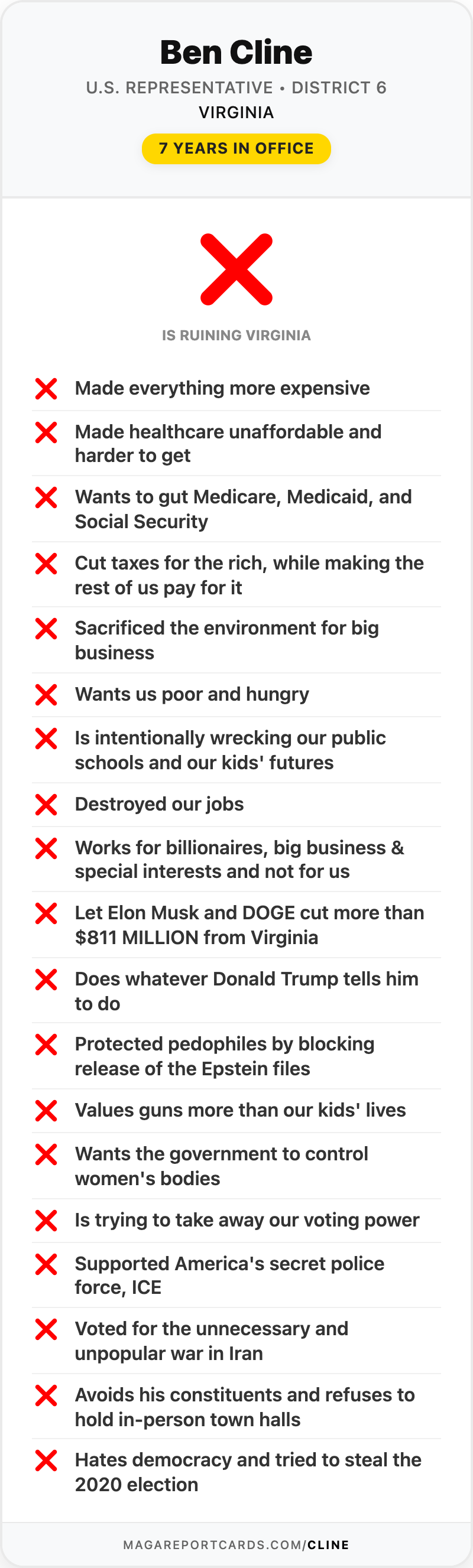
His report card here lists the same trade association among his top funders, alongside the Freedom Caucus Fund and Altria.
What it costs Virginia
Virginia has 12.8 gun deaths per 100,000 people — about 1,200 Virginians a year.
That is roughly three people a day, every day, in the state Cline represents. He sits on the Appropriations Committee, which decides where federal money actually goes, and he has been in Congress since 2019. In seven years he has had the power to move real money at that number.
Instead, the bills with his name on them run the other way: take silencers off the federal registry, destroy the records, override the states that said no, zero out the tax, and keep the export licenses moving when everything else in Washington stops.
The hearing-damage argument in his bill's title is real as far as it goes. Gunfire is loud. But hearing protection costs about thirty dollars at any sporting goods store. It does not require deleting a 92-year-old federal registry, and it does not require burning the records of who owns what.
The tell
Politicians usually work hard to look like they answer to their constituents. What makes this story unusual is that we don't have to guess.
The gun industry evaluated its options in Congress, picked Ben Cline, and published its reasoning. Every item on that list is something he did. Not one of them is something Virginians asked him for.
Source
National Shooting Sports Foundation, "NSSF Honors U.S. Rep. Ben Cline as 2025 Legislator of the Year", April 14, 2026. Photo: NSSF.