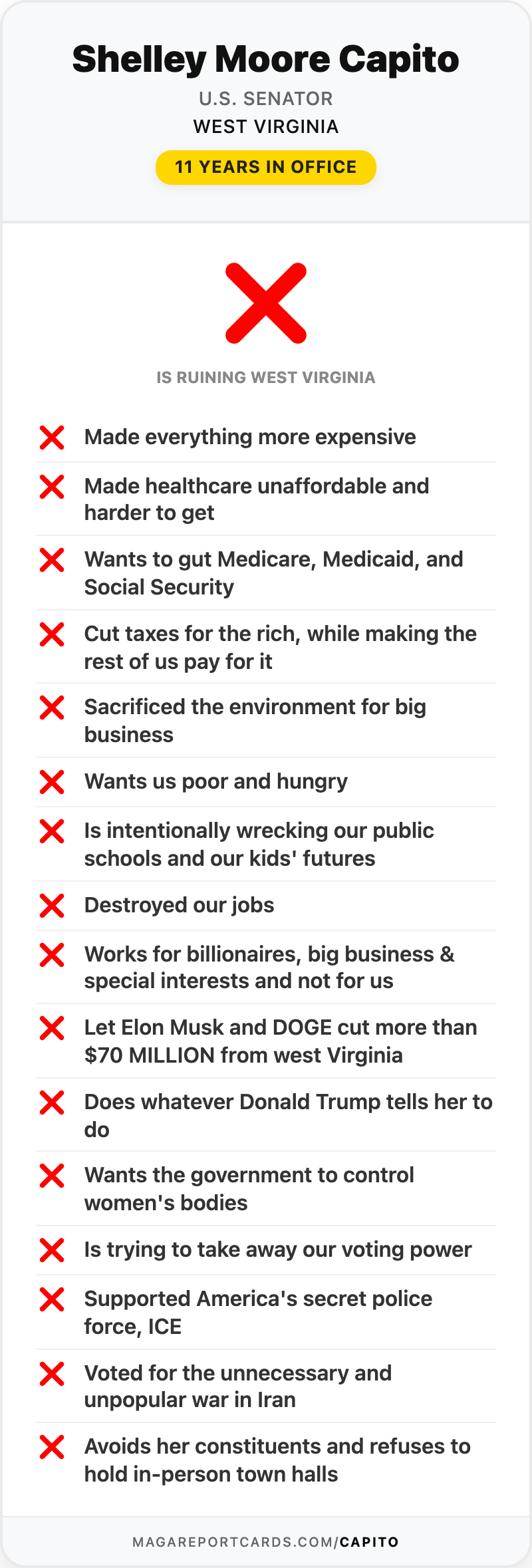
On February 6, 2025, Shelley Moore Capito was asked what she made of Elon Musk's Department of Government Efficiency tearing through federal agencies.
"But for right now, I'm pretty comfortable with the direction that we see," she said in answer to a WV MetroNews question at a news briefing. "I think people wanted things to be disrupted and looked at in a different way." That, she said, "is what Elon Musk brings and his Department of Government Efficiency."
Fifty-four days later, DOGE fired essentially everyone at the one federal facility in West Virginia whose job is to keep coal miners from suffocating.
What happened in Morgantown
On April 1, 2025, West Virginia Watch reported that roughly 200 federal jobs were being eliminated at the National Institute for Occupational Safety and Health facility in Morgantown.
Cathy Tinney-Zara, president of the union local there, said all 185 bargaining-unit employees were in the reduction in force, management was put on administrative leave, and she put the total at about 210 positions. She got word at 5 a.m. that she was fired and would lose building access by midnight. She gave that interview while cleaning out an office she had worked in for more than 30 years.
"It's devastating. People will die," she said.
Officials at the facility, she said, were told the cuts were because the services there were not needed or were duplicative.
"There is no one else in the government that does occupational safety and health. There's no one else in the U.S."
The Morgantown facility runs the Coal Workers' Health Surveillance Program — the free, confidential black lung screening that comes to mining communities in a mobile unit. It can process as many as 5,000 chest X-rays a year from current and former miners, read by specially trained radiologists — and NIOSH is the only body qualified to certify the X-ray that lets a sick miner transfer out of a dusty job.
Take away the readers and the screening stops. Take away the screening and a miner in his thirties keeps cutting rock while his lungs fill in, and nobody tells him until it is too late to matter.
The facility's 674 mice and 37 rats — some in studies running for decades — were expected to be euthanized. The veterinarian required by law to be present had already been let go.
Who actually stopped it
Not the Senate.
It was Harry Wiley, an underground electrician in Raleigh County who had been diagnosed with black lung, who filed a class action against Health and Human Services Secretary Robert F. Kennedy Jr. On May 13, 2025, U.S. District Judge Irene Berger of the Southern District of West Virginia ordered Kennedy and HHS to restore the Respiratory Health Division and the Coal Workers' Health Surveillance Program.
Judge Berger wrote plainly about what was at stake for Wiley: "Remaining in a dusty job may reduce the years in which Mr. Wiley can walk and breathe unassisted, in addition to hastening his death."
The United Mine Workers of America joined a coalition of labor and safety groups in a suit of its own, charging that the administration had bypassed Congress to eliminate the programs. The mobile screening units did not roll again until July 2025. Full staffing was not restored until January 15, 2026 — nine months after the firings.
The union's press release announcing that win is titled "NIOSH Restoration is a Win for Miners, but Progress Delayed has Already Cost Lives."
"While we are glad to see these positions restored, we are disappointed these cuts were made in the first place," UMWA President Brian Sanson said.
Secretary-Treasurer Michael Phillippi spelled out the cost of the gap: freezing the labs forced a pause in enforcement of the new silica dust rule, and "within the mining industry today, we are seeing younger workers in their thirties being diagnosed with advanced black lung because they are cutting more rock than ever before. Every day those labs were empty was a day miners were left unprotected."
Capito's part in it, fairly stated
She did work to get NIOSH back. That is real and it belongs in this story. In the same release, Sanson said: "I want to thank those in and out of Congress who worked with us to get NIOSH back to full staffing, especially Sen. Shelley Moore Capito."
So give her that. Then ask the harder question, which is why a West Virginia senator was ever in the position of begging for it.
Capito is not a bystander to this agency. She chairs the Senate Appropriations Subcommittee on Labor, Health and Human Services, and Education — the subcommittee that writes NIOSH's funding bill. She also voted to confirm Robert F. Kennedy Jr., the man whose department carried out the firings.
And when she raised it with him, at a budget hearing on May 20, 2025 — a week after the judge had already ordered the program restored — here is how she put it:
"I support the president's vision to right-size our government, but as you and I have discussed, I don't think eliminating NIOSH programs will accomplish that goal. I encourage you to look at this closely."
Read that as a West Virginian. Her own state's coal miners had just lost their black lung screening. Her ask was not that the administration stop firing people who keep workers alive. Her ask was that this particular program be spared, while she reaffirmed her support for the project doing the firing. "I encourage you to look at this closely" is not the sentence of someone who controls the money.
She had the power before April 1, not just after. Being "pretty comfortable" in February was a choice about what she would use it for.
It is happening again right now
This is not history. On April 3, 2026, HHS published its fiscal 2027 budget request, and Safety+Health Magazine reported what is in it: NIOSH would be folded into a new National Center for Chemicals and Toxins inside the CDC, and three line items are proposed for elimination — the National Occupational Research Agenda ($120.5 million), "other occupational safety and health research" ($115.1 million), and education and research centers ($32 million).
That is roughly $268 million of occupational safety and health research on the chopping block, one year after the first attempt. NIOSH's mining research program survives the proposal; the cross-industry research agenda that surrounds it does not.
"Congress is expected to weigh in with its budget bills over the coming months," the magazine noted.
Congress, here, means Shelley Moore Capito. It is her subcommittee. She writes the bill.
The pattern is the point
We have watched this same sequence with her before. In July 2025 she cast one of the 50 votes for the budget law that takes more than $1 billion a year from West Virginia's hospitals — and a year later cosponsored a bill to keep rural hospitals from closing. Support the cut, then work the wreckage.
The NIOSH story is the same shape with a sharper edge, because here the fix did not come from Congress at all. It came from a sick coal miner with a lawyer and a federal judge who read the statute.
Capito has represented West Virginia in the Senate since 2015. She is the chair of the Senate Republican Policy Committee and chair of the subcommittee that funds HHS — about as much leverage over this as any single senator gets. A West Virginian is entitled to ask why all of it was pointed at cleanup instead of prevention, and whether, with the same proposal back on her desk in 2026, anything will be different.
Source
"Department of Health and Human Services proposes trimming NIOSH programs," Safety+Health Magazine, April 8, 2026. Photo: G. Edward Johnson/Wikimedia Commons, via Safety+Health Magazine.