If your state has passed a law keeping "forever chemicals" out of food packaging, banning artificial dyes from school food, or requiring baby food to be tested for heavy metals, there is a bill in Washington that would erase it.
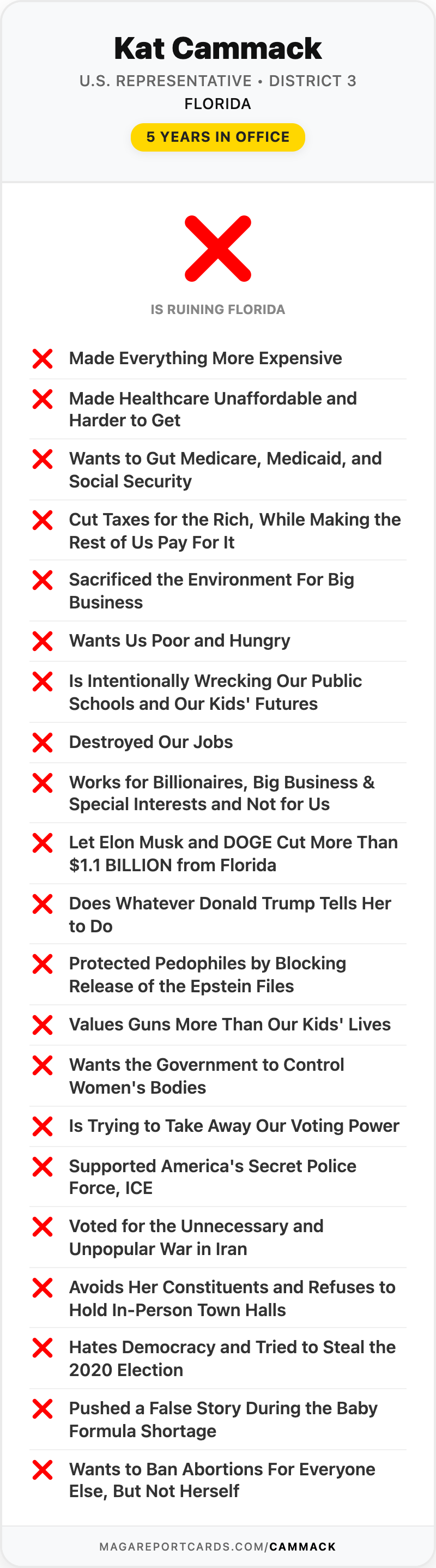
Kat Cammack wrote it.
On April 29, 2026, the House Energy and Commerce Subcommittee on Health held a hearing called "Healthier America: Legislative Proposals on the Regulation and Oversight of Food." Among the 28 proposals debated was a discussion draft released by Cammack — the FDA Review and Evaluation for Safe, Healthy and Affordable Foods Act of 2026, or FRESH Act.
The draft runs to a long list of technical reforms, some of which look like improvements. Buried in it is a provision that takes food-safety power away from the states and hands certainty to the companies that make processed food.
The preemption clause
Here is the operative part, as the food-law trade press describes it. The bill would set a national standard for the "use, sale, labeling, and marketing" of food substances — additives, color additives, GRAS substances, anything that may reasonably become a component of food. And then:
"The provision would preempt any state requirements or prohibitions related to the use, sale, or marketing of such substances in interstate commerce, except those state requirements adopted by public initiative or referendum prior to September 1, 1997."
Read that exception. If a state law was passed by ballot initiative before September 1997, it survives. Everything else states have done since — every legislature, every governor's signature, every one of the last three decades of state food-chemical laws — is wiped.
The two groups fighting it told Food Safety News what falls in that bucket. The Environmental Working Group's reading is that the bill preempts "all state food chemical laws, including those banning the toxic 'forever chemicals' known as PFAS from food packaging and artificial dyes from school food." The Center for Science in the Public Interest says the preemption "squarely targets recent progress on food policy in the states, which includes":
- new bans on harmful chemicals
- requirements for heavy metal testing
- restrictions on the sale of harmful dietary supplements to children
- new allergen and nutrition menu disclosures
CSPI's summary of the clause: it "would broadly wipe out state protections 'related to the use, labeling, sale, or marketing' of food." Consumer Reports said it "would weaken existing regulations that provide a layer of critical protections."
Who asked for this
Not parents. Not state legislators.
Six months before Cammack's draft surfaced, in October 2025, Coca-Cola, PepsiCo, General Mills and Nestlé formed a coalition called Americans for Ingredient Transparency, pushing for exactly this: its published priorities are GRAS reform, national labeling standards and federal preemption of state food-safety laws. The industry asked first. The bill came after.
That is the whole business case. A national soda or cereal company doesn't want to reformulate for California, then again for New York, then again for Texas. Preemption solves that — by taking the option away from the states rather than by meeting the strictest one.
Cammack sits on the Energy and Commerce Committee, which has jurisdiction over the FDA, and on the House Agriculture Committee, which writes the farm bill. The food business pays her accordingly. Federal Election Commission records for her campaign committee show the National Cattlemen's Beef Association PAC has given her $30,000 across the 2022, 2024 and 2026 cycles, and American Crystal Sugar's PAC another $30,000 over the same period — $10,000 apiece from the cattlemen in each of those three cycles. This is a member who writes food policy for a living and is paid by the industry she writes it about.
The GRAS part is worse than the preemption part
"GRAS" stands for "generally recognized as safe," and it is the loophole through which nearly every new food chemical in America enters the food supply.
Food policy scholar Marion Nestle explains how it works: "chemical companies – not the FDA – decide whether a food chemical is safe." Since 2000, she writes, citing an Environmental Working Group analysis, "almost all new chemicals – nearly 99% – have come onto the market through the GRAS loophole."
Cammack's bill does add real things — a mandatory notification system where the current one is voluntary, a public registry, an explicit FDA power to revoke GRAS status. Those are improvements on paper, and that's what makes the draft persuasive.
But look at how the machinery actually runs under it:
- A GRAS notification automatically takes effect after 90 days unless the FDA acts. A missed deadline at an under-resourced agency becomes a safety approval.
- Third-party scientific panels get a formalized pathway: a substance a panel declares GRAS can go on the market immediately upon notifying the FDA. The panels must have conflict-of-interest procedures — and the draft names the industry-funded Flavor Extract Manufacturers Association as an example of one.
- Every substance already treated as GRAS stays on the market, so long as it is listed in the FDA's food-substances database or notified to the agency.
- A new "common food ingredients" category — anything ordinarily consumed before January 1, 1958, and "any substance derived from such ingredients" — is exempted from food-additive review entirely, with the FDA free to expand the category by rulemaking.
The list Nestle reproduces is EWG's, and it is blunter than ours. Top of it: the bill would "allow new food chemicals linked to cancer and reproductive harm to be considered 'safe.'" She prints four of its items and adds "and more" — Food Safety News ran ten. Her own verdict on the whole thing:
"The system is already inadequate; this act would make it worse."
Melanie Benesh of the Environmental Working Group told Food Safety Magazine the draft would "gut rules on the information companies must provide" to the FDA, and — in the magazine's summary of her — would let new substances enter the food supply without an affirmative finding of safety by the agency. Sarah Sorscher of CSPI said it "would broadly block state food safety policies while weakening current FDA authority," and noted it "would not require FDA premarket review of new food chemicals."
Consumer Reports, CSPI and EWG do not agree on everything. They agree on this.
A ceiling, not a floor
The tell in any preemption fight is which direction it runs.
A federal floor sets a minimum and lets states go further if their voters want to. A federal ceiling sets a maximum and forbids them. Cammack's draft is a ceiling. States that decided to keep PFAS out of food packaging or dyes out of school food did so through their own legislatures, and this provision voids that work — while carving out an exception narrow enough to be almost decorative, for ballot measures passed before September 1997.
That is an industry-backed federal ceiling, sold with the vocabulary of ingredient transparency, written by a member whose committee oversees the agency that would set the ceiling's height.
Meanwhile Cammack's own constituents in Florida's 3rd District don't get to ask her about it in person. She does her town halls by telephone, and told the local ABC station that "recently in-person town halls are all about the theatrics." When more than 100 of them held an in-person one anyway in April 2025, they addressed an empty chair, and her office called it a "political stunt."
She has time for Americans for Ingredient Transparency. The rest of us get the registry.
Source
FRESH Act Aims to Preempt State Food Safety Laws, Proposes Controversial GRAS Reforms — Food Safety Magazine, April 24, 2026. Photo: Freepik via Food Safety Magazine.