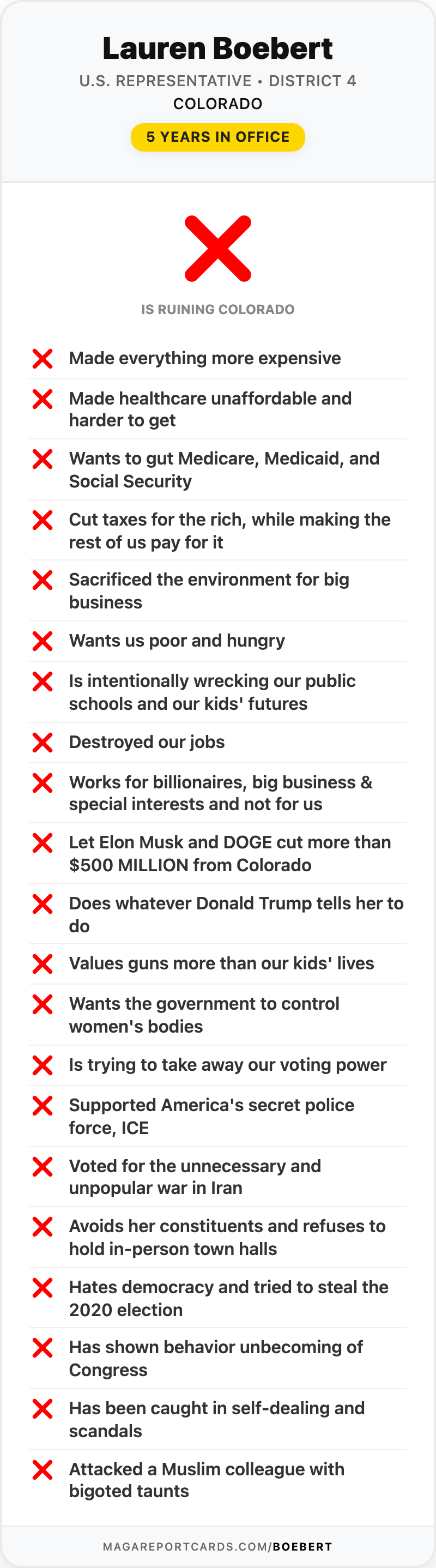
In her only televised debate of the campaign, Lauren Boebert tried to put some distance between herself and Trump's war with Iran.
On October 12, in the 9News debate against Democrat Eileen Laubacher, Boebert said she "never wanted" the country in the war, Colorado Newsline reported, and called it "detrimental on many levels," Axios reported.
Then she explained why she has voted, again and again, to keep it going.
"I do agree that this is expensive, and I hear from Republicans, unaffiliated (voters) and Democrats that they want this to come to an end, and so do I," Boebert said, Colorado Newsline reported. "We are having conversations with the Department of War and with the president on a regular basis about how to come to an end with this. A symbolic procedural vote put on by progressive Democrats is not going to be the answer."
The votes she called symbolic are the tool the War Powers Resolution gives Congress to stop a war the president started.
What the record shows
Under the War Powers Resolution, a member of Congress can force a vote ordering the president to pull U.S. forces out of fighting that Congress never approved. Between March and September, the House voted on that question six times for the Iran war. Here is how Boebert voted, from the House clerk's official records:
- March 5 — No. The resolution failed 212 to 219.
- April 16 — Not voting. The resolution failed 213 to 214.
- May 14 — No. The resolution deadlocked 212 to 212. A tie fails.
- June 3 — No. It passed anyway.
- July 23 — No. It passed anyway.
- September 15 — No. It passed anyway.
Laubacher, a retired Navy rear admiral, said in the debate that Boebert's votes against those resolutions contradict her job to "raise the voices" of the people in her district who oppose the war.
The vote that was decided by one
Look at May 14 again. The House split exactly in half — 212 for ending the war, 212 against. Under House rules a tie loses.
Boebert voted no. If she had voted yes, the count would have been 213 to 211, and the resolution would have passed that day — three weeks before the House finally passed one.
So when Boebert says the votes are "symbolic," it's worth remembering that on the closest one, a yes from her — or from any one of the 212 who voted no — would have passed it. We wrote at the time about how the House came within a single vote of passing a war powers resolution twice, including the two Republicans we track who switched to yes for the tie.
"Symbolic" votes that keep passing
Boebert's other argument — that these are stunts by "progressive Democrats" — doesn't match what happened either. The resolutions that passed in June, July and September passed with Republican votes. On September 15, seven Republicans voted yes as it passed 220 to 204.
None of them has become law. When the Senate finally voted on the House's July resolution on September 24, it failed 49 to 50.
Meanwhile, the bill keeps growing. The same day as the September House vote, the Congressional Budget Office put the war's direct cost at $38.1 billion and said it would push inflation higher into 2027, as we reported then. Boebert agreed on stage that the war "is expensive." She just won't vote to end it.
What she's offering instead
Boebert's alternative is "conversations" with the Pentagon and the president. She didn't say what those conversations have produced. When she spoke, the war she says she never wanted was still going, more than seven months after the House's first vote to stop it.
She also told the debate she stands by Trump's decision as commander in chief, according to Colorado Newsline. By her own account she doesn't like the war. On the record, she has never voted to end it.
What the votes show
In her only televised debate, Lauren Boebert said she "never wanted" the Iran war, called it "detrimental on many levels" and said she wants it to end. The House clerk's records show she voted no on five resolutions to end it — March 5, May 14, June 3, July 23 and September 15 — and did not vote on a sixth on April 16. The May 14 resolution failed in a 212-212 tie; a yes vote from Boebert would have passed it. She called those votes "symbolic."
Source
This post is based on Colorado Newsline's report on the October 12 debate by Sara Wilson, and AlterNet's coverage of Boebert's follow-up attacks on her opponent.