On the night of June 14, 2025, a 30-year-old singer named Nezza stood on the field at Dodger Stadium and sang the national anthem in Spanish.
She had been told not to. A Dodgers staffer had told her, she later shared on TikTok, "We are going to do the song in English today." She sang it in Spanish anyway. Federal immigration agents had been raiding Los Angeles since June 6. Her reason was simple:
"My parents are immigrants. They've been citizens my whole life at this point, but I just can't imagine them being ripped away from me. Not now. Not when I was a kid. Never."
Twenty-six days later, a member of Congress from Oklahoma City decided that this required legislation.
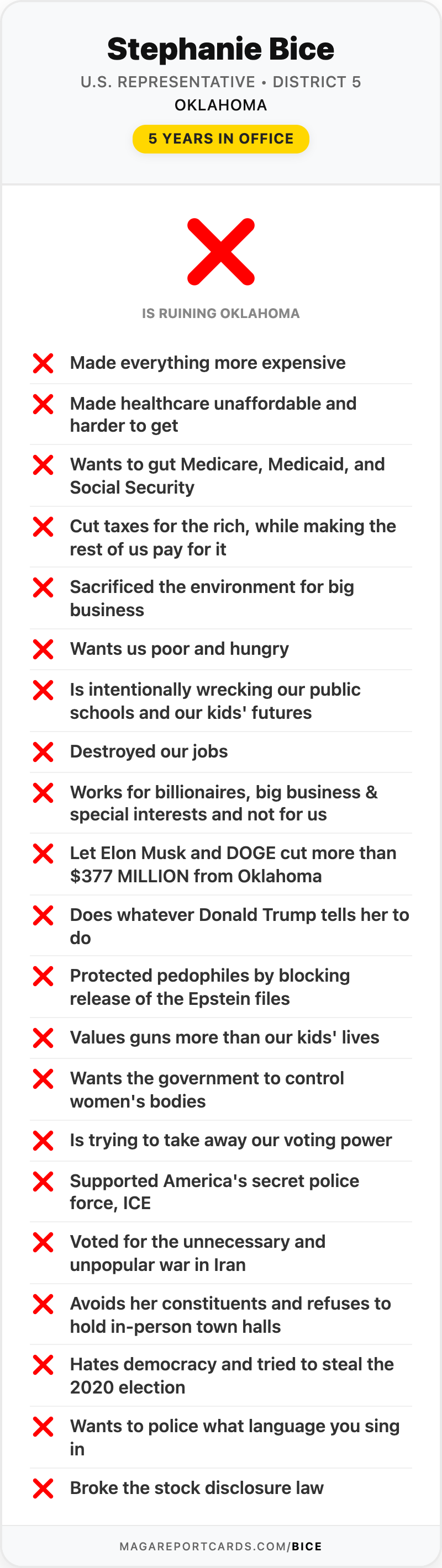
On July 10, 2025, Stephanie Bice introduced H.Con.Res.43 — "Expressing the sense of Congress that any public rendition of 'The Star-Spangled Banner' must be performed as written by Francis Scott Key, in English."
Her explanation, given to the Daily Wire: "The United States is a nation built on shared values, and 'The Star-Spangled Banner' is a symbol of our unity and resilience."
What she actually filed
It's worth being precise about what this thing is, because the reporting wasn't.
It was described as a "joint resolution." It isn't one. A joint resolution goes to the president and, if signed, carries the force of law. What Bice filed is a concurrent resolution — a formal statement of opinion. Even if it passed the House and the Senate unanimously and every member signed it in blood, it would not change a single line of federal law. Nobody could be fined. No stadium could be penalized. It is a press release with a bill number.
And it didn't even get that far. According to the official congressional record for the resolution, here is the complete list of everything that has happened to H.Con.Res.43:
- July 10, 2025 — Submitted in House.
- July 10, 2025 — Referred to the House Committee on the Judiciary.
That's it. That's the whole file. Thirteen months later, it has never had a hearing, never had a markup, never had a vote. Sen. Markwayne Mullin's Senate companion, S.Con.Res.17, was referred to the Senate Judiciary Committee on July 14, 2025 and has sat there ever since.
There's one more tell. The title of Bice's resolution says the anthem "must" be performed in English. The actual operative text — the part that would have been adopted — says it "should" be, and that performers are "encouraged to honor the tradition." The Senate version drops "must" from the title entirely.
So the strong word is in the headline, and the soft word is in the document. That's how you write something built to be reported on rather than enacted.
The Spanish version was commissioned by the United States government
Here is the part that makes the whole exercise collapse.
Nezza did not improvise a translation. She sang "El Pendón Estrellado," and that song exists because the U.S. government paid for it.
In 1945, the State Department's Division of Cultural Cooperation went looking for an official Spanish-language version of the anthem to distribute in Latin America — part of the Good Neighbor policy. A Peruvian-American composer in Brooklyn named Clotilde Arias won. The State Department paid her $150 for what its own letter called a "satisfactory translation." Her version is the only official translation of the national anthem cleared for performance, and it still is today. Her original music manuscript is in the collection of the Smithsonian's National Museum of American History, which built an exhibition around her life and commissioned a choir to record and perform it for the exhibition.
So a congresswoman filed a resolution declaring that a song the United States commissioned, paid for, and sent out into the world shouldn't be performed.
There's a second problem with "as written by Francis Scott Key." Key wrote four verses. At a ballgame you get one. Under the standard Bice put in her own title, essentially every performance of the national anthem in America — including every English one — falls short.
Who she was writing this about
Bice represents Oklahoma's 5th District, which is centered on Oklahoma City.
According to the Census Bureau, 22.1% of Oklahoma City is Hispanic or Latino, and 21.6% of residents over age five speak a language other than English at home. That's more than one in five of her neighbors.
Those are the people the resolution is aimed at. Not the Dodgers. Not a singer in Los Angeles. The message lands at home, on the people in her own city who speak Spanish at the dinner table and are now being told, by a congresswoman from their own city, that there's a wrong language to be patriotic in.
And the trigger matters. Nezza wasn't making a statement about music. She was protesting immigration raids. The thing Bice moved to formally discourage was a protest — a person using the anthem to say something about her own government. That is about as close to the core of the First Amendment as it gets. It is also, probably, why the operative text only "encourages" and never requires: a rule would have to survive a court.
What was happening in Oklahoma that same summer
While this resolution was being drafted, filed, and press-released, here is what Bice's constituents were dealing with.
Hospitals. Oklahoma hospital leaders were warning that the budget bill Bice voted for could cut federal reimbursements to Oklahoma hospitals by $8.7 billion over the next decade and eliminate nearly 15,000 jobs. That warning ran on June 27, 2025 — two weeks before she filed the anthem resolution.
Food. Two weeks after she filed it, Oklahoma Watch reported that the same bill put 131,000 Oklahomans at risk of losing SNAP benefits.
Health insurance. By that fall, with the enhanced ACA tax credits set to expire, a 60-year-old Oklahoma couple earning $85,000 was looking at annual premiums going from $7,225 to $30,784. The same Census profile for Oklahoma City shows 15.7% of people under 65 already have no health insurance at all, and 15.1% live in poverty.
Access. At the end of July, a constituent finally got a question through on one of her telephone town halls — by pretending to ask about something else — and told her the phone events are "a joke, and are screened, carefully screened." The caller asked why she wouldn't look her constituents in the face. Her answer: "I am never going to get that kind of engagement if I'm doing in-person town halls."
She had time to legislate the language of a song sung at a ballpark in Los Angeles. She did not have time to stand in a room in Oklahoma City and take questions about the hospitals.
Eleven other members signed on
This wasn't a solo act. H.Con.Res.43 picked up eleven cosponsors, every one of them a Republican: Mike Rogers and Barry Moore of Alabama, Randy Feenstra and Mariannette Miller-Meeks of Iowa, Gregory Murphy and David Rouzer of North Carolina, Troy Downing of Montana, Erin Houchin of Indiana, Buddy Carter of Georgia, Ralph Norman of South Carolina, and Derrick Van Orden of Wisconsin.
Twelve members of Congress, one week's work, on a document that cannot become law and never got a vote.
This is a genre now
If the pattern feels familiar, that's because we keep writing it down.
In February 2026, Missouri's Mark Alford went on cable news and said House Republicans were investigating Bad Bunny's Super Bowl halftime show, threatened to call the FCC chairman about it, and admitted in the same breath that he doesn't speak fluent Spanish — he was reacting to what he'd heard about the lyrics, not the lyrics.
In October 2025, during a government shutdown, Nebraska congressional candidate Brinker Harding posted his own version of the White House's sombrero memes, then defended it when the former head of a Latino group he'd asked to join asked him to delete it and apologize.
And in 2019, Missouri's Jason Smith shouted "Go back to Puerto Rico!" across the House floor at a Latino colleague, then wouldn't own up to it when the man turned around and asked who said it.
Different states, different props — a halftime show, a hat, a song. Same move every time: pick something a lot of Latino Americans love, declare it un-American, and let the news cycle do the rest. It costs nothing, it fixes nothing, and it never once lowered a grocery bill.
The scoreboard
Bice's resolution has now been sitting in the House Judiciary Committee, untouched, for over a year. In that same period, the hospital cuts she voted for went on the books, the SNAP cuts went on the books, and the premium increases hit.
The anthem is still sung in English at almost every game in America, exactly as it was before she filed anything. Nothing she did changed that, because nothing she did was supposed to.
What it was supposed to do was tell one in five people in Oklahoma City where they stand. That part worked.
Source
After Spanish National Anthem Debacle, Lawmakers Move To Keep 'The Star Spangled Banner' In English — Spencer Lindquist, The Daily Wire, July 14, 2025. Photo: Elizabeth Conley/Houston Chronicle via Getty Images.