In October 2025, the federal government was shut down. People were about to lose food assistance. People were about to lose health coverage. And the White House was answering with pictures of Democrats in sombreros.
Brinker Harding, the Republican running for Congress in Nebraska's 2nd District, decided to join in.
He posted a campaign video on his own social media riffing on the memes. "Get back to work and the sombreros go away," he said in the post.
Then the woman who had led the Latino group he personally asked to join two years earlier asked him to take it down and apologize.
He didn't. He went on camera and defended it.
Where the sombreros came from
This wasn't a meme Harding invented. It started at the top.
In late September 2025, right after meeting with Democratic leaders about avoiding a shutdown, President Trump posted an AI-generated video showing House Minority Leader Hakeem Jeffries — who is Black — wearing a fake mustache and a sombrero, with mariachi music playing underneath.
Jeffries didn't laugh it off. He said it at a rally on the House steps the next day: "Mr. President, the next time you have something to say about me, don't cop out through a racist and fake AI video."
Vice President JD Vance was asked about it and said: "Oh, I think it's funny. The President's joking and we're having a good time." Then he turned it into a hostage note:
"I'll tell Hakeem Jeffries right now, I make the solemn promise to you that if you help us reopen the government, the sombrero memes we'll stop."
That's the line Harding picked up and ran with. The same day, White House deputy communications director Kaelan Dorr made it official policy: "The sombreros will continue until the government reopens."
So the pitch to voters in Omaha was: a Nebraska congressional candidate saw the vice president openly using a racial caricature as leverage in a budget fight, and his reaction was to make his own version of it.
What the shutdown was actually doing to Nebraska
Denise Powell, then one of the Democrats running for the seat, called it "political theater."
"It is not a time for racist and juvenile memes," Powell said.
She then listed what was actually happening to people in the state while the memes flew: "We have 150,000 people who are about to lose their SNAP benefits next month. We have 110,000 people that are gonna lose their ACA coverage. People are gonna go hungry."
Those aren't abstractions in NE-02. Nearly 23,000 households in this district use SNAP to buy groceries, according to USDA's own district dashboard. More than 15,000 people in the district are projected to lose health coverage by 2034, according to the Joint Economic Committee's House minority — about half of them on Medicaid under the budget law Harding celebrated on the day it was signed, the rest on Affordable Care Act coverage.
Powell won the Democratic primary on May 12, 2026, so she's the person Harding faces in November.
He was asked to fix it. He defended it instead.
Here is the part that turns a bad post into a record.
The criticism didn't only come from his opponent. It came from LULAC — the League of United Latin American Citizens, a national organization that advocates for Latin Americans. And it came from someone Harding knew personally.
Harding asked to be on the LULAC Nebraska Council in 2023. Elsa Aranda was the council's president at the time.
"Brinker Harding and I, in my role as state director and as president had always been one of mutual respect, and I don't know what drove him to use a sombrero and the graphics that he used, but it makes me angry to think that he feels he can mock the Latino community," Aranda said.
Aranda asked him to delete the video and apologize to the Latino community.
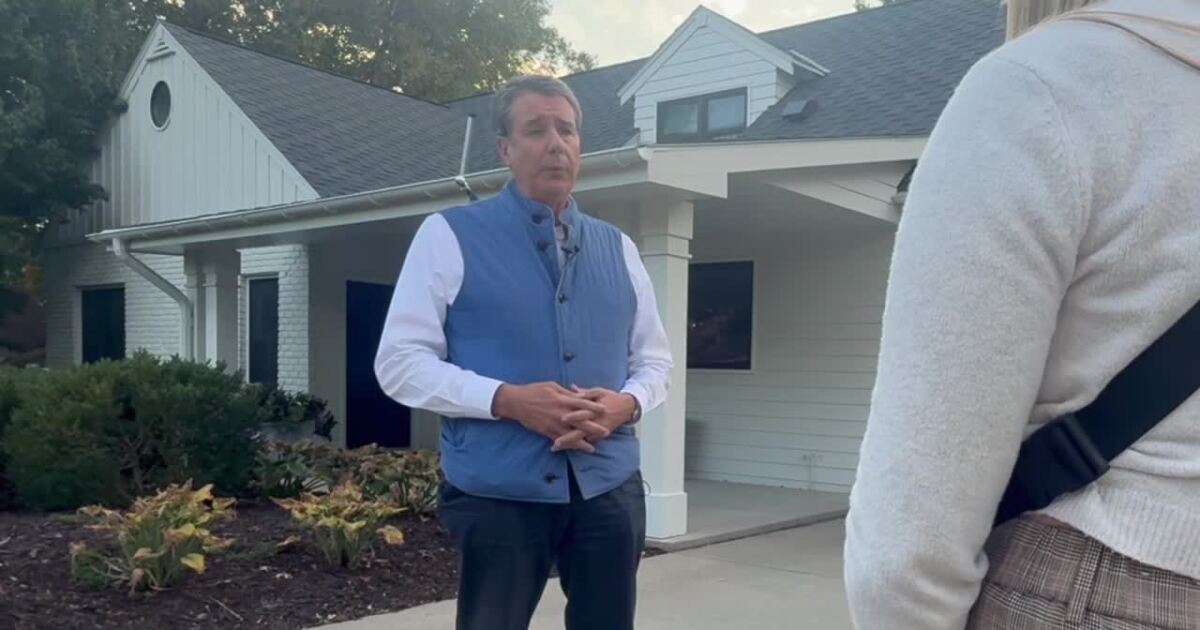
That was a door held wide open. Delete a post, say you got it wrong, move on. Instead, in a one-on-one interview, Harding defended the video and argued that memes are a funny and effective way to get a point across:
"If I use a meme to get that point across, I think that's an effective way to do it because there are military families and single mothers not getting the resources that they need to survive. And for Denise Powell to make a political issue out of it and whine about it and, and clearly she obviously has said that I'm the front runner and I appreciate that, Denise."
Read that again. His defense of mocking Latinos was that he was standing up for military families and single mothers who weren't getting resources — during a shutdown his own party was using the memes to win.
He didn't apologize to Aranda. He took a victory lap about being the front-runner.
Six months later, he wrote down the exact standard he'd failed
In April 2026, the Jewish Community Relations Council of Omaha sent every NE-02 candidate a written questionnaire. Harding answered it at length. His answers are worth putting side by side with what he'd done six months earlier.
Asked how he would engage with faith-based and minority communities:
"Consistently and genuinely. I've spent my career building coalitions across Omaha — across party lines, faiths, and backgrounds — because I believe relationships are the foundation of good governance."
Asked how he would respond to acts of hate or bias affecting any community in NE-02:
"I would, and have spoken out immediately and unequivocally to acts of hate or bias in NE-02... Hate directed at any community in NE-02 is unacceptable, and elected officials have a responsibility to say so clearly. As someone who has spent decades building coalitions across Omaha, I know that communities are stronger when leaders show up for one another."
Asked what responsibilities elected officials have in promoting civil discourse:
"Elected officials set the tone. When leaders use their platforms to inflame division, dehumanize opponents, or spread misinformation, they erode the trust that makes self-governance possible. I believe in winning arguments with evidence and persuasion — not fear or falsehood."
And asked how he'd keep extremist rhetoric from targeting minority communities:
"Extremist rhetoric and misinformation thrive when leaders stay quiet. I believe elected officials have an obligation to speak plainly when hate targets any community."
Every one of those sentences describes something he had the chance to do in October 2025 and chose not to do. A leader used his platform to amplify a racial caricature. A minority community said it felt mocked. Its leaders asked him to speak plainly. He stayed quiet on the apology and loud on the meme.
He also told the JCRC that "the federal government has a responsibility to ensure every American (regardless of religion, background, or ethnicity) can participate fully in civic life free from fear." That's a good sentence. It's just not what he did when the community in question was the Latino one.
This is a pattern, not a one-off
Harding is not the only Republican who thinks mocking Latinos is a campaign strategy.
Missouri's Jason Smith screamed "Go back to Puerto Rico!" across the House floor at a Latino colleague during the 2019 shutdown — his excuse, then, was that Democrats had gone to Puerto Rico during the shutdown. Missouri's Mark Alford went on cable news and said House Republicans were investigating Bad Bunny's Spanish-language Super Bowl halftime show, then admitted in the same breath that he couldn't understand it.
The formula is always the same: use a Latino stereotype to score a point, then act baffled that anyone took offense.
What this tells you about the job he wants
The 2nd District is Omaha and the area around it. Whoever wins represents everybody in it — including the Latino families whose neighbors, coworkers, and kids saw that video.
Harding wrote in the same voter guide that a good representative "knows their communities, understands their concerns, and remains accessible long after Election Day." He had a real community, with a real concern, and a former council president he already knew, asking him for one small thing.
He said no, and told a camera the meme was working.
One more thing worth knowing. The opponent who called the memes "racist and juvenile" is Denise Powell, who says she is "the first Latina to ever file to run for federal office in the history of our state." That's who Brinker Harding is running against in November, and that's who he decided to answer with a sombrero joke.
We deserve better.
Source
KMTV 3 News Now: "'Sombrero memes' in Nebraska congressional race draw criticism from community advocates," October 20, 2025. Photo: KMTV 3 News Now.