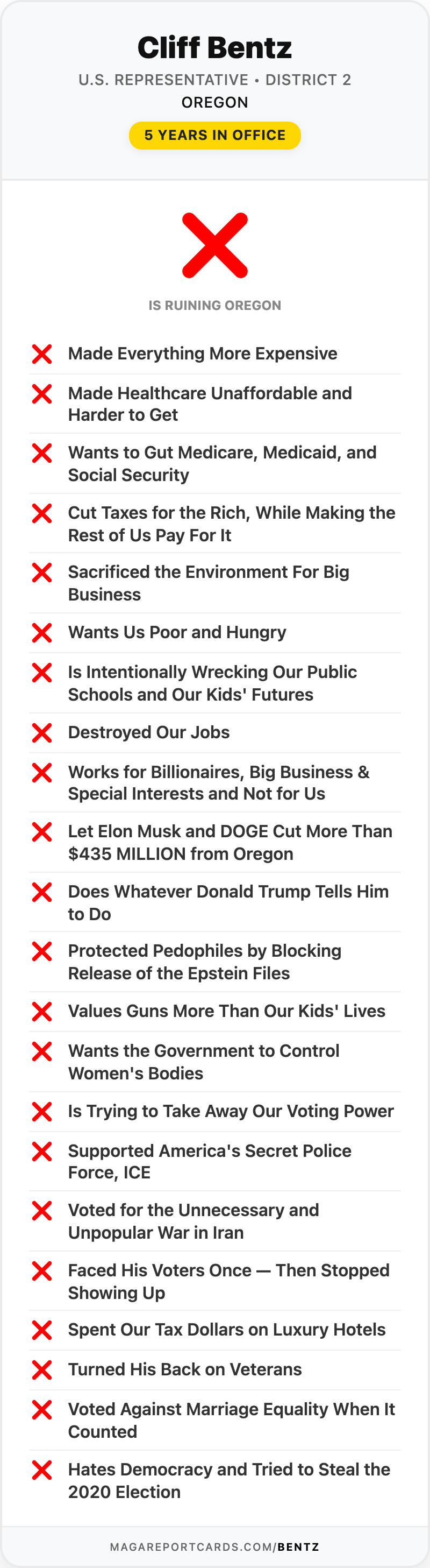
On January 27, 2026, Cliff Bentz sat down with the Baker City Herald and said something his voters had never heard him say in public.
He disagrees with how Trump is doing the deportations.
Not all of it. He supports removing people who came here illegally and committed crimes in their home countries — a group he put at about 1 million people. But the crackdown has also swept up people with no criminal record, and on that, he told the reporter plainly: "I disagree with that approach."
Then he explained where he'd been saying so. Not on the House floor. Not in a press release. In private meetings with Stephen Miller, the White House deputy chief of staff who designed the policy.
Bentz said he belongs to the Main Street Caucus, a group of about 85 House Republicans, and that the group had spent about six months urging the administration to focus on immigrants with criminal records and to make sure enforcement is done lawfully. He was part of a delegation that met with Miller directly. "We've expressed to him our concerns," Bentz said.
Six months before late January 2026 puts the start of that private lobbying campaign in late July 2025.
Three weeks earlier, he voted to pay for all of it
On July 3, 2025, Bentz voted for Trump's budget bill. His "Aye" is on the roll call. Trump signed it the next day.
The American Immigration Council called it "the largest investment in detention and deportation in U.S. history". Its line-by-line breakdown puts the total at $170.7 billion for immigration and border enforcement, including:
| What it funds | Amount |
|---|---|
| Detention capacity expansion, including family detention | $45 billion |
| Enforcement and removal — hiring ICE agents, transportation, detaining families | $29.9 billion |
| State immigration and border enforcement cost-reimbursement funds | $13.5 billion |
That's roughly $75 billion handed directly to ICE for detention and deportation operations. The Council calculates it raises ICE's detention budget to at least $14 billion a year — a 308 percent increase over 2024, and more than the entire federal Bureau of Prisons budget.
The Council notes that the agencies receiving this money have "significant discretion as to how to allocate them" over the next 51 months. In other words, the bill bought agents, buses and beds, and left the decisions about whom to arrest to the administration Bentz says he's been privately asking to be more careful.
So the sequence, by his own account, is: vote to build the machine on July 3, then spend the next six months asking the man operating it to please point it somewhere else.
He hadn't heard about the raid in his own district
The same interview contains one more line worth sitting with. Bentz said he has not heard of any ICE operations in his district.
Here is what happened in his district.
On July 30, 2025 — four weeks after his vote — federal agents executed search warrants at 11 sites across Medford, Central Point, Eagle Point and Grants Pass. All four are in Oregon's 2nd District. Seventeen cannabis workers were detained and handed to ICE, then bused overnight to the Northwest ICE Processing Center in Tacoma, Washington.
Volunteers tracked the bus by license plate from the Medford ICE facility to the Washington detention center and confirmed who was inside using names and birthdates supplied by families whose relatives never came home from work. The Drug Enforcement Administration eventually confirmed the arrests. Ashland.news reported the whole thing on December 20, 2025, calling it one of the largest such enforcement actions in Oregon since the crackdown began.
That story ran in his district five weeks before he said he hadn't heard of any operations there.
It kept going after the interview, too. By late May 2026, six people were taken into custody in public places in the Rogue Valley in eleven days — including outside the Jackson County Circuit Court in Medford — by the count of Rogue Valley Migra Watch, the volunteer group tracking ICE there, which says it was the first confirmed courthouse detention in the valley. Local volunteers had by then trained more than 200 people to spot and report ICE activity in southern Oregon.
Bentz's district covers most of Oregon east of the Cascades plus Jackson and Josephine counties in the southwest. It is farm country — orchards, cattle, cannabis, watermelon, onions. The people ICE is picking up are, in many cases, the people harvesting his district's crops.
Private disagreement isn't a record
There's a pattern here that shows up again and again in this Congress: what a Republican says behind a closed door and what they do on the board are two different things. In Iowa, Ashley Hinson privately told a voter at a campaign stop that the Iran war was a "political liability" while voting seven times in public to keep it going. Bentz's version is quieter but works the same way — a real objection, expressed only where it costs him nothing.
Asked about the January killings of two Minneapolis residents by federal agents — the deaths he cited as showing the need for a new strategy — Bentz wouldn't say whether the shootings were justified. He cautioned against "prejudging" based on videos, noting that those images don't tell a complete story of what preceded the shootings.
By his own account the objection has only ever been made in private. The vote to pay for it is the part that is on the record.
He also stopped taking questions in person
The same interview covered why his constituents could not ask him about any of this face to face.
Bentz switched from in-person town halls to phone events in 2025. In January he gave two reasons: concern for his physical safety, and that protests make dialogue impossible. He said he'd hold in-person events again but had none scheduled. "I really enjoy my town hall meetings, very very much," he said. "I'd be more than happy to (resume) if we can make them productive."
He held no in-person town hall between February 2025 — when four of them across eastern Oregon drew crowds up to five times his usual turnout and one room in deep-red Union County shouted him down until he snapped, "If you just came here to yell, I can leave — do you want me to do that?" — and late August 2026, when he scheduled four of them on wildfires, in Klamath, Harney, Crook and Jefferson counties. None was in the Rogue Valley. His phone town halls, he said, drew 31,000 to 32,000 callers — a number that sounds enormous until you remember he answered fewer than a dozen questions in an hour at one of them.
It's a tidy arrangement. The disagreement goes to Stephen Miller in a private meeting. The vote goes on the board in public. And the constituents whose neighbors got put on a bus to Tacoma don't get to ask about either one.
Bentz has represented Oregon's 2nd District since 2021 — five years, and the only Republican in Oregon's congressional delegation. Congress paid for the surveillance and enforcement apparatus he now says he has concerns about; we wrote about one piece of it, the social media dragnet, here.
Source
Bentz advocates for 'different approach' on deportations — Jayson Jacoby, Baker City Herald, January 27, 2026. Photo: La Grande Observer.