In October 2025, delegates at the Alaska Federation of Natives convention voted to formally oppose a bill written by their own congressman.
It was Resolution 25-42, and its operative line is one sentence: the delegates "express our opposition to the HB draft currently being considered in the House Natural Resources Committee." The amendments were Nick Begich's.
Begich's response, reported by KNOM's Ben Townsend, was that he had only been asking:
"It was presented for the purposes of soliciting feedback, and we'll certainly take that feedback under consideration."
The feedback had been arriving for months. He had not taken it under consideration then either.
What the draft would actually do
The Marine Mammal Protection Act became law in 1972, after commercial hunting had pushed whale species close to extinction. Today tens of thousands of whales migrate to and around Alaska's waters every year.
On July 22, 2025, Begich brought a "discussion draft" rewriting it to the House Subcommittee on Water, Wildlife, and Fisheries. Kodiak's KMXT reported what was in it, and the draft itself — 32 pages, filed under his name on July 8, 2025 — spells it out:
- The law's population goal, "optimum sustainable population," is rewritten by striking the words "which will result in the maximum productivity" and inserting "necessary to support the continued survival." In plain terms: from thriving to not extinct yet.
- The language defining harm and harassment of marine mammals is softened.
- Permits get automatic approval on a clock. A request "shall be deemed approved and the applicant may proceed with the specified activity" if the Secretary fails to act within 165 days. A second category is deemed approved after 135 days. Nobody has to have read it.
- One provision states that two key prohibitions of the Endangered Species Act "shall not apply" to a marine mammal taken under one of those authorizations.
Begich's stated reason was that the law causes "confusion, delay, and unintended harm," and that it has held up energy development and port construction.
The witness who backed him up at that hearing was Forrest Burkholder, president and CEO of SAExploration, a Texas-based seismic survey company that works for the oil industry. Burkholder testified that "decades of regulation and litigation" had caused the act "to be interpreted far more expansively than Congress intended."
"My goal is simple," Begich said. "I want a bill that protects marine mammals and also works for the people who live and work alongside them."
The people who live and work alongside them said no
Alaska Native organizations did not read it as protection.
August 4, 2025 — Kawerak, Inc., the regional tribal nonprofit for the Bering Strait region, sent a letter warning that the amendments "would undo decades of progress and risk irreparable harm" to marine ecosystems and the communities that depend on them.
August 25, 2025 — the Eskimo Walrus Commission opposed the proposal in a letter signed by its director, Vera Metcalf, urging Begich to move carefully and to bring Alaska Native co-management organizations into the process.
October 18, 2025 — AFN delegates passed Resolution 25-42, submitted by the Nome Eskimo Community and the Bering Straits Regional Caucus. It warned the changes would weaken protections for the whales, seals and polar bears that Alaska Native subsistence and culture depend on.
Delbert Rexford, a delegate from the Ukpeaġvik Iñupiat Corporation, put the stakes directly:
"The magnitude of the intent to amend MMPA is going to threaten and jeopardize our continued protection of subsistence harvest."
That is the part worth sitting with. Alaska Native communities harvest marine mammals under the Marine Mammal Protection Act's own subsistence exemption. Their right to hunt is written into the same law Begich proposed to loosen for industry. When populations crash, the subsistence harvest is what gets restricted — not the seismic surveys.
The whales are already dying
This wasn't a theoretical debate about paperwork.
Between 2018 and 2023, nearly one-third of the Eastern North Pacific gray whale population died in what NOAA declared an unusual mortality event. The federal scientists found the whales died mainly of starvation, with others killed by orcas, entanglement in fishing gear, and ship strikes.
Matt Van Daele, natural resources director for the Sun'aq Tribe, told KMXT that at least 10 dead gray whales and another 10 humpbacks had been reported in the area that summer alone, three of them washed up on Kodiak's road system.
Lauren Eckert, board president of the Alaska Whale Foundation, told KMXT that the permitting process is deliberately slow, and that speeding it up could do irreparable damage: "Large projects may be approved because there's no ability to regulate them under this incidental harm concern only for us to find out and provide evidence 10 years later that a project has caused considerable harm to a species, at which point, it may be too late."
To be fair to Begich: the Alaska Department of Fish and Game backed the effort, publishing a key-points document on September 23, 2025 supporting an update to the law. Begich also argued that marine mammal predation is itself hurting subsistence harvests.
But a state agency's endorsement is not the same as the consent of the people whose food security is on the line. AFN, Kawerak and the Eskimo Walrus Commission all represent those people. All three said no.
"Soliciting feedback" is not an answer
After the July hearing, the subcommittee adjourned without acting and set the marine mammal rewrite aside. It has not moved since. The MMPA bills Begich has formally introduced are all narrow ones, and not one of them is the rewrite. The ARTIST Act (H.R. 5694), filed October 6, 2025, bars states from banning the sale of Alaska Native ivory, bone and baleen handicrafts. H.R. 6251, filed on November 21 — a month after the AFN vote — would let hunters import polar bear trophies from sport hunts in Canada. H.R. 8401, from April 2026, would allow the sale of pelts and handicrafts from northern sea otters taken for subsistence.
So the draft is sitting there. Not withdrawn. Not rewritten with the co-management organizations at the table, the way the Eskimo Walrus Commission asked. Just quiet.
Begich says he was soliciting feedback. He got it, in writing, from Kawerak and the Eskimo Walrus Commission, and then on the floor of the AFN convention by formal vote. A congressman who meant it would have said what he was changing.
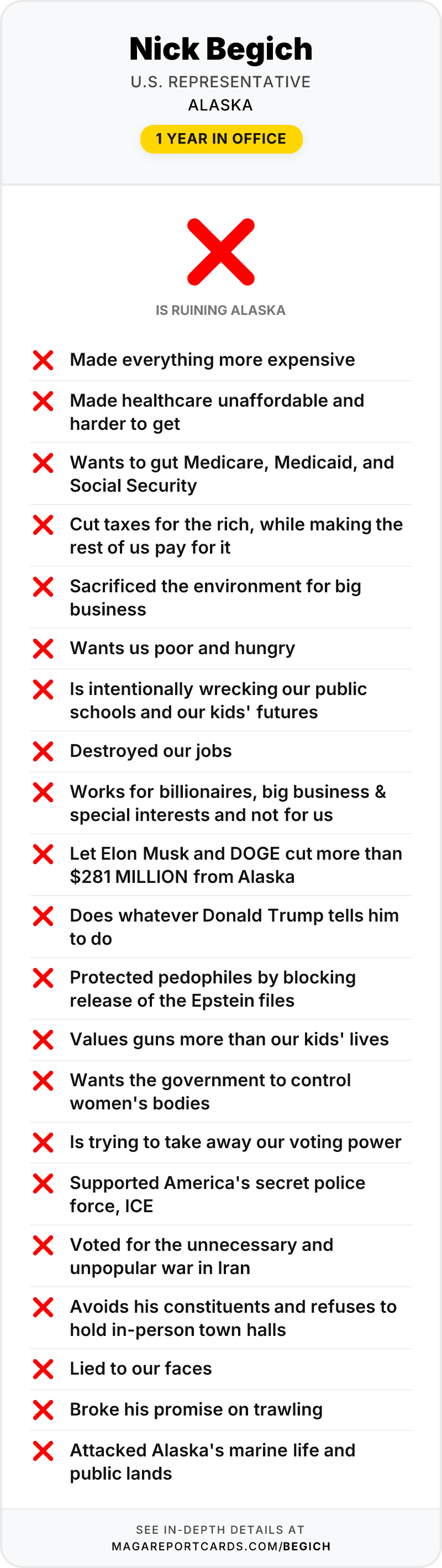
It fits a habit. In March 2026, National Fisherman reported that more than 5,000 Alaskans had signed a letter delivered to Begich urging him to pursue a ban on bottom trawling in federal waters off Alaska. Melissa Norris of Fish Alaska Magazine, one of the people quoted, said Begich had told Alaskans on the campaign trail that "domestic trawling is not sustainable and major reform is needed" — and then put it the same way the marine mammal fight ended: "Alaskans are still waiting to hear from Nick following through on the stance he took during the campaign."
And it's the same congressman who won't hold an in-person town hall — whose own campaign rally with the Speaker of the House this month required a photo ID and barred reporters.
Alaskans keep telling him what they want. He keeps saying he's listening.
Source
Ben Townsend, "AFN delegates vote to oppose proposed Marine Mammal Act changes," KNOM, October 18, 2025, and Brian Venua, "Begich proposes to roll back parts of the Marine Mammal Protection Act," KMXT, July 29, 2025. Photo: Ben Townsend/KNOM.