On January 20, 2025, Donald Trump signed an executive order declaring that babies born in the United States to parents here illegally or temporarily are not citizens.
The next day, Brian Babin refiled his bill to put it in federal law.
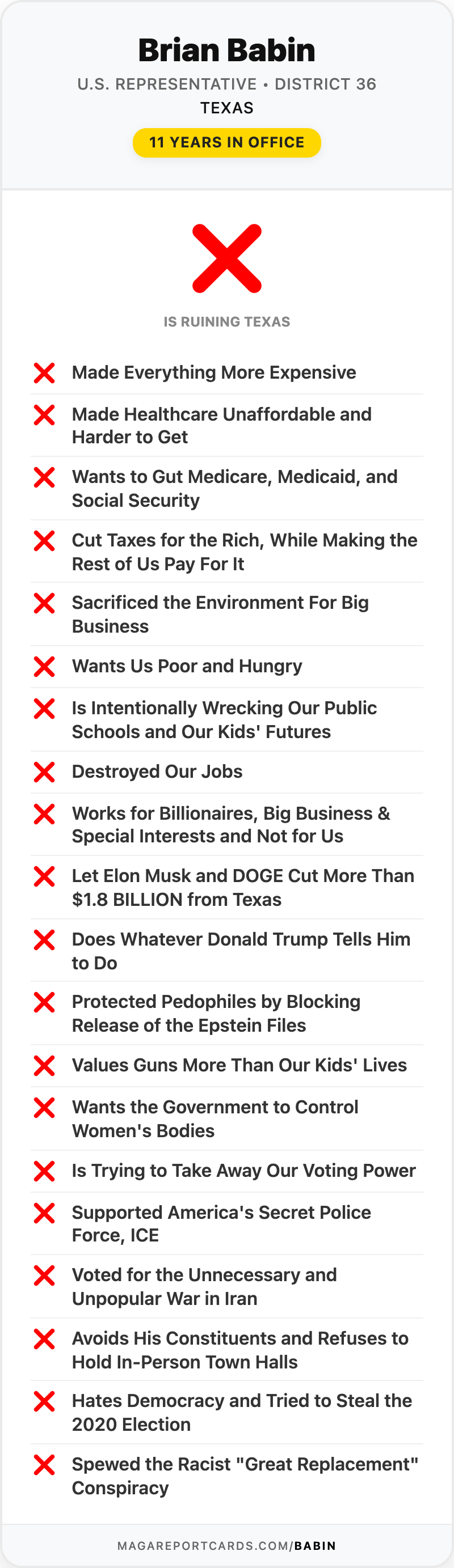
Babin is the Republican congressman for Texas's 36th District, which covers part of southeast Houston and stretches east toward Louisiana. He has held the seat since 2015. He is the lead sponsor of the Birthright Citizenship Act of 2025, H.R. 569, filed January 21, 2025 with 35 original cosponsors. It now has 93. It is not a new bill: he filed all but the same text in December 2023 and in January 2021, four years before Trump's order.
Seventeen months later the Supreme Court threw Trump's order out. Babin's bill is still alive, and it is still the Republican Study Committee's official position.
What his bill actually does
The 14th Amendment says citizenship belongs to anyone "born … in the United States, and subject to the jurisdiction thereof." Babin's bill doesn't repeal that clause — it redefines the six words in the middle.
Under the text of H.R. 569, a baby born on American soil is only "subject to the jurisdiction" of the United States if at least one parent is:
- a U.S. citizen or national;
- a lawful permanent resident living in the United States; or
- someone with lawful immigration status performing active service in the armed forces.
Read that list again for what isn't on it.
A baby born in Houston to two parents on H-1B work visas — engineers at a refinery, doctors at the Texas Medical Center — is not a citizen under this bill. Neither is a baby born to parents on student visas. Neither is a baby born to a family that entered legally and is waiting years for an asylum hearing. Neither is a baby born to a green-card applicant whose paperwork hasn't cleared.
Lawful presence isn't enough. You need permanent residence, citizenship, or a uniform.
Babin's own press office describes it as closing "a dangerous loophole that encourages illegal immigration." But the bill doesn't stop at illegal immigration. It writes a new, narrower class of Americans, and it does it by statute rather than by amendment.
The Supreme Court already answered the question
On June 30, 2026, the Supreme Court struck Trump's executive order down in Trump v. Barbara. Chief Justice John Roberts wrote the majority opinion, SCOTUSblog reported, and he was direct about it. Children "born of parents unlawfully or temporarily present in the United States," Roberts wrote, "satisfy both elements of the Citizenship Clause." His conclusion:
"Under the Constitution, they are citizens at birth."
Roberts walked through the history. The rule came over from English common law, was adopted after the Revolution, and in 1868 the framers of the 14th Amendment wrote it into the Constitution specifically to repudiate Dred Scott — the 1857 decision holding that a Black man descended from enslaved people was not and could not be a citizen. The amendment's purpose, Roberts wrote, was to "permanently enshrine" birthright citizenship.
The Court also rejected the argument that a parent's permanent residence — "domicile" — is required, finding "scant evidence for this dramatically revisionist view."
Domicile is the exact thing Babin's bill requires.
If the Citizenship Clause means what the Court's majority said it means, a statute cannot change it. That takes a constitutional amendment: two-thirds of both chambers and three-quarters of the states. Speaker Mike Johnson conceded as much the day of the ruling: "I'm sure the conclusion from this opinion is going to be that you've got to amend the Constitution to fix that."
Babin's bill is not a constitutional amendment. It's a statute. It was written to do by majority vote a thing the Supreme Court has now said requires changing the Constitution.
Where this comes from
To understand why Babin wrote this bill, it helps to hear how he talks about immigration when he isn't drafting legislation.
On September 23, 2021, Babin went on Newsmax to discuss migrants — many of them Haitian — gathered at the border in Del Rio, Texas. Mediaite transcribed what he said:
"We know what the Democrats are up to here. They want open borders. This is exactly their strategy. They want to replace the American electorate with Third World electorate that will be on welfare and public assistance."
He went on to say Democrats want to put migrants "on a path to citizenship and amnesty, and franchise them with the vote, and they will have a permanent majority."
That is the Great Replacement. It's a conspiracy theory, originally French and explicitly ethno-nationalist, holding that elites are deliberately importing non-white people to dilute the political power of white citizens. The Anti-Defamation League's explainer traces its path from the European far right into American politics. Its language has turned up in the manifestos of mass shooters.
The timing is not incidental. Babin made his remarks the day after Tucker Carlson aired a Fox News segment about the same Biden clip Babin referenced — a segment in which Carlson used the phrase "the great replacement" himself.
The two things fit together
A congressman who believes immigrants are being brought in to replace the electorate will naturally write a bill that stops their children from becoming voters.
That's what H.R. 569 does. Not deportation, not border security, not visa limits — it reaches the baby, and it reaches forward across that child's entire life. Someone born in Houston who grows up there, goes to school there, works there and pays taxes there would never be able to vote there.
The bill exempts children born before enactment, so it doesn't take citizenship from anyone who already has it. It just closes the door behind them.
It's not going away
Babin's bill isn't a message bill sitting in a drawer. In January 2026, he announced that the Birthright Citizenship Act had been included in the Republican Study Committee's Fiscal Year 2026 budget — the budget blueprint of the largest conservative caucus in the House. His statement called it "a major step forward."
And after the Supreme Court ruling, House Republicans didn't drop it. They started shopping for other routes: a constitutional amendment from the Speaker, a surrogacy bill from Sen. Rick Scott, and Babin's statute still on the table.
We've written about the reaction across the party. In Iowa, Ashley Hinson said the Supreme Court "got it wrong" and backs doing it by executive order anyway. In Tennessee, Andy Ogles introduced his own bill to gut birthright citizenship and called the babies "anchors". In Louisiana, Speaker Mike Johnson said he was "disappointed" and that Congress will "deal with it".
Babin is the one who wrote the bill they're all pointing at.
What it means in the 36th District
Texas's 36th runs from southeast Houston out through the refinery towns along the Gulf and into the piney woods toward Louisiana. Houston is a port city with a large immigrant workforce, and some of Babin's constituents are families where the parents arrived on a visa and the children were born in a Houston hospital.
Under the bill their congressman wrote, those children would be foreign nationals in the only country they have ever lived in — able to be here, work here, and pay taxes here, but never able to vote here.
Babin has been in Congress for 11 years. He chairs the House Science, Space and Technology Committee. He is a dentist by training and a deacon in his church. And the bill with his name on it, the one that made it into the Republican Study Committee's budget, is one the Supreme Court has effectively already told him he cannot pass.
Source
"Republicans float new ideas to restrict birthright citizenship after ruling" by Susan Carpenter, Spectrum News, June 30, 2026. Bill text and cosponsor counts from congress.gov. Babin's 2021 remarks as transcribed by Mediaite. Photo: official congressional portrait.