On June 30, 2026, the Supreme Court did something rare in the Trump era: it told the president no. In a decision that upheld birthright citizenship, the justices rejected Trump's executive order trying to end the guarantee that people born on American soil are American citizens.
Most people would call that the system working. The most powerful member of Congress called it a disappointment.
Mike Johnson, the Speaker of the House, reacted to the ruling the same day by saying he was "very disappointed in that outcome" and warning of "serious challenges going forward and we'll have to deal with that." He went further, predicting that "you've got to amend the Constitution to fix that."
Read that again. A guaranteed right just got confirmed by the highest court in the country — and the Speaker's response was to start looking for ways around it.
What birthright citizenship actually is
This isn't some loophole or modern invention. Birthright citizenship comes from the very first sentence of the 14th Amendment, added to the Constitution after the Civil War: "All persons born or naturalized in the United States … are citizens of the United States." It was written to make sure the government could never again decide that some people born here don't count as full Americans.
The Supreme Court has recognized this for more than 125 years. That's the "textualist, originalist view" — the plain words of the Constitution — that Johnson himself admitted the ruling followed, even as he complained the right has been "grossly abused."
When Johnson says Congress should "deal with it," he's talking about taking away a constitutional birthright from babies born in the United States. That's not fixing a problem. That's picking a fight with the Constitution because his side lost.
He's done this before
If it feels familiar that Mike Johnson wants to override an outcome he doesn't like, that's because it's the central story of his career.
The New York Times called Johnson "the most important architect of the Electoral College objections" meant to keep Trump in office after he lost in 2020. He led the Supreme Court brief backing a lawsuit to throw out Joe Biden's wins in four states, and lobbied his colleagues until more than 100 House Republicans signed it. Hours after the Capitol was attacked on January 6, he voted twice to reject states' electoral votes. Then he voted against impeaching Trump and against even an independent commission to investigate the attack.
The pattern is the same. When the law, the voters, or the courts deliver a result Johnson doesn't want, his instinct isn't to accept it — it's to look for a way to reverse it.
Using his power against constituents, not for them
Johnson isn't a backbencher firing off a hot take. As Speaker, he decides what comes to a vote and what dies without one. And he's already made his priorities clear on immigration.
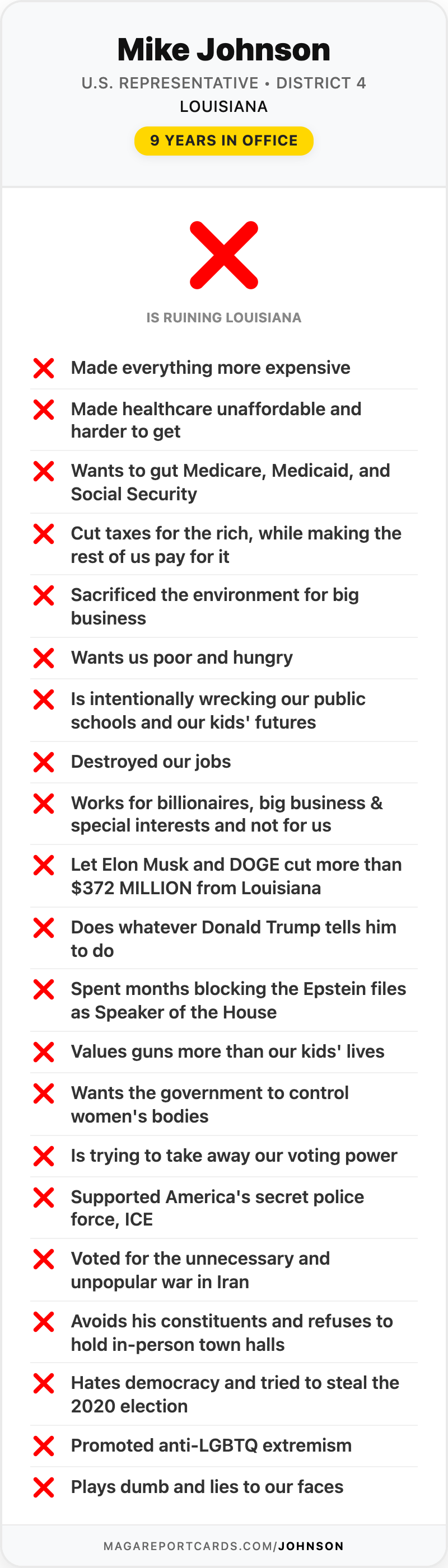
His own page describes how, as Speaker, he isn't just voting to expand ICE — he drove through Congress the law that turned ICE loose. Now he's signaling that stripping citizenship from American-born children could be next on the agenda.
Meanwhile, the things that would actually help Louisiana families keep getting the opposite treatment. Johnson drove Trump's budget bill to passage, with a record $1.7 trillion in spending reductions, mostly from Medicaid — even though, as KFF Health News reported, Medicaid is a lifeline for thousands of families in his own district. He has the power to bring relief to a vote. He uses it to chase culture-war fights instead.
What "deal with it" really means
Amending the Constitution is supposed to be extraordinarily hard — on purpose. It takes two-thirds of both chambers of Congress and three-quarters of the states. The founders made it that way so a bad month, or one angry politician, couldn't strip away basic rights.
Mike Johnson knows that. When he says Congress will "deal with" birthright citizenship, he's telling us he'd spend that enormous effort not on lowering costs or protecting health care, but on unwinding a right that has defined American citizenship since the 1860s.
The court protected the Constitution. The Speaker of the House called it a disappointment. That tells you everything about whose side he's on.
Source
This post is based on reporting by Talking Points Memo, with the ruling and constitutional text drawn from States Newsroom and the National Constitution archive of the 14th Amendment.