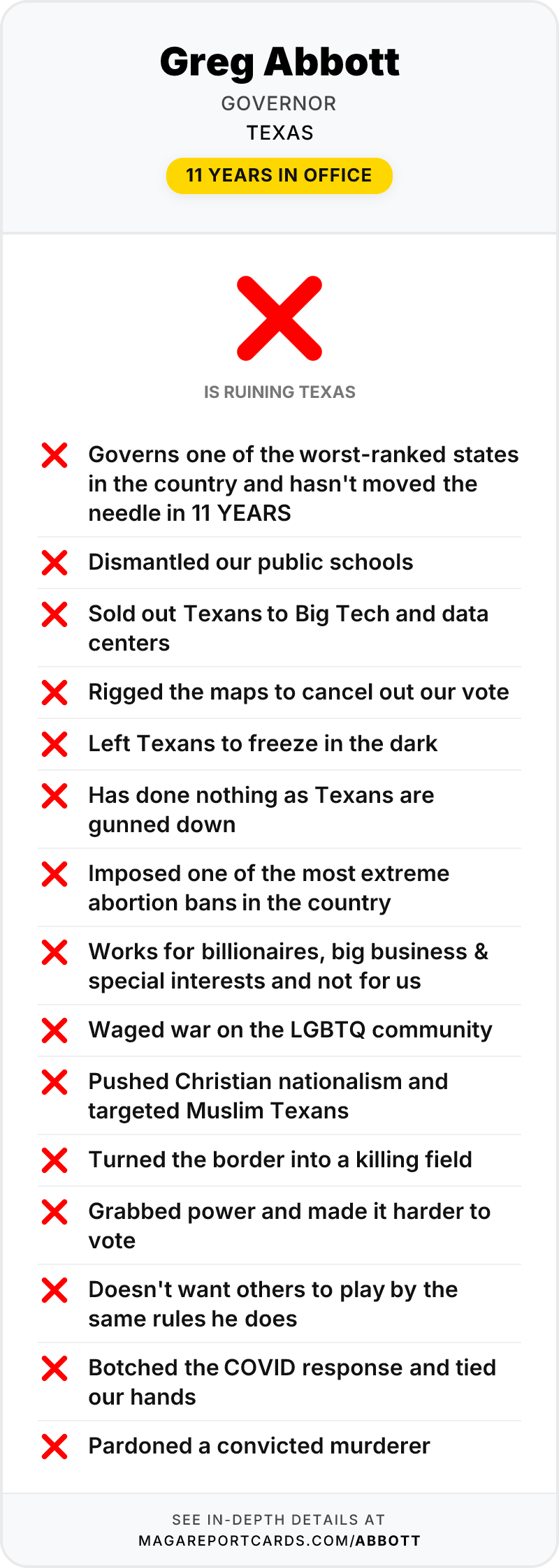
Rural voters probably can't stop data centers from spreading across Texas. But they might be able to stop Greg Abbott.
That's the finding of POLITICO's reporting on the Texas governor's race, published August 19, 2026, and it should worry him more than any Democratic attack ad. Abbott is seeking a fourth term. He is bleeding support in the small towns that have carried him for eleven years. And the reason is data centers — an industry he courted, on a tax break that ballooned under him for all eleven of those years.
The same week, yellow was all around the Texas Capitol grounds — bandanas, pins, shirts, the signal of a grassroots movement against the 765-kV buildout. They rallied on the steps, then sat through a nine-hour hearing on data centers and the giant power lines being built to feed them.
These are not activists Abbott can dismiss. They are his voters.
He Courted Them, and the Tax Break Ballooned Under Him
There is no version of this story where Abbott is a bystander.
He branded Texas the "epicenter" of AI development. He stood next to Google's CEO to announce a $40 billion buildout. He presided over a data center sales tax break that has ballooned so far past its original estimate that the Comptroller's office now puts the state's forgone revenue at $1.3 billion in a single year, against an estimated $5.4 million in the break's first year in 2014. We laid out that whole record two weeks ago.
The result is a queue. About 90% of everything waiting to plug into the Texas power grid is a data center.
Then, in an Election Year, He Announced a Pause
In June, Abbott proposed guardrails — make data centers use water-efficient cooling, repeal their sales tax break, make them pay their own power infrastructure costs. In early August he went further and directed state electricity regulators to pause approvals for new data centers to connect to the grid until the state audits the hundreds of projects lined up.
His campaign press secretary, Eduardo Leal, says this proves the Governor "has taken decisive action to ensure data centers pay their own way, bring their own power, reuse their own water, be good neighbors, and never force Texas families to subsidize their infrastructure."
Read that sentence again and notice what it concedes. Every problem it promises to fix is a problem that already exists — because of the eleven years that came before it.
And note the calendar. The grid operator's CEO told lawmakers the audit should be finished around December. The Legislature doesn't return until 2027. The election is in November.
The Pollster and the Voters
Here is the part that gives the game away.
A memo from Cygnal, a Republican pollster, said Abbott's pause "found the sweet spot to make data centers deliver for Texas."
The sweet spot. That is a Republican consultant assessing a governor's policy decision the way you'd assess an ad buy — not as a fix, as a position.
Abbott's own voters reached the same conclusion, and they didn't need a memo.
Shawn Nanny, a Republican county commissioner in Tom Green County, told POLITICO his neighbors were briefly encouraged by the pause and then soured on it. They decided it was a ploy to get rural voters to drop their guard. "They think it was all smoke and mirrors," Nanny said.
Mary Jo Bloomquist, a Republican in Hood County: "Personally, I think it's just covering his butt. It makes him look like he's doing something, but he's really not." She says she can't recall ever voting for a Democrat. She won't vote for Abbott: "He sold Texans out to big business, and I just don't trust him anymore."
Greg Torres, the McCulloch County attorney and a Republican, is still voting for Abbott — and still said this: "There will be no enthusiasm for Governor Abbott this time in rural areas."
Nanny says some neighbors are talking about doing the unthinkable. In his words, what he hears is: "Yeah, we'll have a Democrat in there and grit our teeth and bear it, but hopefully we'll come out of it the following election."
The Numbers Behind the Anger
This isn't a handful of cranks. POLITICO reports that Texas Politics Project polling shows Abbott's approval among rural voters fell from 63% in 2018 to 48% this year — a 15-point collapse in his own base.
Recent Texas A&M and Fox News polls put Abbott just one point ahead of Democratic challenger Gina Hinojosa. No Democrat has won the Texas governorship in more than 35 years. Abbott cannot lose much of rural Texas and survive that math.
The POLITICO Poll also found that 51% of rural U.S. adults oppose data centers, against 32% of urban residents. Rural Americans are more skeptical of big infrastructure generally — power plants, warehouses, airports — but their dislike of data centers runs higher than any of those.
Hinojosa is running straight at it, with an ad in rural markets targeting what she calls "Abbott Intelligence." Her line: "I'll fight to put the people of Texas first, not the billionaire class."
The Money Kept Coming
While rural Texans were being told the Governor was on their side, the checks kept clearing.
POLITICO reports that groups supporting Abbott have taken campaign contributions from data center developers and from a transmission company building some of the new 765-kilovolt power lines. C-suite officials at Oncor Electric — a co-applicant on one of those 765-kV segments — have given a pro-Abbott political action committee $265,000. Elon Musk gave the same PAC $500,000.
Abbott's pause covers data center hookups. It does not cover the $33 billion power line build-out that rural landowners are fighting just as hard — three first-of-their-kind lines that would cut across tens of thousands of acres of private property.
On that, Abbott has stayed publicly quiet, telling people to send their feedback to the Public Utility Commission. The commission is run by five commissioners, all appointed by the Governor. Abbott appointed every one of them.
His own Lieutenant Governor didn't stay quiet. After a July Senate hearing, Dan Patrick and Sen. Charles Schwertner, the Republican who chairs the Business and Commerce Committee, called on the commission to deny the pending 765-kV applications until the companies address what landowners have raised.
So Abbott moved on the half of the story that polls, and said nothing about the half his donors are building. That is what "the sweet spot" looks like from underneath.
It also isn't new. Earlier this summer he moved to break up San Antonio's city-owned utility — the one that says it has the lowest combined residential rates in Texas — in favor of retail providers, while electricity companies and their PACs gave his campaign at least $230,000.
And Locally, There's Nothing They Can Do
The cruelest part is that rural Texans can't fix this at home either, because Abbott's party spent years making sure they couldn't.
In most unincorporated areas — where the majority of the state's planned data centers are going — counties can regulate drainage plans, floodway construction, septic tanks and driveway permits. That's the list. Then in 2025 the Legislature passed HB 2559, limiting how long a city can pause development. Counties weren't in the bill, and Republican state Sen. Paul Bettencourt took that to the Attorney General's office as proof they never had the power at all.
The threat worked without anyone winning a case. Hood County voted a moratorium down. Hill County passed one and rescinded it after a developer sued for $100 million. Tom Green County dropped the idea too.
"Right now it's just the Wild West," Navarro County Commissioner Jason Grant told POLITICO. Officials say they routinely learn about a data center only after the land is bought.
Rural Texas had legislators who might have fought this. Abbott removed a lot of them. When a bloc of 21 House Republicans, mostly from rural districts, blocked his school voucher plan in 2023, he spent more than $8 million of his own campaign funds backing primary challengers against his own party. Fifteen Republican incumbents lost across the 2024 primaries, a record. Suzanne Bellsnyder — a field director on Abbott's 2014 campaign, now running the Texas Rural Reporter — told POLITICO that when those members went, so did the Legislature's expertise on water rights and agriculture.
He Could Fix the Timing Tomorrow
Activists, landowners and state Rep. Rafael Anchía have all asked Abbott for one thing: call a special session so the Legislature can write data center rules now instead of in 2027. At the August rally, protesters shouted it as their group-photo caption — "one, two, three: special session!"
He hasn't called one. He calls them when he wants something. He called four in a single year — more than in any year with a regular session in the Legislature's 176-year history — with the last two of them aimed at forcing through vouchers, and another in 2025 to redraw the congressional map for Donald Trump.
Even the Republican who created the data center tax break is further along than Abbott. Rep. Charlie Geren of Fort Worth told the August hearing he expects to carry the repeal himself: "I passed the bill to get it done. I'm going to probably carry the one to repeal it."
And Abbott isn't the only Texas Republican who sees the wreck coming. Two weeks ago, Agriculture Commissioner Sid Miller said Republicans will lose elections over data centers, that Abbott has never returned his call in twelve years, and that other statewide Republicans stay quiet because they fear Abbott's $105 million war chest.
What It Costs
Strip out the politics and what's left is the water, the land and the electric bill.
Texans already know what it looks like when the people in charge treat the grid as somebody else's problem. In February 2021, Winter Storm Uri knocked out the power and 246 Texans died. Four years later a state audit found the winterization inspections meant to prevent a repeat produced two violations out of 8,732 inspections.
Now the largest new industrial power demand in state history is being bolted onto that same grid, on a tax break the Legislature is scrambling to repeal, with an audit that reports back after the election.
Rural Texans asked their Governor for a pause with teeth. What they got was a pause a Republican pollster graded as good positioning. They noticed.
We deserve better.
Source
'We are not a bunch of woke Marxist liberals here': Rural voters scramble Texas election — Shelby Webb, POLITICO, August 19, 2026.