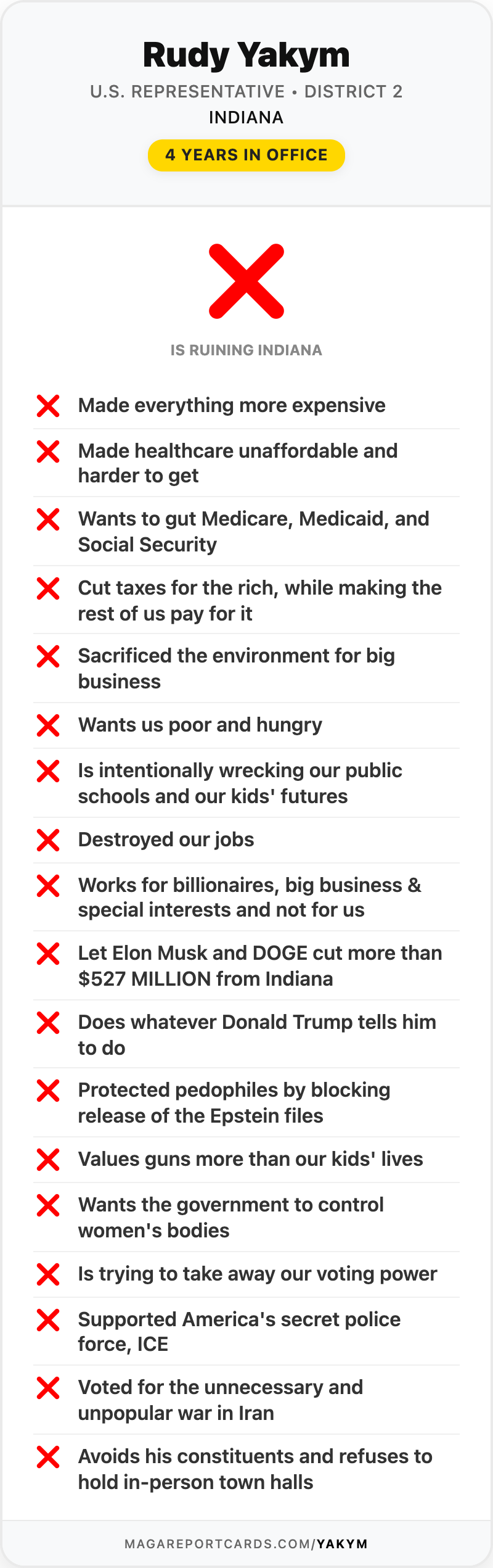
On May 21, 2026, Rudy Yakym introduced H.R. 8953, the Preserving Community Food Assistance Act of 2026. It was referred to the House Agriculture Committee. It has no cosponsors. He is the only member of Congress on it.
Here's what it does.
It amends the Emergency Food Assistance Act of 1983 — the law behind TEFAP, the federal program that sends USDA food to food banks and pantries. The whole bill is one sentence. Into the residency test at 7 U.S.C. 7503(b)(4) it inserts the words "(at the option of the State agency based on documented proof of residency such as a photo identification card, a piece of mail, residency documentation, or other similar document)." A state could then write a document check into the eligibility rules its pantries apply. Yakym's own title for it is "to restore choice to community food assistance providers to request identification"; WRTV's headline was that it "could lead to ID requirements for food aid."
It is aimed at one specific rule. On December 30, 2024, a USDA regulation took effect providing that "Length of residency, address, or identification documents shall not be used as an eligibility criterion" for TEFAP food. Yakym's bill turns that prohibition into a permission, and names the documents.
His stated reason:
"Hoosiers are generous by nature, but that charity should not be abused."
What "abuse" turns out to mean
Read the complaint the bill is built on, because it isn't fraud.
The Mishawaka Alliance for Care Food Pantry, which supports the bill, said the 2024 change has led to an increase in people from outside its service area and repeat visits from members of the same household. The result, its director Kristi York said in a statement, is that "our resources have been depleted at a much faster rate, placing additional pressure on our volunteers, donors, and operational funding." Hearts United for Bristol Food Pantry said it withdrew from USDA grocery support because of the change.
Those are real operational problems, and the people running those pantries aren't villains. Small pantries running on donations and volunteers do get overwhelmed.
But look at what the described behavior actually is. Someone came from outside the service area. Someone came back a second time. Someone in the same household came separately.
That is what hungry people do when there isn't enough food. It is the signature of scarcity, not of cheating. And Yakym's fix isn't more food. It's a document check at the door.
Who a document check keeps out
TEFAP is emergency food. The people at the far end of it are, by definition, at the end of something.
A photo ID, a piece of mail in your name, residency documentation — those are the exact things you don't have when you've just been evicted, when you're couch-surfing, when you left a violent house in a hurry, when your ID was in the car that got repossessed, when you're a kid sent to pick up a box for the family, when you're elderly and your mail goes to a relative's address.
Nobody in that list is defrauding a food pantry. They're the reason the federal rule was written the way it was.
And the fix Yakym is reversing was not a Washington whim about paperwork — it was a decision about whether a free box of food should require you to prove where you sleep.
The part he leaves out
Here is the sequence, in order.
On July 3, 2025, Yakym voted Aye on final passage of Trump's budget bill, H.R. 1 — it cleared the House 218 to 214. According to Feeding America Action, that law cuts nearly $200 billion from SNAP — through state cost-shifting, tighter eligibility, expanded work requirements, and new limits on USDA's ability to adjust benefits. Feeding America estimates it could take nearly 6 billion meals off the table for SNAP participants every year.
Six billion meals is roughly what the entire Feeding America network distributes in a year: 5.9 billion at the last count.
Then, nearly eleven months later, he introduced a bill making it easier for food pantries to turn people away.
You cannot separate these two things. Cutting SNAP does not make people stop being hungry; it moves them from the grocery store checkout to the pantry line. The increase in visits that Yakym's supporting pantries describe is the predictable downstream effect of the vote he cast. Since the law took effect, SNAP enrollment has fallen by more than 4.5 million people — about 11 percent, according to the Center on Budget and Policy Priorities, while unemployment stayed flat. Nobody stopped being hungry.
He voted to push people off food stamps. Then he wrote the bill to let the backstop check their papers.
In his own district
Indiana's 2nd District is not a place with a surplus.
25,416 households in IN-02 — about 9% of every household in the district — rely on SNAP to put food on the table, according to USDA data. That includes 13,986 households with children and 7,736 with someone 60 or older.
Those are the households the cuts hit. They are also, when the benefit shrinks, the households that show up at MAC in Mishawaka and Hearts United in Bristol.
Nationally, Feeding America counts 48 million people a year facing food insecurity, including 14 million children.
The pattern
This is the shape the food fight keeps taking: vote for the cut, then perform concern about the consequences.
In Arkansas, Rick Crawford voted to cut food assistance by $187 billion and then threw a celebration over an amendment letting SNAP recipients buy a hot rotisserie chicken — a change that adds no money and helps nobody already cut off. In California, David Valadao cast a deciding vote for the same bill in a district where 27% of households are on SNAP, and said the enrollment drop doesn't worry him. And a 1,000-mile reporting trip through four states found what the cuts look like on the ground: people selling blood twice a week, people who can't afford toilet paper.
Yakym's contribution to that record is a bill that would let the last place those people can go ask them for a piece of mail first.
The bill nobody else would sign
The tell is the cosponsor count.
Members of Congress cosponsor thousands of bills a year. They are cheap to sign and cost nothing if they never move. H.R. 8953 has been sitting in the Agriculture Committee since May with exactly one name on it — Yakym's.
If the case were as simple as he makes it sound — pantries overwhelmed, a bureaucratic rule to fix, Hoosier generosity being abused — this would be an easy signature for a hundred colleagues.
Nobody else signed.
We deserve better.
Source
US Rep. Yakym's bill could lead to ID requirements for food aid — WRTV Indianapolis, May 24, 2026, and the same report via WISH-TV. Bill status from congress.gov. Photo: WRTV / Scripps.