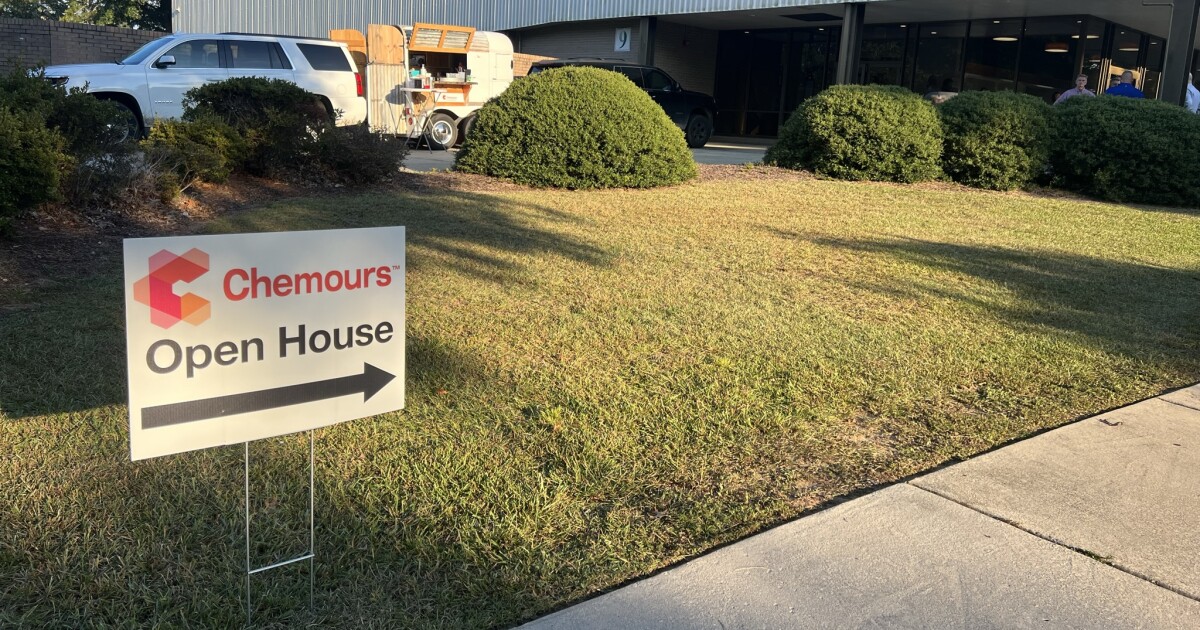
For decades, the Chemours Fayetteville Works plant discharged PFAS — "forever chemicals" — into the Cape Fear River. Company officials have admitted it. Those discharges contaminated the drinking water for Wilmington and the surrounding area, and air emissions from the plant polluted groundwater nearby.
North Carolina's attorney general puts the number of people whose drinking water was contaminated at about half a million.
That company now has a favorite in North Carolina's U.S. Senate race. WUNC reported that the Chemours corporate PAC contributed $5,000 to Michael Whatley.
WUNC asked Whatley's campaign three straightforward questions about it. Nobody answered.
Three questions he wouldn't touch
WUNC's Adam Wagner put these to Whatley campaign spokesman DJ Griffin:
- Does Whatley believe Chemours has adequately addressed the contamination allegedly caused by it and DuPont?
- What is his stance on the recent settlement agreement?
- What does he think of the Trump EPA's decision to repeal Biden-era health limits for GenX and three other PFAS?
Griffin "did not reply to either an email or a text message."
Erin Carey, deputy director of the Sierra Club's North Carolina chapter, lives in Wilmington and drank the contaminated water for two decades. Her assessment of a Senate candidate taking Chemours money while saying nothing about PFAS:
"It's as baffling as it is disgraceful."
This is the first time Chemours has done this
The donation is unusual enough that it's worth spelling out.
Chemours formed its corporate PAC in 2018 — one year after the Wilmington-area contamination became public. Since then, in North Carolina, it has mostly funded powerful anti-regulatory Republicans in the state legislature, giving $6,500 to five GOP state legislators this biennium.
At the federal level, the PAC had made exactly one contribution before this: $1,000 to former Democratic Congressman Wiley Nickel in 2023.
Whatley's is the first North Carolina U.S. Senate campaign the Chemours PAC has ever spent in. WUNC asked the company why. Chemours didn't respond to that question either — or to questions about what legislation or rules it's concerned about.
Two more details matter. The $5,000 came on March 3, technically during the primary, which means the PAC can legally give another $5,000 for the general election. And this cycle the Chemours PAC also cut a maximum $15,000 check to the National Republican Senatorial Committee, the campaign arm working to put Whatley in the Senate.
What Chemours is buying influence over
The timing isn't subtle. Chemours is on the verge of getting things it has wanted for years.
The EPA rollback. The Trump EPA is repealing Biden-era PFAS limits that Chemours long opposed. The company has argued the maximum contaminant levels for GenX and three other chemicals aren't backed by science. Those are exactly the limits that force water utilities to filter this stuff out.
The settlement. Last month Chemours and the U.S. Department of Justice announced a deal: a $22.5 million civil penalty covering PFAS contamination in New Jersey, North Carolina, and West Virginia, plus a commitment to spend at least $90 million over 15 years on contamination prevention at three plants, including Fayetteville Works.
North Carolina officials are furious about it. Attorney General Jeff Jackson said state officials had no role in crafting the agreement and called it "insulting" to the roughly half a million people whose water was contaminated. He also pointed out the math: North Carolina stands to receive at most $30 million, while the deal includes up to $280 million for drinking water around the New Jersey and West Virginia plants, plus another $60 million to stop discharges at West Virginia's Washington Works.
Roy Cooper, the former governor and Whatley's Democratic opponent — who dealt with this contamination throughout his time in office, starting when it broke in 2017 — called it what it looks like:
"This backroom deal is another example of Washington bailing out billionaires and corporations instead of standing up for hardworking people."
North Carolinians are paying for the cleanup themselves
Here's the cost that never shows up in a settlement press release.
New Hanover County's Cape Fear Public Utility Authority spent $43 million building a granular activated carbon system to strip PFAS out of the water at one treatment plant — and it keeps paying to swap the filters. Brunswick County is spending about $170 million to expand a plant and install reverse osmosis filters.
Both utilities are suing Chemours to try to get that money back. In the meantime, it comes out of ratepayers' pockets.
Carey, who drank that water for 20 years, described the arrangement:
"It's very disheartening as someone who drank poisoned drinking water for 20 years to know that the company that did it is essentially buying their way out of it as those of us who were left behind are paying to clean up the mess."
Scientists have linked PFAS exposure to certain cancers, decreased fertility, and developmental delays in children.
Not answering is the pattern
Whatley's silence here isn't a scheduling problem.
He has already made a habit of avoiding questions he doesn't like — he has called police on reporters at public campaign events rather than answer them, and prefers friendly podcasts to press availabilities.
And this is a man whose career was built on exactly this kind of relationship. Before running the Republican National Committee, Whatley was a big oil lobbyist. Taking a chemical company's money and refusing to say whether that company has cleaned up its mess is not out of character for him. It's the job he used to have, from the other side of the table.
He has also already shown where he lands when North Carolinians' health is on the line. He backed Trump's budget bill, which was estimated to strip health coverage from over 650,000 North Carolinians and put rural hospitals at risk.
The bottom line
Half a million North Carolinians drank contaminated water. Their utilities have spent more than $200 million filtering it out. The company responsible is getting federal limits rolled back and a settlement that sends most of the cleanup money to other states.
That company just wrote its first-ever check in a North Carolina Senate race, to Michael Whatley. Asked what he thinks about any of it, he sent no reply — not to an email, not to a text.
North Carolinians deserve a senator who will at least say whose side he's on. We deserve better.
Source
This post is based on reporting by WUNC: What role could PFAS play in North Carolina's closely watched U.S. Senate race? by Adam Wagner (Photo: Celeste Gujardo).