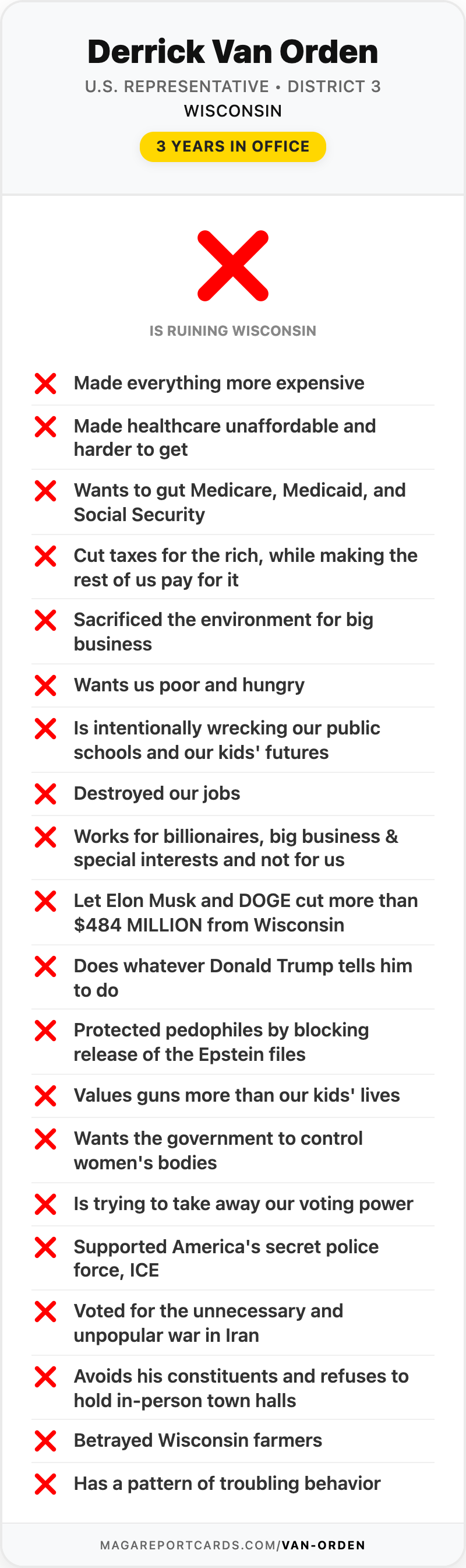
On August 6, 2026, Derrick Van Orden introduced a bill in the House of Representatives. He is its sole sponsor. It has no cosponsors.
Its entire purpose, per the official title, is "to prohibit the District of Columbia from requiring a person to wear a protective helmet to operate, or ride on, a motorcycle or motor-driven cycle."
He calls it the Ride in Freedom Act. He represents Wisconsin's 3rd District — La Crosse, Eau Claire, and the farm country along the Mississippi. Nobody in it lives under the District of Columbia's traffic code.
What the bill does
D.C. requires every motorcycle rider to wear a helmet, regardless of age. Van Orden's bill would take that away. Sen. Tim Sheehy of Montana introduced the companion in the Senate the same day.
Congress can do this because D.C. isn't a state. Its laws, written by a city council its residents elect, can be overridden by members of Congress those residents didn't vote for and can't vote out. That's the mechanism Van Orden is using.
D.C. Council member Charles Allen, who chairs the council's transportation committee, put it on X:
"An unserious & unsafe proposal. A Congressman from Wisconsin has nothing they can do to make life a little more affordable or a little bit better for their own constituents, so they spend their time trying to repeal helmet laws for motorcycles in DC?"
He added: "I really think they can be better than this."
It isn't really about D.C.
Van Orden's own office says the quiet part on the record. His communications director, Grace Kim, told Straight Arrow News:
"The federal government has had a hand in helmet requirements going back to the Highway Safety Act, which used highway funding as leverage to get states to adopt helmet laws. That's part of why D.C. is an important place to start. If Congress can change the policy here, it opens the door to having a larger conversation about the federal government's role in helmet mandates across the country."
"An important place to start." D.C. is the test case. The target is the helmet laws in the rest of the country.
Seventeen states and the District of Columbia have universal helmet laws. Thirty states cover only some riders, usually those under 18. Wisconsin is in that second group: the state's law reaches riders 17 and younger and nobody else, so an adult can legally ride there bareheaded today.
So Van Orden isn't fighting for a freedom his own constituents lack. He already has it. He wants to take the other version away from the places that chose it.
What happens when helmet laws go away
This is one of the most thoroughly studied questions in road safety, because states have run the experiment over and over. The Insurance Institute for Highway Safety keeps the record:
- Helmets reduce the risk of death by 37% to 42%.
- Riders without helmets are three times more likely to suffer a traumatic brain injury.
- Texas weakened its law in 1997 to cover only riders under 21. Operator deaths rose 31% in the first full year.
- Kentucky repealed its universal law in 1998 and Louisiana in 1999. Motorcyclist deaths rose 50% and 100%.
- Florida weakened its law in 2000. The death rate went up about 25%, and hospital admissions for head injuries climbed 82% over 30 months.
- Across 1976 to 2022, IIHS estimates more than 22,000 motorcyclists died because of lower helmet use in states without universal helmet laws — 11% of all motorcyclist deaths in those years.
The Governors Highway Safety Association reports the split plainly: in states without universal helmet laws, 51% of motorcyclists killed in 2023 weren't wearing a helmet. In states with them, it was 10%.
And the National Highway Traffic Safety Administration's summary is one sentence long: "If you're ever in a serious motorcycle crash, the best hope you have for protecting your brain is a motorcycle helmet."
None of this is contested. It's why the law Van Orden wants to repeal exists.
The timing
Six people have died in motorcycle crashes in D.C. so far this year. Last year the total was two.
Van Orden filed the bill in the middle of that.
What his district is actually dealing with
Van Orden is heading into a competitive November race. Western Wisconsin has real problems: grocery and energy costs, farm income, rural hospitals.
His record on those is not a mystery. He voted for the 2025 budget bill that cut Medicaid by roughly $900 billion — and then asked for credit when federal regulators grandfathered Wisconsin's hospital provider tax, shielding the state from one provision of the law he'd voted for. Wisconsin still loses about $7 billion.
When he isn't doing that, he's posting. A June 2026 review of his social media by the Milwaukee Courier documented a pattern of anti-Muslim and racist comments, and the Wisconsin Muslim Civic Alliance called it a "documented pattern of anti-Muslim rhetoric."
Now the legislative output is a bill about who has to wear a helmet in a city he doesn't represent, written — by his own office's account — as a wedge to pry open the helmet laws in seventeen states that decided they wanted them.
Charles Allen's question was rhetorical, but it's a fair one to ask in La Crosse too. If a member of Congress has nothing left to do for the people who sent him, this is what he does instead.
We deserve better.
Source
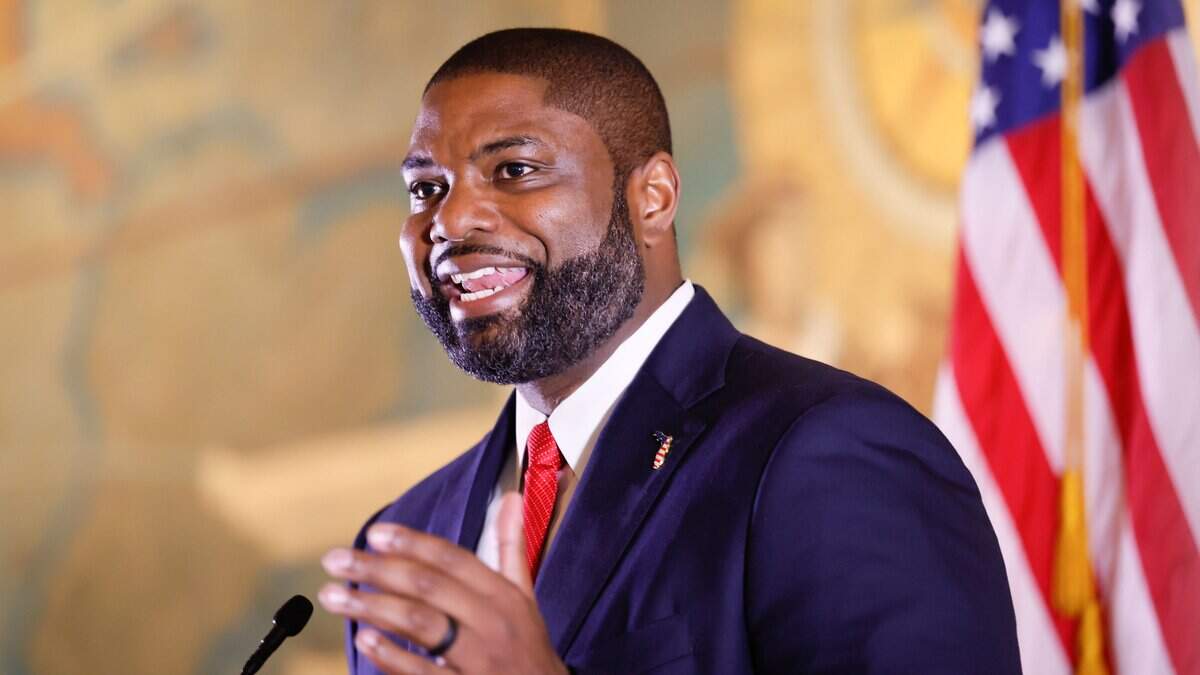
Shea Taylor, "How a GOP effort to repeal DC's motorcycle helmet mandate could affect highway safety nationwide," Straight Arrow News (August 10, 2026), and the bill text and status for H.R. 10067. Photo: USA TODAY Network via Reuters Connect.