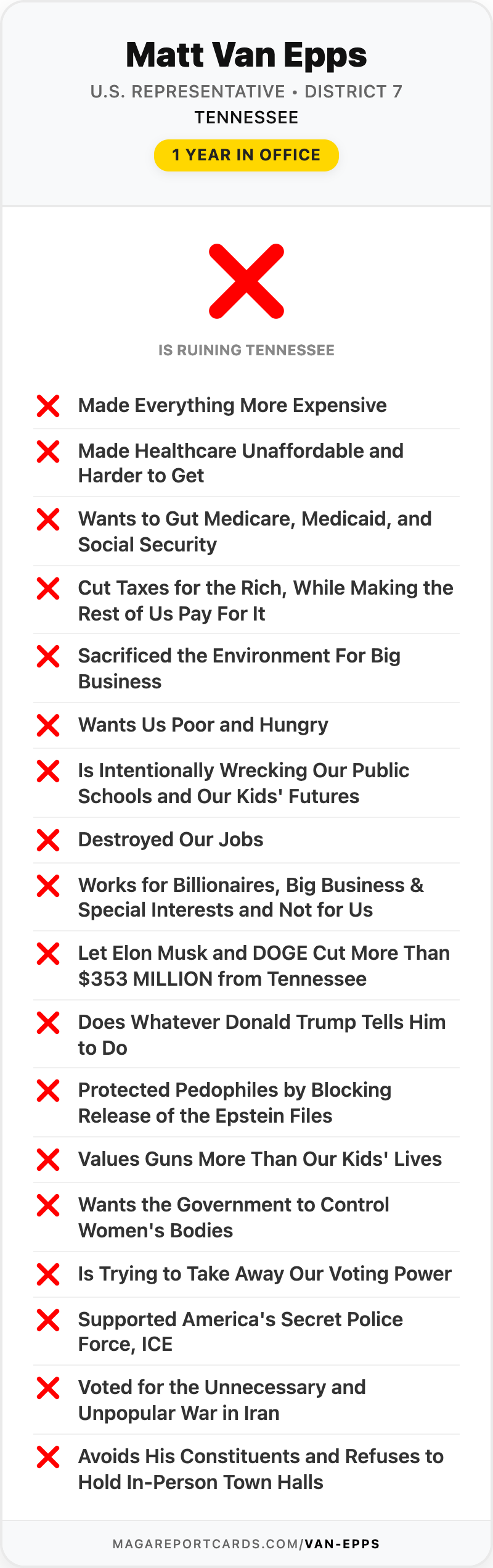
Eight months into his first term, Matt Van Epps has picked the thing he wants to be known for. It isn't groceries, or insurance premiums, or the rural hospitals in his state that are hanging on by a thread.
It's bitcoin.
On May 22, 2026, Van Epps announced he was helping lead the American Reserve Modernization Act — a bill that takes Trump's March 2025 executive order creating a Strategic Bitcoin Reserve and writes it into permanent law. He is an original cosponsor of Rep. Nick Begich's bill.
Read how he sold it, because the sales pitch does not survive a reading of his own press release.
The pitch
Here is Van Epps in his own announcement:
"In addition to establishing a reserve, this legislation promotes transparency, security, and oversight of federally held Bitcoin. Just as importantly, the reserve would be established without cost to American taxpayers, while any sale of Bitcoin would only be for the purposes of reducing our national debt. With a national debt of $39 trillion, this is an essential piece of legislation."
And again, a paragraph later:
"A Strategic Bitcoin Reserve could potentially be used to solve major problems, like our federal debt."
A congressman just told Tennesseans that a bitcoin reserve is "essential" because of the national debt, and that it "could potentially be used to solve" that debt.
The bill
Now here is the background section of that same press release, describing what the bill actually requires:
"To reinforce the strategic nature of the reserve, the bill requires Bitcoin held in the Strategic Bitcoin Reserve to be maintained for a minimum of 20 years."
The bill itself is blunter than the summary. The Treasury Secretary must hold the government's bitcoin "for not less than 20 years from the date of enactment," and anything acquired later for 20 years from the day it is deposited. During that window, it says, "no Bitcoin held in the Strategic Bitcoin Reserve may be sold, swapped, auctioned, encumbered, or otherwise disposed of for any purpose."
For any purpose. Including the one Van Epps named. A thing you are forbidden to sell for two decades after the bill is signed is not a plan for a debt you have today. He put the promise and the fine print in the same document, three paragraphs apart, and hoped nobody would read both.
There's a second sleight of hand in there too. He says the reserve costs taxpayers nothing — and the reserve is filled with digital assets the government already seized through forfeitures and penalties, so that's true as far as it goes. But the bill also directs Treasury and Commerce to study "the risks, costs, and potential benefits of the acquisition of additional bitcoin over the next 5 years," and whether that can be done "in a budget neutral manner that does not, in practice, increase the national debt nominally or economically." That's the government studying how to buy more bitcoin — with an instruction to look for a way to pay for it that doesn't show up as a cost. The mechanisms it names for Congress to consider include "revaluation of gold certificates held by the Federal Reserve Banks" and taking bitcoin in "tax payments." "No cost to taxpayers" is doing a lot of work in a bill that opens that door.
And there is the risk nobody in the press release mentions: bitcoin's price moves. Assets the government could sell today to reduce the debt get locked in a vault for two decades instead, whatever happens to their value. If that's a good bet, it's still a bet — made with public property, on behalf of people who never agreed to it.
Whose district is this for?
Van Epps was unusually candid about who the bill is meant to please:
"Nashville is quickly emerging as one of the nation's leading Bitcoin hubs, with a growing digital asset community, institutions like Bitcoin Park, and the annual Bitcoin conference, which is scheduled to come back to Nashville in 2027! Supporting this bill means supporting the financial innovation taking place in my district."
He's not wrong that it's an industry. Trump first promised the bitcoin reserve at the Bitcoin Nashville conference in 2024 — Van Epps's own release says so.
But "supporting the financial innovation taking place in my district" is a strange summary of what a member of Congress owes the people who live there. Whatever Bitcoin Park is worth to Nashville, the people in Clarksville, Dickson and Springfield are not asking their congressman to safeguard a conference.
What we know about the crypto industry is that when it wants something from Congress, it pays. It spent more than $12 million to make Barry Moore Alabama's Senate nominee this year — the industry's single largest bet anywhere in the country this cycle, placed on a member who had already voted its way every time. Moore is an original cosponsor of this bill too. That is the company this legislation keeps.
What isn't getting this kind of attention
While Van Epps was co-leading a bill about federally held bitcoin, this is what was happening to the people he represents:
- At least 110,000 Tennesseans are expected to lose health coverage under Trump's budget law, with an estimated $7 billion cut from TennCare over the next decade and at least nine rural hospitals "on the chopping block".
- About 696,100 Tennesseans rely on SNAP food benefits every month.
- One in five Tennessee children faces hunger.
Search his press releases for a bill with his name on it addressing any of that. The bill he chose to co-lead and announce in his first year is a twenty-year lockbox for seized cryptocurrency, sold to us as debt relief.
The standard
We're not against digital assets, and we're not asking a freshman to solve the national debt. We're asking for something simpler: don't tell people a bill does something your own bill forbids it from doing.
Van Epps arrived in Congress on more than $2.4 million in outside spending — more than his own campaign raised. Eight months later, the thing he's proudest of is a bill for an industry, pitched with a claim that falls apart at the second read.
We deserve better.
Sources
- "Rep. Van Epps Helps Lead Legislation to Establish Strategic Bitcoin Reserve" — office of Rep. Matt Van Epps, May 22, 2026. All quotes attributed to Van Epps are from that release.
- H.R. 8957, the American Reserve Modernization Act of 2026, as introduced — introduced May 21, 2026 by Rep. Nick Begich, with 21 original cosponsors including Van Epps. Quotes from the bill are from that text.
- Photo: official congressional portrait.