NPR went through the campaign ads Republicans are running on YouTube this midterm cycle. In a story published July 31, 2026, it reported what it found in California's 22nd District:
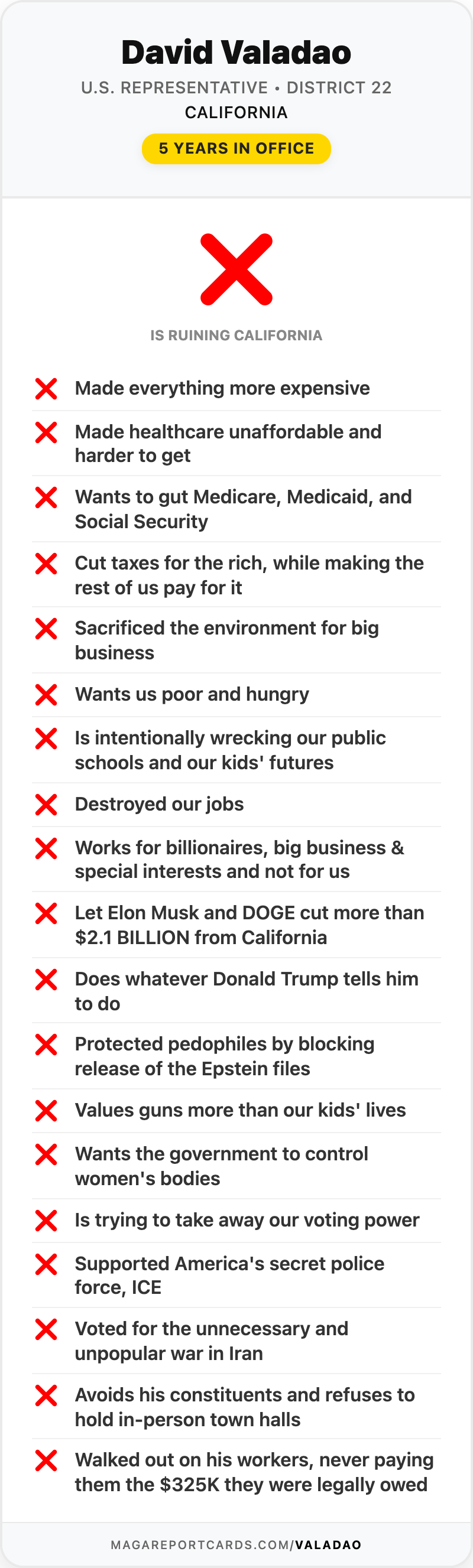
"In California, Rep. Valadao ran ads promising to lower costs and protect Medicare and Medicaid. Valadao voted for the OBBBA."
That's the whole story in two sentences, and it's worth slowing down on both of them.
David Valadao represents the Central Valley. His district has the highest Medicaid enrollment rate of any Republican-held seat in the country — about 527,000 people on Medi-Cal, roughly 64% of everyone he represents.
The "OBBBA" is the One Big Beautiful Bill Act, Trump's budget bill. Valadao voted for it.
He didn't just vote for it. He was the vote.
When the bill first cleared the House on May 22, 2025, the roll call was 215 to 214.
One vote.
There were 220 Republicans in the House that morning, and 215 of them voted yes. Any one of those 215 could have killed the bill by voting no. Valadao voted yes — and he backed it at each procedural step along the way, not just on final passage.
The law slashed an estimated $28.4 billion from California's Medi-Cal program, and stripped health insurance from an estimated 3.4 million Californians statewide. In his district alone, nearly 57,000 people could lose coverage once the new eligibility checks and work requirements take effect, according to Joint Economic Committee Democrats' analysis of Congressional Budget Office data.
He knew. He wrote it down.
This is not a case of a congressman being surprised by what was in a bill.
In April 2025, Valadao was one of a dozen Republicans who signed a letter opposing Medicaid cuts. His name is first on it. The letter said:
"Balancing the federal budget must not come at the expense of those who depend on these benefits for their health and economic security."
He put his name on that in April. He voted for the cuts in May.
When the Senate's version came back and he voted for it again on July 3, 2025, he put out a statement that opened: "It was not an easy decision for me, but I voted yes on the budget reconciliation bill."
The rest of the statement is a list of things he says he stopped and things he says he won. He says he prevented a change to California's federal match rate and per-capita caps on the expansion population. He says another $25 billion was added to the new Rural Health Transformation Program, bringing it to $50 billion, and that the administration assured him it would be structured to benefit Valley providers.
He also conceded, in the same statement, that he "still ha[s] concerns with the implementation of the provider tax and state directed payment provisions of H.R. 1."
About that $50 billion. KFF's analysis, cited by NPR, found the rural health fund does not offset the $137 billion in Medicaid cuts that would directly affect rural areas — and the money comes with the threat of clawbacks if states miss outcome targets, which is making states slow to roll it out.
So the concession he claims is worth about a third of the damage, arrives late, and may get taken back.
Why the ads work right now
Here is the part that makes the advertising a strategy rather than a coincidence.
Most of the pain hasn't arrived yet.
As NPR put it in that same story: "Key changes, like the reduction of Medicaid funding, don't occur until after this year's midterms." Frequent eligibility redeterminations and work requirements start next year. The Medicaid funding reduction lands after November.
So a congressman can run an ad in August 2026 saying he'll protect Medicaid, and most voters won't have lost their coverage yet. The bill is written. The check just hasn't cleared.
Daniel Hopkins, a political scientist at the University of Pennsylvania, told NPR why Republicans are advertising on health care so early: "[Congressional Republicans] know that that's going to be a potent line of attack from their challengers and they have to get in front of it and defend it."
The costs part of the ad
Valadao's ads also promise to lower costs. Health care costs went the other way.
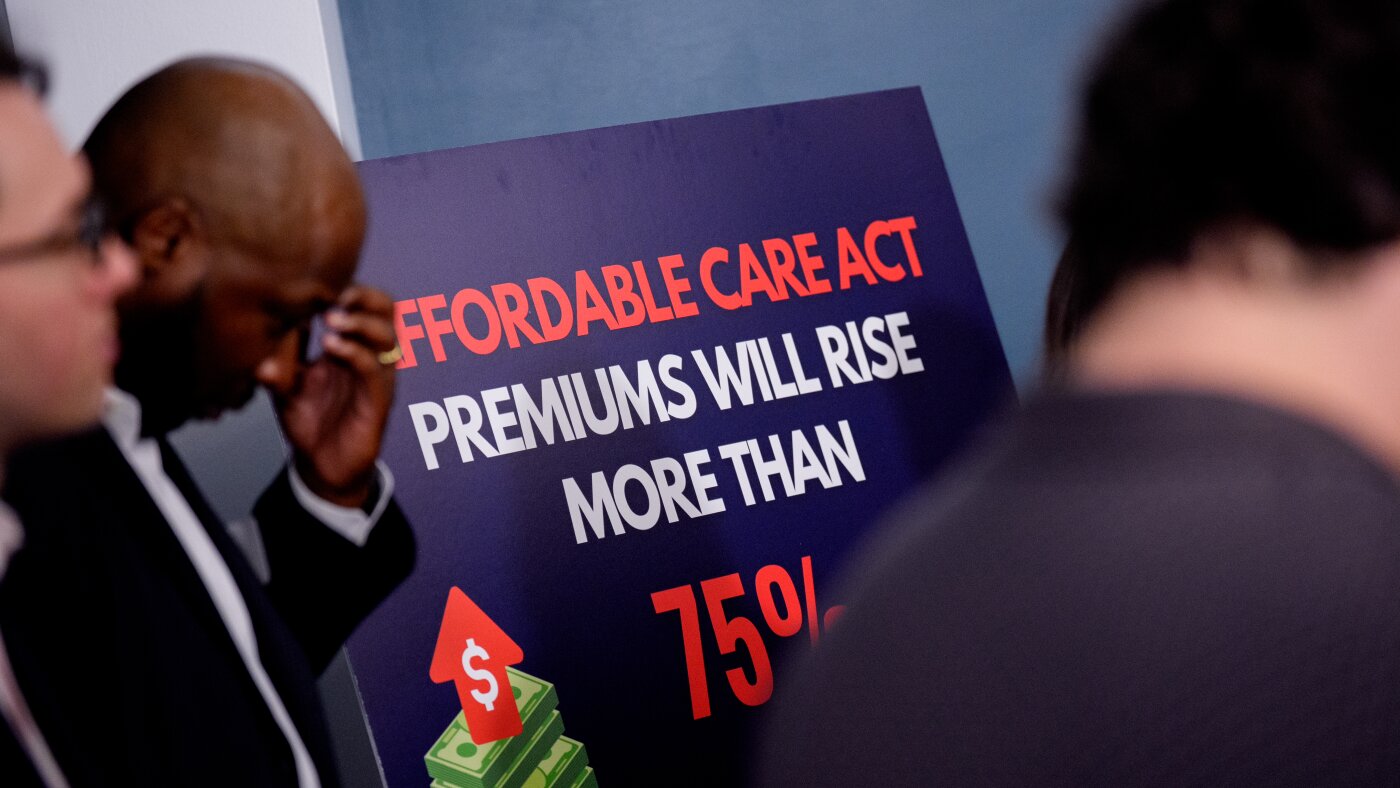
ACA premiums rose 21.7% nationwide between 2025 and 2026, according to an Urban Institute report cited in the NPR piece. About 3 million fewer people were enrolled through the health insurance exchanges in early 2026 than when the bill passed, per the Centers for Medicare & Medicaid Services. The Congressional Budget Office expects about 10 million fewer people to have insurance in 2034.
Jonathan Oberlander, a health policy expert at the University of North Carolina, connected those numbers directly to what Congress did:
"[Republican] policy, both on the One Big Beautiful Bill and not renewing the enhanced subsidies and rules and regulations, has been to make it harder for people to get health insurance coverage through the Affordable Care Act and through Medicaid. When you take Medicaid away from people, when you take those enhanced subsidies away, it really increases the costs that they face."
The premium spike wasn't only the budget bill. Congress also let the enhanced ACA tax credits expire. Senate Republicans filibustered the bill that would have extended them, and then the House passed a substitute — H.R. 6703, the "Lower Health Care Premiums for All Americans Act" — that loosens the rules on skimpier association health plans and leaves the price increase in place. We went through both votes here. On December 17, 2025, Valadao voted yes on the substitute.
The same answer he gave on food stamps
This is the second time this year Valadao has been asked about a program he cut and had an answer ready.
More than a quarter of the households in his district get food assistance. When HuffPost asked him whether the sharp drop in SNAP enrollment might be a problem for him in November, he said he wasn't worried about it — the people leaving the rolls, in his telling, were people who could work and chose not to.
Same bill. Same deciding vote. Same message: this is fine.
What he won't do
Valadao has not held an in-person town hall in years. He does telephone town halls, and told a Bakersfield station in April 2025 that constituents prefer it: "We started off a few years back doing town halls in person, but the feedback we were getting from actual constituents and people in the district, 70-80% told us we prefer the tele Town Hall."
He said that while people in his district were protesting the very cuts he would vote for weeks later.
He also isn't taking questions from reporters about it. CalMatters, working on a long profile of his race in July 2026, noted that Valadao "has consistently declined CalMatters' interview requests," and that his spokesperson said he "was not available to answer questions for this story."
So the ads are doing the talking.
An ad is a message you pay for and control. A town hall is a room full of people who have your voting record and want to know why 57,000 of their neighbors are about to lose their health insurance.
He's buying the first one.
Source
Rahul Mukherjee, "Ahead of midterms, Republicans run ads after cutting healthcare funds," NPR, July 31, 2026. Photo: Andrew Harnik / Getty Images.