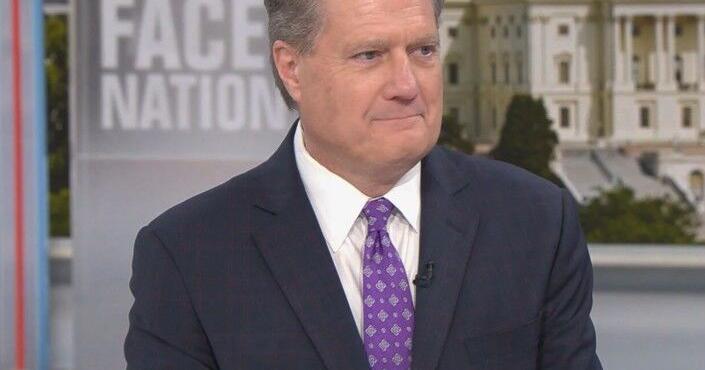
On Sunday, April 12, 2026, Margaret Brennan opened her interview with a poll.
Sixty-four percent of Americans disapproved of the war with Iran. Sixty-two percent said the president had no clear plan. And in Dayton, Ohio, she noted, gas prices were "up a buck from where they were same time last year."
Then she asked the congressman sitting across from her a simple question: how are you explaining to people in your district that this war is worth it?
Mike Turner answered:
"Well, first off, no — no conflict ever polls well."
He went on: "And no one is willing to trade lower gas prices for Iran becoming a nuclear state."
Nobody asked the people of Ohio's 10th District whether they were willing to trade. Turner answered for them, on national television, and moved on.
He is one of the war's most reliable guests
Turner is not a bystander to this war. He has become one of its most visible congressional defenders. He was on "Face the Nation" in April defending it. He was on ABC's "This Week" on July 26, in a week when four American service members were killed in action, calling the war "an inevitable conflict." He was back on "Face the Nation" on August 2, nine days ago.
He is also one of the 207 House Republicans who voted in July to keep American forces in the fighting when the House voted 214-208 to order them out.
So when he goes on television, he is not commenting on someone else's war. He is defending a war he has voted to continue, in front of an audience that includes the district paying for it at the pump.
The exchange that tells you everything
The April interview is worth reading in full, because of how it ends.
Brennan listed the president's public statements about the Strait of Hormuz over about six weeks: the Navy would escort tankers no matter what; he was thinking about taking the strait over; it was someone else's problem and allies should handle it; he'd strike Iran's power plants if it wasn't opened in 48 hours; a two-week ceasefire; ships to clear mines; and then a naval blockade.
"Can you see here why the public doesn't think the president has a clear strategy?" she asked.
Turner's answer: "conflict is going to be fluid," and "your adversary has a vote in this too."
Then Brennan asked whether the Strait of Hormuz had been mined — something the president himself had cast doubt on in a post that morning.
TURNER: No, I think you'll have to ask the president. It's his tweet.
BRENNAN: But that's the point that Congress has not been … briefed on that. As a member, Oversight and Armed Services. Do you feel like this has actually been adequately explained to you? Because the American public does not.
TURNER: The president just tweeted this this morning, so you'll have to ask the president.
He sits on the Armed Services Committee. He sits on Oversight. Asked whether Congress had been told what the Navy is doing in a war Americans are dying in, he said: it's his tweet, ask him.
Brennan closed by noting that CBS would love to ask the president, or the secretary of state, or the secretary of defense — but "members of Congress from his party are the only ones sitting here today."
Nobody in Congress is asking either
Brennan pressed on the same point: there had been no public congressional hearing on the war since it began in February, and the House had been in session for 11 days.
Turner's response was that "there have been hearings on Iran's nuclear ambitions for decades," and that Congress had received classified briefings.
Hearings held years ago about a different situation are not oversight of this war. Classified briefings are not oversight the public can see. And Turner is not alone in offering this answer — in the Senate, Foreign Relations Chairman Jim Risch declined to hold an open hearing on the war at all, and when a Democrat tried to force a war powers vote on the House floor in April, the Republican holding the gavel refused to recognize him and gaveled the session out.
By August, even Turner was conceding the point. Asked on August 2 whether he was satisfied with what the administration was telling Congress, he began with "Yes" — and then, in the same breath: "still the administration could be sharing more with congress. I don't think anybody is satisfied with the level of information we're receiving."
That is a member of the Armed Services Committee saying, five months into a war, that nobody in Congress knows enough about it — and then continuing to defend it every Sunday.
Who pays him
There is a reason his answer to "is this war worth it" comes so easily.
Turner sits on the House Armed Services Committee, which writes the annual defense authorization bill. According to the FEC-derived contribution records compiled by Who Bought My Rep, which cover 2020 to the present, the political action committees of nine major weapons contractors have given his campaigns:
- Lockheed Martin — $40,000
- L3Harris Technologies — $40,000
- General Dynamics — $35,000
- RTX (formerly Raytheon) — $34,000
- Sierra Nevada Company — $33,000
- Boeing — $33,000
- BAE Systems — $31,000
- Leidos — $30,000
- Northrop Grumman — $28,500
That's $304,500 since 2020, from companies whose programs his committee authorizes.
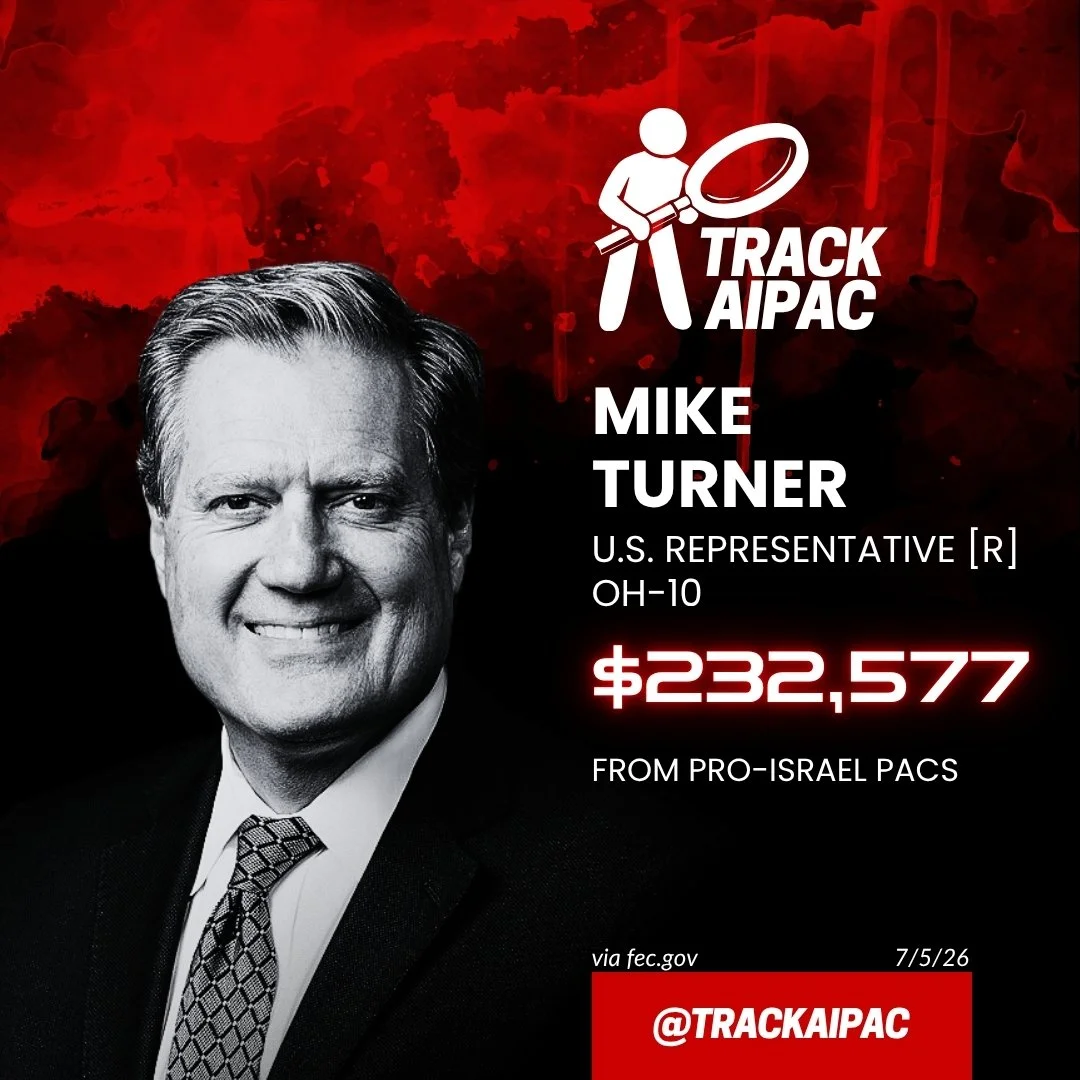
Separately, TrackAIPAC's tally of FEC filings puts Turner's career total from pro-Israel PACs at $232,577, as of July 5, 2026. AIPAC's own PAC accounts for $44,993 of the money Who Bought My Rep has logged since 2020. Over that same period, only about 4% of the $5.3 million he raised came from small grassroots donors, and Who Bought My Rep ranks him 237th out of 440 House members for grassroots funding.
None of that is illegal, and none of it proves he'd hold a different view without it. But it is the answer to a question Brennan didn't get to ask: when Turner weighs a dollar a gallon in Dayton against a war, whose interests are sitting in the room with him?
This is not unique to him. The appropriator who literally holds the pen on the Pentagon's budget, Ken Calvert, took more than $200,000 from defense contractors in the first three months of 2026, the quarter the war began. The industry funds the people who fund it.
What it costs at home
Brennan's question was about Dayton, and Turner never really answered it.
Gas up a dollar a gallon is not an abstraction in Montgomery and Greene counties. It's every commute, every delivery, every small business with a truck.
Turner has now made the same argument twice, in almost the same words. In April it was "no one is willing to trade lower gas prices for Iran becoming a nuclear state." On ABC in July, asked about a senator's argument that ending the offensive would reopen the strait, he called it "a foolish trade … to say, 'Well, we'll have the [strait] open, we'll have lower gas prices, but we'll have a nuclear Iran.'"
Both times he framed it as a trade his constituents were too shortsighted to accept. Both times he was the one who made the trade for them, and neither time did he explain how much longer they'll be paying, or what the plan is, or when Congress will vote on any of it.
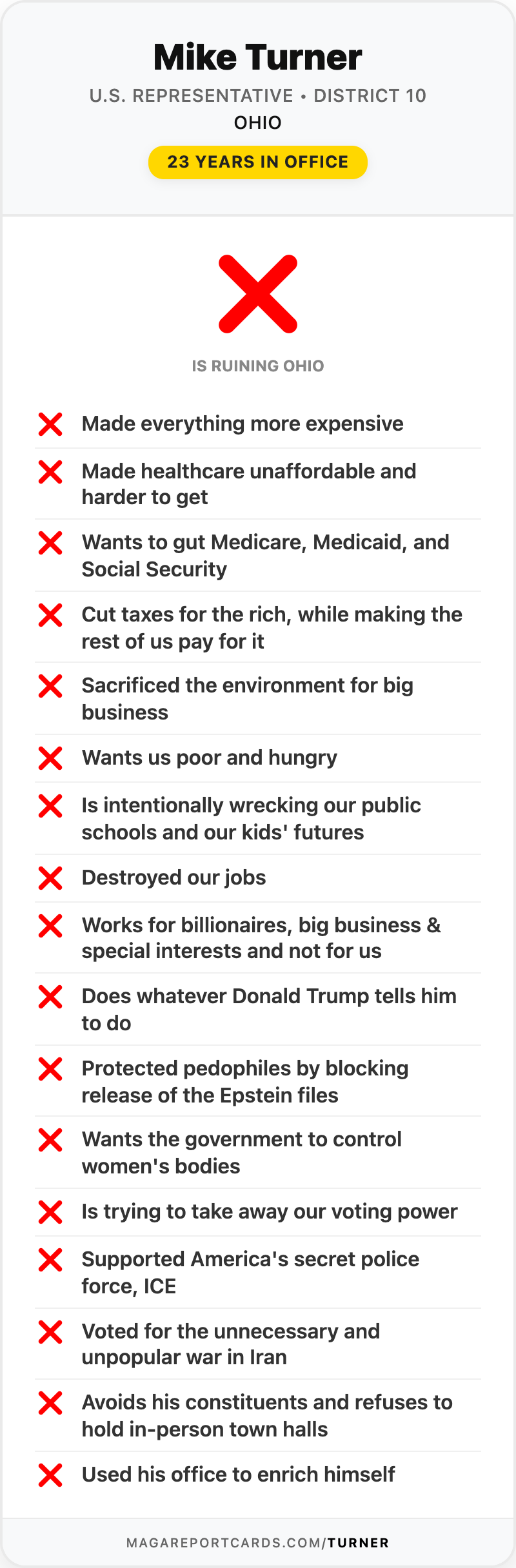
And they have no way to tell him otherwise. Turner has not held a public town hall in the nine years his constituents have been asking for one, calls the groups that ask for one "radical groups," and has not said whether he'll debate his opponent before the November 3 election.
He'll answer Margaret Brennan. He won't answer Dayton.
Source
Turner's remarks were reported by Aimee Hancock for the Dayton Daily News: Rep. Mike Turner on Iran war approval ratings: 'No conflict ever polls well' (April 12, 2026). The full interviews are on CBS News. Photo: CBS, via the Dayton Daily News.