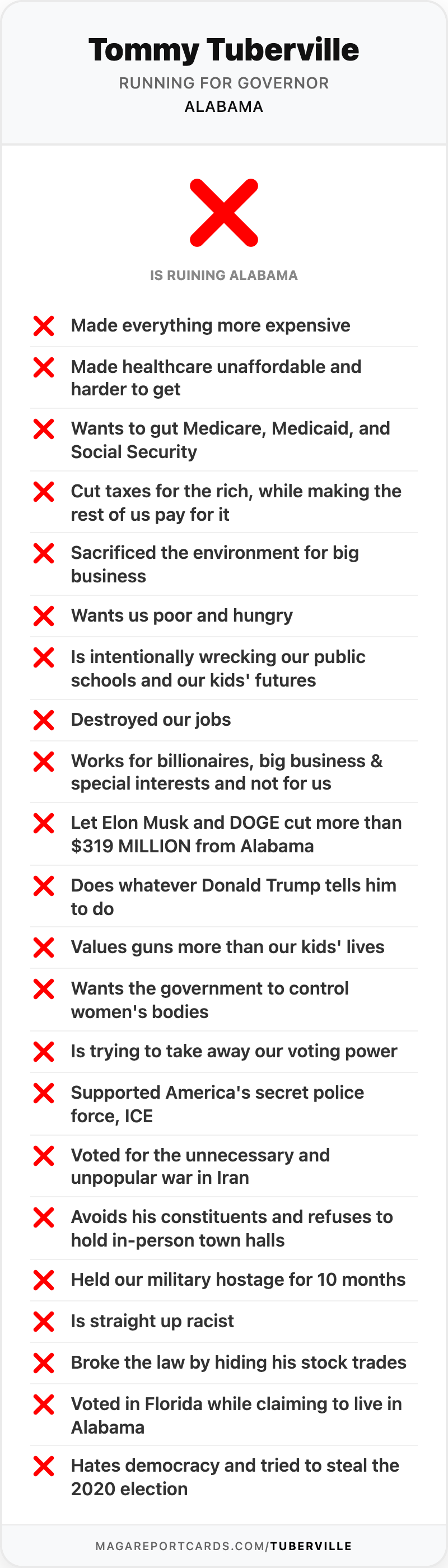
This week, Tommy Tuberville announced a team to help him "clean up the place" if Alabama elects him governor in November.
He's calling it the Golden Action Team. Its job, according to his campaign, is to find waste and duplication in state government — to identify what works, what's broken, and what Alabama taxpayers should no longer be funding.
Tuberville made a point of telling everyone what the team isn't. He noted that the people he picked are not lobbyists and not elected officials.
Take him at his word. It's also not the thing you should be checking.
What the team will be reviewing
Tuberville said the group will look at prisons, public safety, transportation, healthcare, education, energy and economic development.
Hold onto that list. Now here's who he picked.
Among the nine members are a former president of Shell Oil Company, the chairman of a trucking company, an attorney who sits on the Alabama Cannabis Commission, the president of a wood products company, and the founder and owner of a prison healthcare company.
So the panel reviewing energy includes an oil executive. The panel reviewing transportation includes a trucking chairman. And the panel reviewing prisons and healthcare includes a man who sells prison healthcare to the state of Alabama.
They don't need to be lobbyists. They're in the room.
The $500 million problem
The member worth focusing on is Jim McLane, founder and owner of NaphCare.
NaphCare is a Birmingham-based company. And it is not a bystander to Alabama state spending.
On April 29, 2026, NaphCare signed an emergency contract with the Alabama Department of Corrections to provide medical and mental health care in the state's prisons. Gov. Kay Ivey signed it. As the Alabama Reflector reported, it's a $500 million deal, paid out in stages: $98.2 million by September 2026, $246.7 million from October 2026 to September 2027, and $149.2 million from October 2027 to April 2028.
Alabama turned to NaphCare after abruptly ending a $1 billion contract with Tennessee-based YesCare, which ran into financial trouble and filed for bankruptcy — leaving Alabama prison health workers without their final paychecks.
Now do the arithmetic on the calendar. NaphCare's contract was signed in April. Its owner was named to Tuberville's government-review team in July — a team that will advise the next governor on prisons, healthcare, and what taxpayers should stop paying for.
If Tuberville wins, McLane's company will hold a nine-figure contract with an administration his own team helped shape. And most of that $500 million is scheduled to be paid out during the term Tuberville is running for.
New York banned this company
This is not a matter of a routine vendor being handed a routine seat.
In March 2026, the New York Attorney General's office fined NaphCare $875,000 and barred it from contracting with any state or local correctional facility in New York for five years.
The investigation followed three deaths in custody at the Onondaga County Justice Center. The Attorney General's office determined NaphCare had illegally practiced medicine in New York — controlling medical decisions without the required state licensure — and failed to provide adequate care.
"Every New Yorker deserves safe and competent medical care. Our investigation found that NaphCare illegally practiced medicine in New York and failed to adequately protect individuals in custody who relied on their care," Attorney General Letitia James said.
The three cases were harrowing. They included a pregnant woman who received no prenatal care and gave birth alone in her cell, whose premature infant died hours later; a person who died by suicide after inadequate mental health care; and a man in his sixties who died of cardiovascular disease after medication errors.
Arizona is worse. NaphCare is part of a federal lawsuit against that state's corrections department, and the Arizona DOC blamed the company's negligence for the conditions that led U.S. District Judge Roslyn O. Silver to place nine Arizona prisons into federal receivership.
Marc Stern, a physician who served as a monitor auditing NaphCare's work there, put it plainly: "There was an excess of preventable deaths."
Alabama Rep. Chris England, D-Tuscaloosa, a member of the committee that reviews state contracts, was blunt about the company's track record: "Across the country, they have had some issues."
Why the contract structure matters
David Fathi, director of the ACLU National Prison Project, explained to the Alabama Reflector why these deals go wrong. The contracts are lump sums:
"'We will pay you, NaphCare, $200 million to provide health care in our prisons,' and every dollar you do not spend on health care is a dollar that you get to keep as profit, so there is an almost irresistible incentive to deny, delay, care, to maximize profits."
Alabama's contract is structured the same way.
Now put that beside the mission of Tuberville's new team: find things Alabama taxpayers "should no longer be funding."
When a company profits from every dollar not spent on prisoner health care, and its owner is helping decide what the state should stop funding, those two incentives don't just overlap. They're the same incentive.
One more detail from the contract: ADOC agreed to limit what NaphCare tells the public. The agreement says NaphCare "shall not publish any findings based upon data obtained from the operation of this agreement without the prior permission of the ADOC."
"Not lobbyists" is the wrong test
Tuberville's defense — no lobbyists, no elected officials — sounds like a standard. It isn't.
A lobbyist is someone paid to ask the government for things. What Tuberville assembled is a group of people who already have what a lobbyist would ask for: state contracts, regulated industries, business before the very agencies they've been asked to review.
Skipping the middleman isn't reform.
Jon Gray, the political consultant on the team, declined to say what the group has examined so far. He did say they aren't debating whether things can be done:
"The conversations that are taking place are not about what can we do. The conversations are about how to do it."
Alabamians might reasonably want to know what "it" is — and who profits — before November.
Tuberville faces former Sen. Doug Jones in the general election.
Source
- Ruth Serven Smith, "Tommy Tuberville announces transition team to 'clean up' Alabama government", AL.com, July 25, 2026.
- Ralph Chapoco, "Controversies follow new Alabama Department of Corrections healthcare provider", Alabama Reflector, June 1, 2026.
- New York Attorney General's office, March 27, 2026.