On June 30, the U.S. Supreme Court ruled 6–3 that states may ban transgender athletes from girls' and women's sports. Note the word: may. The Court did not say states have to do anything. It left the choice to each state.
Tom Tiffany took less than a day to make his choice. The congressman — now running for governor of Wisconsin — put out a campaign statement applauding the ruling and making a promise:
"As governor, I will sign legislation ensuring that biological males cannot compete in girls' and women's sports in our state."
So there it is, in his own words. Tiffany's first promise after the ruling is a law aimed at transgender kids.
How small is the "problem" he's running on?
Here's the number that should frame this whole debate. In December 2024, the president of the NCAA — Charlie Baker, a former Republican governor — testified to the U.S. Senate that out of more than 500,000 college athletes in America, fewer than 10 were transgender.
Fewer than 10. Out of half a million.
And in Wisconsin, this fight is even emptier than the numbers suggest. The state's own high school athletic association already changed its policy in February 2025 to bar transgender girls from competing in girls' sports. Tiffany is promising a state law against something Wisconsin's school sports body already prohibits. This is not a crisis in Wisconsin schools. It's a wedge issue — one that puts a target on a very small group of kids so a candidate has something to run on.
What Wisconsin already decided — and what Tiffany wants to undo
Wisconsin's legislature passed bills like this before: AB 100 would have barred transgender girls from girls' teams in K-12 schools, and AB 102 would have done the same at UW campuses and technical colleges. Governor Tony Evers vetoed them, along with three other anti-trans bills.
Evers didn't mince words about why. His statement said this kind of legislation "stirs harmful rhetoric, negatively affects Wisconsinites' and kids' mental health, emboldens anti-LGBTQ harassment, bullying, and violence, and threatens the safety and dignity of LGBTQ Wisconsinites, especially our trans and nonbinary kids."
That's the veto Tiffany is promising to undo. His statement attacks Evers by name for it — and goes after Democratic candidates Francesca Hong, Kelda Roys, and Sara Rodriguez for voting against the bans as legislators.
This isn't new for Tiffany
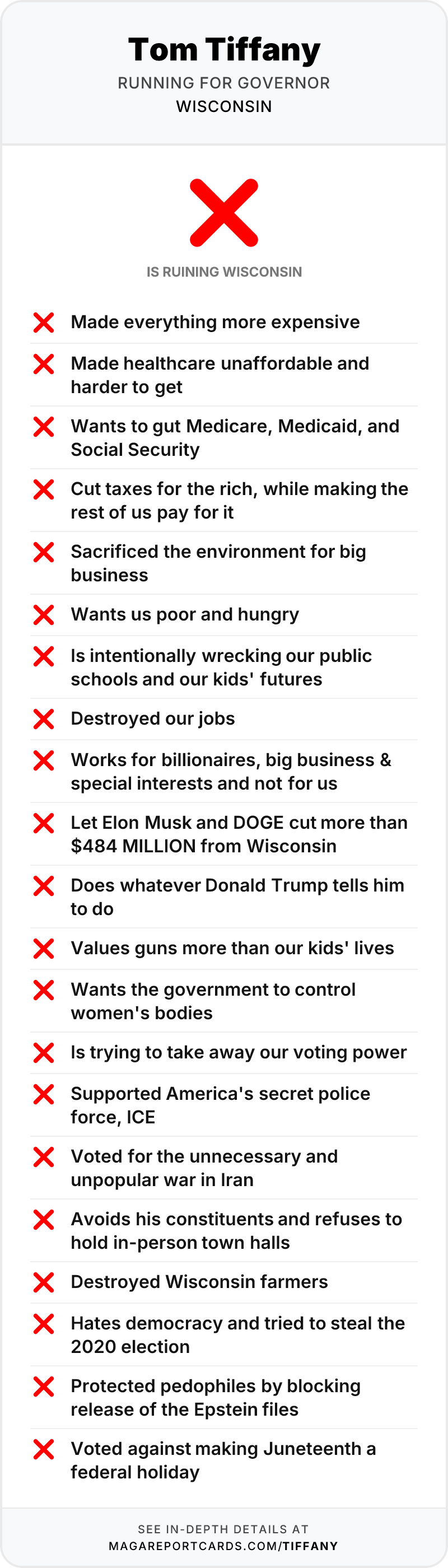
Tiffany isn't reacting to a court ruling. He's been voting for this agenda in Washington all along.
In January 2025, he voted Yea on H.R. 28, the federal bill to bar transgender girls from school sports nationwide by rewriting Title IX — a vote that split almost perfectly along party lines, 218 to 206.
And it fits a longer pattern. Tiffany voted against the Respect for Marriage Act — the bipartisan law protecting same-sex and interracial marriage, which 39 of his fellow House Republicans crossed over to support. When it comes to LGBTQ Wisconsinites, his record is consistent: fewer rights, fewer protections, more laws aimed at them.
What the ruling actually said — and what it didn't
The Supreme Court's decision in West Virginia v. B.P.J. and Little v. Hecox held that state bans don't violate the Constitution's Equal Protection Clause. The three liberal justices dissented on that point, while agreeing with the majority that the laws don't violate Title IX. The Human Rights Campaign called it a ruling that comes "at the expense of all women and girls" and warned that it leaves the future of anti-discrimination protections at risk.
But the Court left the decision to the states. Wisconsin gets to choose what kind of state it wants to be.
Tiffany has told us his choice. While Wisconsin families worry about grocery bills, health care, and their kids' schools, his day-one instinct after a Supreme Court ruling was to promise a law singling out a handful of children. Wisconsin voters should take him at his word — and remember it.
Source
Tiffany's full statement is at WisPolitics.